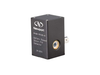
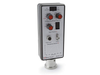
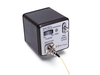
Newport MKS Balanced Optical Receiver, 900-1700 nm InGaAs Detector, 80 MHz, Free Space 1817-FS

Description
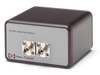
The 1817-FS InGaAs Balanced Optical Receiver is ideal for coherent heterodyne-detection applications including Doppler LIDAR, and optical coherence tomography. This free space, 900 to 1700 nm, DC to 80-MHz balanced receiver can make the difference when you need to see a small signal. Just like our Model 16x7-AC-FS 650-MHz and 800-MHz balanced receivers, the Model 1817-FS balanced receiver works by subtracting the photocurrent from two well-matched photodetectors. Common-mode noise that is present on both the reference and signal beams (such as laser-intensity noise) is cancelled out and doesn't appear as part of the signal. Any imbalance between the photocurrents generated by the reference and signal detectors, whether intentional or unintentional, is amplified and is seen as the signal. These Models 18X7 receivers contain the same detectors as those in our Model 18X1 Series receivers, and provide higher gain than their wider-bandwidth 650-MHz and 800-MHz balanced receiver counterparts. These units are sold as FC-connectorized versions only. 8-32 mounting thread. M4 metric adaptor and tool now included. To ensure safe operation, we strongly recommend our Model power supply, which must be purchased separately. Power supply cables and and connector adapter are included with each receiver.
Request a Quote
Description
The 1817-FS InGaAs Balanced Optical Receiver is ideal for coherent heterodyne-detection applications including Doppler LIDAR, and optical coherence tomography. This free space, 900 to 1700 nm, DC to 80-MHz balanced receiver can make the difference when you need to see a small signal. Just like our Model 16x7-AC-FS 650-MHz and 800-MHz balanced receivers, the Model 1817-FS balanced receiver works by subtracting the photocurrent from two well-matched photodetectors. Common-mode noise that is present on both the reference and signal beams (such as laser-intensity noise) is cancelled out and doesn't appear as part of the signal. Any imbalance between the photocurrents generated by the reference and signal detectors, whether intentional or unintentional, is amplified and is seen as the signal. These Models 18X7 receivers contain the same detectors as those in our Model 18X1 Series receivers, and provide higher gain than their wider-bandwidth 650-MHz and 800-MHz balanced receiver counterparts. These units are sold as FC-connectorized versions only. 8-32 mounting thread. M4 metric adaptor and tool now included. To ensure safe operation, we strongly recommend our Model power supply, which must be purchased separately. Power supply cables and and connector adapter are included with each receiver.
Request a Quote

Suppliers

Company
Product
Description
Supplier Links
Balanced Optical Receiver, 900-1700 nm InGaAs Detector, 80 MHz, Free Space - 1817-FS - Newport MKS
Irvine, CA, United States
Balanced Optical Receiver, 900-1700 nm InGaAs Detector, 80 MHz, Free Space
1817-FS
Balanced Optical Receiver, 900-1700 nm InGaAs Detector, 80 MHz, Free Space 1817-FS
The 1817-FS InGaAs Balanced Optical Receiver is ideal for coherent heterodyne-detection applications including Doppler LIDAR, and optical coherence tomography. This free space, 900 to 1700 nm, DC to 80-MHz balanced receiver can make the difference when you need to see a small signal. Just like our Model 16x7-AC-FS 650-MHz and 800-MHz balanced receivers, the Model 1817-FS balanced receiver works by subtracting the photocurrent from two well-matched photodetectors. Common-mode noise that is present on both the reference and signal beams (such as laser-intensity noise) is cancelled out and doesn't appear as part of the signal. Any imbalance between the photocurrents generated by the reference and signal detectors, whether intentional or unintentional, is amplified and is seen as the signal. These Models 18X7 receivers contain the same detectors as those in our Model 18X1 Series receivers, and provide higher gain than their wider-bandwidth 650-MHz and 800-MHz balanced receiver counterparts. These units are sold as FC-connectorized versions only. 8-32 mounting thread. M4 metric adaptor and tool now included. To ensure safe operation, we strongly recommend our Model power supply, which must be purchased separately. Power supply cables and and connector adapter are included with each receiver.

The 1817-FS InGaAs Balanced Optical Receiver is ideal for coherent heterodyne-detection applications including Doppler LIDAR, and optical coherence tomography. This free space, 900 to 1700 nm, DC to 80-MHz balanced receiver can make the difference when you need to see a small signal. Just like our Model 16x7-AC-FS 650-MHz and 800-MHz balanced receivers, the Model 1817-FS balanced receiver works by subtracting the photocurrent from two well-matched photodetectors. Common-mode noise that is present on both the reference and signal beams (such as laser-intensity noise) is cancelled out and doesn't appear as part of the signal. Any imbalance between the photocurrents generated by the reference and signal detectors, whether intentional or unintentional, is amplified and is seen as the signal. These Models 18X7 receivers contain the same detectors as those in our Model 18X1 Series receivers, and provide higher gain than their wider-bandwidth 650-MHz and 800-MHz balanced receiver counterparts. These units are sold as FC-connectorized versions only. 8-32 mounting thread. M4 metric adaptor and tool now included.

To ensure safe operation, we strongly recommend our Model power supply, which must be purchased separately. Power supply cables and and connector adapter are included with each receiver.

Supplier's Site

Technical Specifications

  Newport MKS
Product Category Fiber Optic Receivers
Product Number 1817-FS
Product Name Balanced Optical Receiver, 900-1700 nm InGaAs Detector, 80 MHz, Free Space
Receiver Type PIN Photodiode
Unlock Full Specs
to access all available technical data

Similar Products

Fiber-Optic Receiver, 320-1000 nm Silicon, 30 kHz to 1 GHz, FC/PC, AC-Coupled - 1601FC-AC - Newport MKS
Specs
Receiver Type PIN Photodiode
Rise Time 0.4000 ns
Bandwidth 0.0300 to 1000 MHz
View Details
Free Space Optical Receiver, 900-1700 nm InGaAs, 25 kHz - 125 MHz, AC-Coupled - 1811-FS-AC - Newport MKS
Specs
Receiver Type PIN Photodiode
Rise Time 3 ns
Bandwidth 0.0250 to 125 MHz
View Details
Fiber-Optic Receiver, DC-Coupled, 800-1650 nm, 12 GHz, FC Multimode - 1544-B-50 - Newport MKS
Specs
Receiver Type PIN Photodiode
Rise Time 0.0320 ns
Bandwidth 0.0 to 12000 MHz
View Details
Balanced Fiber-Optic Receiver, 900-1700 nm InGaAs Detector, 80 MHz - 1817-FC - Newport MKS
Specs
Receiver Type PIN Photodiode
Rise Time 3 ns
Bandwidth 0.0 to 80 MHz
View Details