Current and Voltage Input
Working Frequency up to 45 kHz
Adjustable Sensitivity, Time Constant and Phase
Local and Remote Control
Compact and EMI-Shielded Case
In modern optoelectronic systems lock-in-amplificatio
n is one of the most useful techniques to get rid of unwanted noise and to improve the measurement sensitivity. Therefore we have created a miniaturized, powerful module operating reliably even in heavy noise environments.
Two Ways of Programming
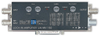
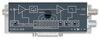
The amplifier settings - e.g. phase, gain, time constant - are controlled either by switches directly on the amplifier module or externally using a standard digital I/O computer board. The variable working frequency is determined by an external reference signal which may be e.g. the synchronization signal of a chopper wheel or the modulation signal of a laser. The current input is well suited for amplifying signals from high impedance sources like photodiodes or PMTs while the voltage input can be used to measure signals from low impedance sources like pyros or coils.
Applications
Spectroscopy
Laser Stabilization
Luminescence, Fluorescence, Phosphorescence Measurements
Light Scattering Measurements
Opto-Electronical Quality Control
Integration in Industrial and Scientific Measurement Systems
OEM Systems
- Current and Voltage Input
- Working Frequency up to 45 kHz
- Adjustable Sensitivity, Time Constant and Phase
- Local and Remote Control
- Compact and EMI-Shielded Case
In modern optoelectronic systems lock-in-amplification is one of the most useful techniques to get rid of unwanted noise and to improve the measurement sensitivity. Therefore we have created a miniaturized, powerful module operating reliably even in heavy noise environments.
Two Ways of Programming
The amplifier settings - e.g. phase, gain, time constant - are controlled either by switches directly on the amplifier module or externally using a standard digital I/O computer board. The variable working frequency is determined by an external reference signal which may be e.g. the synchronization signal of a chopper wheel or the modulation signal of a laser. The current input is well suited for amplifying signals from high impedance sources like photodiodes or PMTs while the voltage input can be used to measure signals from low impedance sources like pyros or coils.
Applications
- Spectroscopy
- Laser Stabilization
- Luminescence, Fluorescence, Phosphorescence Measurements
- Light Scattering Measurements
- Opto-Electronical Quality Control
- Integration in Industrial and Scientific Measurement Systems
- OEM Systems