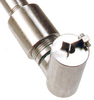
Cambridge Viscosity by PAC Process Viscometer Sensor SPC/L321

Description
Unique viscometer for in-tank blending and reaction monitoring The model SPC/L 321 is an in-line process viscometer that is installed in process fluids to provide continuous temperature and viscosity tracking. Our technology is based on a simple and reliable electromagnetic concept. Two coils move a piston back and forth magnetically at a constant force. Proprietary circuitry analyzes the piston's two-way travel time to measure absolute viscosity. Key Features: For blend tanks and vessels Accurate and reliable Customer specified stem lengths One moving part, no wear points All wetted parts 316L stainless steel
Datasheet

Suppliers

Company
Product
Description
Supplier Links
Process Viscometer Sensor - SPC/L321 - Cambridge Viscosity by PAC
Medford, MA, USA
Process Viscometer Sensor
SPC/L321
Process Viscometer Sensor SPC/L321
Unique viscometer for in-tank blending and reaction monitoring The model SPC/L 321 is an in-line process viscometer that is installed in process fluids to provide continuous temperature and viscosity tracking. Our technology is based on a simple and reliable electromagnetic concept. Two coils move a piston back and forth magnetically at a constant force. Proprietary circuitry analyzes the piston's two-way travel time to measure absolute viscosity. Key Features: For blend tanks and vessels Accurate and reliable Customer specified stem lengths One moving part, no wear points All wetted parts 316L stainless steel

Unique viscometer for in-tank blending and reaction monitoring

The model SPC/L 321 is an in-line process viscometer that is installed in process fluids to provide continuous temperature and viscosity tracking. Our technology is based on a simple and reliable electromagnetic concept. Two coils move a piston back and forth magnetically at a constant force. Proprietary circuitry analyzes the piston's two-way travel time to measure absolute viscosity.

Key Features:

  • For blend tanks and vessels
  • Accurate and reliable
  • Customer specified stem lengths
  • One moving part, no wear points
  • All wetted parts 316L stainless steel
Datasheet

Technical Specifications

  Cambridge Viscosity by PAC
Product Category Viscometers
Product Number SPC/L321
Product Name Process Viscometer Sensor
Dynamic Viscosity Range 0.2000 to 20000 cps
Unlock Full Specs
to access all available technical data

Similar Products

Particle Counter, Wear Classifier, Ferrous Monitor - LaserNet 200 Series - AMETEK Spectro Scientific
Specs
Kinematic Viscosity Range 15 to 320 cSt (1.61E-4 to 0.0034 ft²/sec)
Technology / Test Method Other; Laser & Transducers
Display & Special Features Benchtop or Laboratory; PC Interface / Networkable; SPC or Application Software; Video
View Details
Thermoelectric Sample Conditioner System - TESC-2983 - CANNON Instrument Company
Specs
Dynamic Viscosity Range 9000 to 150000 cps
Display & Special Features Benchtop or Laboratory
Industry / Application Petroleum; Gear Oils, Tractor Fluids, Lubricating Oils, Automatic Transmission Fluids
View Details
Low Cost Digital Viscometer - DV-E - AMETEK Brookfield
Specs
Dynamic Viscosity Range 1 to 1.04E8 cps
Display & Special Features Benchtop or Laboratory; Video
View Details
Process Viscometer - VISCOpro 2000 - Cambridge Viscosity by PAC
Cambridge Viscosity by PAC
Specs
Dynamic Viscosity Range 0.2000 to 20000 cps
Accuracy 1 ±% Full Scale
Technology / Test Method Electromagnetic Piston or Falling Ball; Other; Electromagnetically Driven Piston
View Details