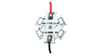
Dual Sandwich Detectors or Two Color Detectors are mostly employed for remote temperature measurements. The temperature is measured by taking the ratio of radiation intensities of two adjacent wavelengths and comparing them with the standard black body radiation curves. The advantages of optical remote measurement have definitely made these devices the perfect match for this type of measurements. They are independent of emissivity and unaffected by contaminants in the field of view or moving targets. In addition, measurements of targets out of the direct line of sights and the ability to function from outside RF / EMI interference or vacuum areas are possible. They also have the advantages of overcoming obstructed target views, blockages from sight tubes, channels or screens, atmospheric smoke, steam, or dust, dirty windows as well as targets smaller than field of view and / or moving within the field of view. These detectors can also be used inch applications where wide wavelength range of detection is needed. OSI Optoelectronics offers three types of dual sandwich detectors. The Silicon-Silicon sandwich, in which one silicon photodiode is placed on top of the other, with the photons of shorter wavelengths absorbed in the top silicon and the photons of longer wavelengths penetrating deeper, absorbed by the bottom photodiode. For applications requiring a wider range of wavelength beyond 1.1 µm, an InGaAs photodiode replaces the bottom photodiode. The silicon-InGaAs version is also available with a two stage thermo-electric cooler for more accurate measurements by stabilizing the temperature of the InGaAs detector. All devices are designed for photovoltaic operation (no bias), however, they may be biased if needed, to the maximum reverse voltage specified. They are ideal for coupling to an operational amplifier in the current mode. For further details refer to the "Photodiode Characteristics" section of this catalog.
Dual Sandwich Detectors or Two Color Detectors are mostly employed for remote temperature measurements. The temperature is measured by taking the ratio of radiation intensities of two adjacent wavelengths and comparing them with the standard black body radiation curves. The advantages of optical remote measurement have definitely made these devices the perfect match for this type of measurements. They are independent of emissivity and unaffected by contaminants in the field of view or moving targets. In addition, measurements of targets out of the direct line of sights and the ability to function from outside RF / EMI interference or vacuum areas are possible. They also have the advantages of overcoming obstructed target views, blockages from sight tubes, channels or screens, atmospheric smoke, steam, or dust, dirty windows as well as targets smaller than field of view and / or moving within the field of view. These detectors can also be used inch applications where wide wavelength range of detection is needed. OSI Optoelectronics offers three types of dual sandwich detectors. The Silicon-Silicon sandwich, in which one silicon photodiode is placed on top of the other, with the photons of shorter wavelengths absorbed in the top silicon and the photons of longer wavelengths penetrating deeper, absorbed by the bottom photodiode. For applications requiring a wider range of wavelength beyond 1.1 µm, an InGaAs photodiode replaces the bottom photodiode. The silicon-InGaAs version is also available with a two stage thermo-electric cooler for more accurate measurements by stabilizing the temperature of the InGaAs detector. All devices are designed for photovoltaic operation (no bias), however, they may be biased if needed, to the maximum reverse voltage specified. They are ideal for coupling to an operational amplifier in the current mode. For further details refer to the "Photodiode Characteristics" section of this catalog.
| OSI Optoelectronics | OSI Optoelectronics | |
|---|---|---|
| Product Category | Photodiodes | Photodiodes |
| Product Number | PIN-DSIN-TEC | PIN-DSIN-TEC |
| Product Name | Two Color Photodiode | Two Color Photodiode |
| Photodiode Type | PIN Photodiode | PIN Photodiode |
| Photodiode Spectral Response | Visible; IR | Visible; IR |
| Spectral Response Range | 400 to 1100 nm (4000 to 11000 Å) | 1000 to 1800 nm (10000 to 18000 Å) |
| Peak Sensitivity Wavelength | 950 nm (9500 Å) | 1300 nm (13000 Å) |
| Photodiode Material | Silicon | Indium Gallium Arsenide |