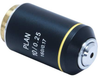
Newport MKS Reflective Microscope Objectives

Description
Designed as a reverse Casegrain, Newport Reflective Microscope Objectives focus light using reflective surfaces that are broadband coated with a usable wavelength range from 200 nm to 20 µm. Wide spectral band Long working distances High numerical apertures Zero chromatic aberration Negligible coma, spherical, and astigmatic aberrations Single material construction for minimal thermal expansion effects Features Broad Bandwidth Reflective optics do not experience chromatic effects associated with refractive optics, where refractive index varies with wavelength. Consequently reflective objectives can have excellent optical performance across an extremely broad wavelength range limited only by mirror reflectance. The reflective surfaces are broadband coated with aluminum or gold and over coated with magnesium fluoride (MgF2) are usable from 200 nm to 20 µm. Special coatings are available upon request including gold for the visible to IR region. Average reflection per surface of each mirror is 85% in the UV-VIS, and 90% in the IR (with a dip to 76% near 820nm). Typical reflectance curves of metallic reflective coatings Reflective Objective Construction Our reflective microscope objectives are fabricated from a single material providing a uniform thermal coefficient of expansion. Each objective contains two highly polished nickel spherical mirrors coated with aluminum and magnesium fluoride. The primary mirror has a spherical concave surface with a center hole. The secondary mirror is a small convex spherical mirror that is machined into the spider assembly. The objectives are hand assembled in interferometric alignment fixtures allowing each pair of mirrors to be optimized as a set to achieve maximum resolution. Spot sizes of 2 µm for the 15X objective and 1 µm for the 36X objective are typical. Reverse Cassegrain Design In a typical focusing application, collimated light passes through the aperture hole in the primary mirror to the secondary mirror. The secondary mirror reflects and diverges the beam to fill the primary mirror. The primary mirror focuses the beam to a small spot called the Object Plane or Focal Point. This dual mirror configuration is known as a reverse Cassegrain ( primary mirror collects or focuses light to or from a point, and the secondary mirror interacts with collimated light, the opposite of a traditional Cassegrain telescope). These objectives follow the Schwarzschild design. Accordingly, they have zero chromatic aberration, and negligible coma, spherical, and astigmatic aberrations. A) Diagram of a typical focusing application of a reflective microscope objective. B) Illustration of the rear focal plane of a 160 mm back focal length objective Fourier Transform IR (FTIR) Spectroscopy Applications In Fourier Transform Infrared (FTIR) spectroscopy, light from a broad spectrum point-like source is collimated and input into a split beam interferometer, such as a Michelson. Displacing one of the mirrors sinusoidally using a motorized mount creates a time dependent optical path difference (OPD) between the two interferometer arms. This OPD corresponds to a different number of wave cycles for each spectral component in the source. Wavelengths that undergo constructive interference will output the system and be focused onto a detector. Spectral composition of the source may be calculated by taking the Fourier transform of the detected light intensity vs time. In FTIR, the maximum spectral resolution depends on system étendue, which is often limited by the size and collection angle of the detector. Reflective microscope objectives allow large collection angles without chromatic aberrations, which helps FTIR systems achieve high spectral resolution over wide spectral ranges. Applications UV Metrology and Microscopy Spatial Filtering Photomicroscopy Laser Energy Delivery Systems FT-IR Spectroscopy
Request a Quote
Description
Designed as a reverse Casegrain, Newport Reflective Microscope Objectives focus light using reflective surfaces that are broadband coated with a usable wavelength range from 200 nm to 20 µm. Wide spectral band Long working distances High numerical apertures Zero chromatic aberration Negligible coma, spherical, and astigmatic aberrations Single material construction for minimal thermal expansion effects Features Broad Bandwidth Reflective optics do not experience chromatic effects associated with refractive optics, where refractive index varies with wavelength. Consequently reflective objectives can have excellent optical performance across an extremely broad wavelength range limited only by mirror reflectance. The reflective surfaces are broadband coated with aluminum or gold and over coated with magnesium fluoride (MgF2) are usable from 200 nm to 20 µm. Special coatings are available upon request including gold for the visible to IR region. Average reflection per surface of each mirror is 85% in the UV-VIS, and 90% in the IR (with a dip to 76% near 820nm). Typical reflectance curves of metallic reflective coatings Reflective Objective Construction Our reflective microscope objectives are fabricated from a single material providing a uniform thermal coefficient of expansion. Each objective contains two highly polished nickel spherical mirrors coated with aluminum and magnesium fluoride. The primary mirror has a spherical concave surface with a center hole. The secondary mirror is a small convex spherical mirror that is machined into the spider assembly. The objectives are hand assembled in interferometric alignment fixtures allowing each pair of mirrors to be optimized as a set to achieve maximum resolution. Spot sizes of 2 µm for the 15X objective and 1 µm for the 36X objective are typical. Reverse Cassegrain Design In a typical focusing application, collimated light passes through the aperture hole in the primary mirror to the secondary mirror. The secondary mirror reflects and diverges the beam to fill the primary mirror. The primary mirror focuses the beam to a small spot called the Object Plane or Focal Point. This dual mirror configuration is known as a reverse Cassegrain ( primary mirror collects or focuses light to or from a point, and the secondary mirror interacts with collimated light, the opposite of a traditional Cassegrain telescope). These objectives follow the Schwarzschild design. Accordingly, they have zero chromatic aberration, and negligible coma, spherical, and astigmatic aberrations. A) Diagram of a typical focusing application of a reflective microscope objective. B) Illustration of the rear focal plane of a 160 mm back focal length objective Fourier Transform IR (FTIR) Spectroscopy Applications In Fourier Transform Infrared (FTIR) spectroscopy, light from a broad spectrum point-like source is collimated and input into a split beam interferometer, such as a Michelson. Displacing one of the mirrors sinusoidally using a motorized mount creates a time dependent optical path difference (OPD) between the two interferometer arms. This OPD corresponds to a different number of wave cycles for each spectral component in the source. Wavelengths that undergo constructive interference will output the system and be focused onto a detector. Spectral composition of the source may be calculated by taking the Fourier transform of the detected light intensity vs time. In FTIR, the maximum spectral resolution depends on system étendue, which is often limited by the size and collection angle of the detector. Reflective microscope objectives allow large collection angles without chromatic aberrations, which helps FTIR systems achieve high spectral resolution over wide spectral ranges. Applications UV Metrology and Microscopy Spatial Filtering Photomicroscopy Laser Energy Delivery Systems FT-IR Spectroscopy
Request a Quote

Suppliers

Company
Product
Description
Supplier Links
Reflective Microscope Objectives -  - Newport MKS
Irvine, CA, United States
Reflective Microscope Objectives
Designed as a reverse Casegrain, Newport Reflective Microscope Objectives focus light using reflective surfaces that are broadband coated with a usable wavelength range from 200 nm to 20 µm. Wide spectral band Long working distances High numerical apertures Zero chromatic aberration Negligible coma, spherical, and astigmatic aberrations Single material construction for minimal thermal expansion effects Features Broad Bandwidth Reflective optics do not experience chromatic effects associated with refractive optics, where refractive index varies with wavelength. Consequently reflective objectives can have excellent optical performance across an extremely broad wavelength range limited only by mirror reflectance. The reflective surfaces are broadband coated with aluminum or gold and over coated with magnesium fluoride (MgF2) are usable from 200 nm to 20 µm. Special coatings are available upon request including gold for the visible to IR region. Average reflection per surface of each mirror is 85% in the UV-VIS, and 90% in the IR (with a dip to 76% near 820nm). Typical reflectance curves of metallic reflective coatings Reflective Objective Construction Our reflective microscope objectives are fabricated from a single material providing a uniform thermal coefficient of expansion. Each objective contains two highly polished nickel spherical mirrors coated with aluminum and magnesium fluoride. The primary mirror has a spherical concave surface with a center hole. The secondary mirror is a small convex spherical mirror that is machined into the spider assembly. The objectives are hand assembled in interferometric alignment fixtures allowing each pair of mirrors to be optimized as a set to achieve maximum resolution. Spot sizes of 2 µm for the 15X objective and 1 µm for the 36X objective are typical. Reverse Cassegrain Design In a typical focusing application, collimated light passes through the aperture hole in the primary mirror to the secondary mirror. The secondary mirror reflects and diverges the beam to fill the primary mirror. The primary mirror focuses the beam to a small spot called the Object Plane or Focal Point. This dual mirror configuration is known as a reverse Cassegrain ( primary mirror collects or focuses light to or from a point, and the secondary mirror interacts with collimated light, the opposite of a traditional Cassegrain telescope). These objectives follow the Schwarzschild design. Accordingly, they have zero chromatic aberration, and negligible coma, spherical, and astigmatic aberrations. A) Diagram of a typical focusing application of a reflective microscope objective. B) Illustration of the rear focal plane of a 160 mm back focal length objective Fourier Transform IR (FTIR) Spectroscopy Applications In Fourier Transform Infrared (FTIR) spectroscopy, light from a broad spectrum point-like source is collimated and input into a split beam interferometer, such as a Michelson. Displacing one of the mirrors sinusoidally using a motorized mount creates a time dependent optical path difference (OPD) between the two interferometer arms. This OPD corresponds to a different number of wave cycles for each spectral component in the source. Wavelengths that undergo constructive interference will output the system and be focused onto a detector. Spectral composition of the source may be calculated by taking the Fourier transform of the detected light intensity vs time. In FTIR, the maximum spectral resolution depends on system étendue, which is often limited by the size and collection angle of the detector. Reflective microscope objectives allow large collection angles without chromatic aberrations, which helps FTIR systems achieve high spectral resolution over wide spectral ranges. Applications UV Metrology and Microscopy Spatial Filtering Photomicroscopy Laser Energy Delivery Systems FT-IR Spectroscopy

Designed as a reverse Casegrain, Newport Reflective Microscope Objectives focus light using reflective surfaces that are broadband coated with a usable wavelength range from 200 nm to 20 µm.

  • Wide spectral band
  • Long working distances
  • High numerical apertures
  • Zero chromatic aberration
  • Negligible coma, spherical, and astigmatic aberrations
  • Single material construction for minimal thermal expansion effects

Features

Broad Bandwidth

Reflective optics do not experience chromatic effects associated with refractive optics, where refractive index varies with wavelength. Consequently reflective objectives can have excellent optical performance across an extremely broad wavelength range limited only by mirror reflectance. The reflective surfaces are broadband coated with aluminum or gold and over coated with magnesium fluoride (MgF2) are usable from 200 nm to 20 µm. Special coatings are available upon request including gold for the visible to IR region. Average reflection per surface of each mirror is 85% in the UV-VIS, and 90% in the IR (with a dip to 76% near 820nm).

Typical reflectance curves of metallic reflective coatings Reflective Objective Construction

Our reflective microscope objectives are fabricated from a single material providing a uniform thermal coefficient of expansion. Each objective contains two highly polished nickel spherical mirrors coated with aluminum and magnesium fluoride. The primary mirror has a spherical concave surface with a center hole. The secondary mirror is a small convex spherical mirror that is machined into the spider assembly. The objectives are hand assembled in interferometric alignment fixtures allowing each pair of mirrors to be optimized as a set to achieve maximum resolution. Spot sizes of 2 µm for the 15X objective and 1 µm for the 36X objective are typical.

Reverse Cassegrain Design

In a typical focusing application, collimated light passes through the aperture hole in the primary mirror to the secondary mirror. The secondary mirror reflects and diverges the beam to fill the primary mirror. The primary mirror focuses the beam to a small spot called the Object Plane or Focal Point. This dual mirror configuration is known as a reverse Cassegrain ( primary mirror collects or focuses light to or from a point, and the secondary mirror interacts with collimated light, the opposite of a traditional Cassegrain telescope). These objectives follow the Schwarzschild design. Accordingly, they have zero chromatic aberration, and negligible coma, spherical, and astigmatic aberrations.

A) Diagram of a typical focusing application of a reflective microscope objective. B) Illustration of the rear focal plane of a 160 mm back focal length objective Fourier Transform IR (FTIR) Spectroscopy Applications

In Fourier Transform Infrared (FTIR) spectroscopy, light from a broad spectrum point-like source is collimated and input into a split beam interferometer, such as a Michelson. Displacing one of the mirrors sinusoidally using a motorized mount creates a time dependent optical path difference (OPD) between the two interferometer arms. This OPD corresponds to a different number of wave cycles for each spectral component in the source. Wavelengths that undergo constructive interference will output the system and be focused onto a detector. Spectral composition of the source may be calculated by taking the Fourier transform of the detected light intensity vs time. In FTIR, the maximum spectral resolution depends on system étendue, which is often limited by the size and collection angle of the detector. Reflective microscope objectives allow large collection angles without chromatic aberrations, which helps FTIR systems achieve high spectral resolution over wide spectral ranges.

Applications

  • UV Metrology and Microscopy
  • Spatial Filtering
  • Photomicroscopy
  • Laser Energy Delivery Systems
  • FT-IR Spectroscopy
Supplier's Site

Technical Specifications

  Newport MKS
Product Category Microscope Lenses and Objectives
Product Name Reflective Microscope Objectives
Lens Type Objective Lens
Unlock Full Specs
to access all available technical data

Similar Products

Laser Diode Objective Lenses -  - Newport MKS
Specs
Lens Type Objective Lens
Numerical Aperture 0.2500 to 0.5000 NA
View Details
ValuMax Microscope Objective Lenses -  - Newport MKS
Specs
Lens Type Objective Lens
Magnification 4 to 60 X
Numerical Aperture 0.1000 to 0.8500 NA
View Details
Long Working Distance Microscope Objectives Lenses -  - Newport MKS
Specs
Lens Type Objective Lens
Optical Type / Correction Factor Apochromat
Magnification 2 to 50 X
View Details
UV Microscope Objective Lenses -  - Newport MKS
Specs
Lens Type Objective Lens
Magnification 13 to 37 X
Numerical Aperture 0.1100 to 0.1300 NA
View Details