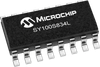
Microchip Technology, Inc. SY100S834L

Description
The SY100S834/L is low skew (÷1, ÷2, ÷4) or (÷2, ÷4, ÷8) clock generation chip designed explicitly for low skew clock generation applications. The internal dividers are synchronous to each other, therefore, the common output edges are all precisely aligned. The devices can be driven by either a differential or single-ended ECL or, if positive power supplies are used, PECL input signal. In addition, by using the VBB output, a sinusoidal source can be AC-coupled into the device. If a single-ended input is to be used, the VBB output should be connected to the CLK input and bypassed to ground via a 0.01µF capacitor. The VBB output is designed to act as the switching reference for the input of the SY100S834/L under single-ended input conditions. As a result, this pin can only source/sink up to 0.5mA of current. The Function Select (FSEL) input is used to determine what clock generation chip function is. When FSEL input is LOW, SY100S834/L functions as a divide by 2, by 4 and by 8 clock generation chip. However, if FSEL input is HIGH, it functions as a divide by 1, by 2 and by 4 clock generation chip. This latter feature will increase the clock frequency by two folds.The common enable (EN) is synchronous so that the internal dividers will only be enabled/disabled when the internal clock is already in the LOW state. This avoids any chance of generating a runt clock pulse on the internal clock when the device is enabled/disabled as can happen with an asynchronous control. An internal runt pulse could lead to losing synchronization between the internal divider stages. The internal enable flip-flop is clocked on the falling edge of the input clock, therefore, all associated specification limits are referenced to the negative edge of the clock input.Upon start-up, the internal flip-flops will attain a random state; the master reset (MR) input allows for the synchronization of the internal dividers, as well as for multiple SY100S834/Ls in a system. Additional Features 3.3V and 5V power supply options 50ps output-to-output skew Synchronous enable/disable Master Reset for synchronization Internal 75K input pull-down resistors Available in 16-pin SOIC package
Datasheet
Description
The SY100S834/L is low skew (÷1, ÷2, ÷4) or (÷2, ÷4, ÷8) clock generation chip designed explicitly for low skew clock generation applications. The internal dividers are synchronous to each other, therefore, the common output edges are all precisely aligned. The devices can be driven by either a differential or single-ended ECL or, if positive power supplies are used, PECL input signal. In addition, by using the VBB output, a sinusoidal source can be AC-coupled into the device. If a single-ended input is to be used, the VBB output should be connected to the CLK input and bypassed to ground via a 0.01µF capacitor. The VBB output is designed to act as the switching reference for the input of the SY100S834/L under single-ended input conditions. As a result, this pin can only source/sink up to 0.5mA of current. The Function Select (FSEL) input is used to determine what clock generation chip function is. When FSEL input is LOW, SY100S834/L functions as a divide by 2, by 4 and by 8 clock generation chip. However, if FSEL input is HIGH, it functions as a divide by 1, by 2 and by 4 clock generation chip. This latter feature will increase the clock frequency by two folds.The common enable (EN) is synchronous so that the internal dividers will only be enabled/disabled when the internal clock is already in the LOW state. This avoids any chance of generating a runt clock pulse on the internal clock when the device is enabled/disabled as can happen with an asynchronous control. An internal runt pulse could lead to losing synchronization between the internal divider stages. The internal enable flip-flop is clocked on the falling edge of the input clock, therefore, all associated specification limits are referenced to the negative edge of the clock input.Upon start-up, the internal flip-flops will attain a random state; the master reset (MR) input allows for the synchronization of the internal dividers, as well as for multiple SY100S834/Ls in a system. Additional Features 3.3V and 5V power supply options 50ps output-to-output skew Synchronous enable/disable Master Reset for synchronization Internal 75K input pull-down resistors Available in 16-pin SOIC package
Datasheet

Suppliers

Company
Product
Description
Supplier Links
 - SY100S834L - Microchip Technology, Inc.
Chandler, AZ, United States
The SY100S834/L is low skew (÷1, ÷2, ÷4) or (÷2, ÷4, ÷8) clock generation chip designed explicitly for low skew clock generation applications. The internal dividers are synchronous to each other, therefore, the common output edges are all precisely aligned. The devices can be driven by either a differential or single-ended ECL or, if positive power supplies are used, PECL input signal. In addition, by using the VBB output, a sinusoidal source can be AC-coupled into the device. If a single-ended input is to be used, the VBB output should be connected to the CLK input and bypassed to ground via a 0.01µF capacitor. The VBB output is designed to act as the switching reference for the input of the SY100S834/L under single-ended input conditions. As a result, this pin can only source/sink up to 0.5mA of current. The Function Select (FSEL) input is used to determine what clock generation chip function is. When FSEL input is LOW, SY100S834/L functions as a divide by 2, by 4 and by 8 clock generation chip. However, if FSEL input is HIGH, it functions as a divide by 1, by 2 and by 4 clock generation chip. This latter feature will increase the clock frequency by two folds.The common enable (EN) is synchronous so that the internal dividers will only be enabled/disabled when the internal clock is already in the LOW state. This avoids any chance of generating a runt clock pulse on the internal clock when the device is enabled/disabled as can happen with an asynchronous control. An internal runt pulse could lead to losing synchronization between the internal divider stages. The internal enable flip-flop is clocked on the falling edge of the input clock, therefore, all associated specification limits are referenced to the negative edge of the clock input.Upon start-up, the internal flip-flops will attain a random state; the master reset (MR) input allows for the synchronization of the internal dividers, as well as for multiple SY100S834/Ls in a system. Additional Features 3.3V and 5V power supply options 50ps output-to-output skew Synchronous enable/disable Master Reset for synchronization Internal 75K input pull-down resistors Available in 16-pin SOIC package

The SY100S834/L is low skew (÷1, ÷2, ÷4) or (÷2, ÷4, ÷8) clock generation chip designed explicitly for low skew clock generation applications. The internal dividers are synchronous to each other, therefore, the common output edges are all precisely aligned. The devices can be driven by either a differential or single-ended ECL or, if positive power supplies are used, PECL input signal. In addition, by using the VBB output, a sinusoidal source can be AC-coupled into the device. If a single-ended input is to be used, the VBB output should be connected to the CLK input and bypassed to ground via a 0.01µF capacitor. The VBB output is designed to act as the switching reference for the input of the SY100S834/L under single-ended input conditions. As a result, this pin can only source/sink up to 0.5mA of current.
The Function Select (FSEL) input is used to determine what clock generation chip function is. When FSEL input is LOW, SY100S834/L functions as a divide by 2, by 4 and by 8 clock generation chip. However, if FSEL input is HIGH, it functions as a divide by 1, by 2 and by 4 clock generation chip. This latter feature will increase the clock frequency by two folds.The common enable (EN) is synchronous so that the internal dividers will only be enabled/disabled when the internal clock is already in the LOW state. This avoids any chance of generating a runt clock pulse on the internal clock when the device is enabled/disabled as can happen with an asynchronous control. An internal runt pulse could lead to losing synchronization between the internal divider stages.
The internal enable flip-flop is clocked on the falling edge of the input clock, therefore, all associated specification limits are referenced to the negative edge of the clock input.Upon start-up, the internal flip-flops will attain a random state; the master reset (MR) input allows for the synchronization of the internal dividers, as well as for multiple SY100S834/Ls in a system.

Additional Features

    • 3.3V and 5V power supply options
    • 50ps output-to-output skew
    • Synchronous enable/disable
    • Master Reset for synchronization
    • Internal 75K input pull-down resistors
    • Available in 16-pin SOIC package
Supplier's Site Datasheet

Technical Specifications

  Microchip Technology, Inc.
Product Category Logic Dividers
Product Number SY100S834L
Package Type SOIC; ['SOIC']
Unlock Full Specs
to access all available technical data

Similar Products

Logic - Counters, Dividers - MC10EL32DT - Lingto Electronic Limited
Specs
Clock Frequency 3000 MHz
View Details
12-stage binary ripple counter - 74HC4040D,653 - Nexperia B.V.
Specs
Features ESD Protection
Counter Category Asynchronous
Supply Voltage 2.5V; 3V; 3.3V; 3.6V; 5V; 2.0 - 6.0
View Details
9 suppliers
CD74HC4520 High Speed CMOS Logic Dual Binary Up-Counters - CD74HC4520E - Texas Instruments
Specs
Supply Voltage 6
Package Type PDIP,SOIC
Logic Family HC
View Details
7 suppliers