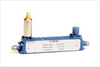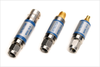
KRYTAR, Inc. Planar Doped Barrier Detectors 703AK 703AK

Description
KRYTAR Planar Doped Barrier Detectors are specifically designed for use in today’s high-performance microwave instrumentation and systems. KRYTAR detectors are designed for such applications as power measurements, analyzing radar performance, leveling pulsed signal sources, AM noise measurements, system monitoring and pulsed RF measurements in ultra-broadband and mm-Wave applications.
Request a Quote
Datasheet
Datasheet Summary
Powered by GS/AI

The KRYTAR 703AK is a planar doped barrier detector for microwave applications, operating from 100 MHz to 40 GHz with a frequency response of ±0.3 dB up to 20 GHz, ±0.6 dB up to 26.5 GHz, and ±1.0 dB up to 40 GHz. It has a maximum VSWR of 1.3 up to 20 GHz, 1.4 up to 26.5 GHz, and 1.7 up to 40 GHz, and uses a 2.92 mm male input connector. The detector has a negative output polarity, 3.0 pF output capacitance, and a video impedance range of 0.8 to 7.5 kΩ. It operates from -54°C to +100°C, supports a maximum input power of 200 mW, and measures 1.57 inches in length by 0.4 inches in diameter.

Suppliers

Company
Product
Description
Supplier Links
Planar Doped Barrier Detectors 703AK - 703AK - KRYTAR, Inc.
Sunnyvale, CA, United States
Planar Doped Barrier Detectors 703AK
703AK
Planar Doped Barrier Detectors 703AK 703AK
KRYTAR Planar Doped Barrier Detectors are specifically designed for use in today’s high-performance microwave instrumentation and systems. KRYTAR detectors are designed for such applications as power measurements, analyzing radar performance, leveling pulsed signal sources, AM noise measurements, system monitoring and pulsed RF measurements in ultra-broadband and mm-Wave applications.

KRYTAR Planar Doped Barrier Detectors are specifically designed for use in today’s high-performance microwave instrumentation and systems. KRYTAR detectors are designed for such applications as power measurements, analyzing radar performance, leveling pulsed signal sources, AM noise measurements, system monitoring and pulsed RF measurements in ultra-broadband and mm-Wave applications.

Supplier's Site Datasheet

Technical Specifications

  KRYTAR, Inc.
Product Category RF Power Detectors
Product Number 703AK
Product Name Planar Doped Barrier Detectors 703AK
Frequency Range 100000 to 40000 MHz
Unlock Full Specs
to access all available technical data

Similar Products

Broadband Planar Tunnel Diode Detectors KDT1018 - KDT1018 - KRYTAR, Inc.
Specs
Frequency Range 1000 to 18000 MHz
View Details
Power Sensors 9517A - 9517A - KRYTAR, Inc.
Specs
Frequency Range 0.1000 to 18000 MHz
Connector Type Type N
View Details
Directional Detectors 264010KS - 264010KS - KRYTAR, Inc.
Specs
Frequency Range 26500 to 40000 MHz
dBm Measurement Range 30 dBm
Connector Type BNC (optional feature); SMA (optional feature); SMC (optional feature); 2.92 mm
View Details
Directional Detectors 120410S - 120410S - KRYTAR, Inc.
Specs
Frequency Range 4000 to 12400 MHz
dBm Measurement Range 30 dBm
Connector Type BNC (optional feature); SMA (optional feature); SMC (optional feature)
View Details