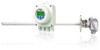
HORIBA Instruments, Inc. Vapor Concentration Monitor IR-300

Description
The Metal-Organic Chemical Vapor Deposition (MOCVD) process is widely used in the manufacture of LEDs, optical devices and other components. Liquid and solid precursors are delivered to the reaction chamber by controlling the temperature, pressure and the carrier gas flow rate (bubbling method). The in-line IR-300 Series measures and reports the precursor concentration in real time giving the user the following benefits: Optimize process control to produce more high-grade devices Improve device yield and reduce scrap Improve reproducibility Know when a bubbler will require exchanging Extend MTTA Reduce unplanned interventions Reduce valuable precursor waste Real-time monitoring Fast response and excellent repeatability allow real time tracking of changes in vapor concentration Multi-calibration Curve Function (Optional) Allows for concentration measurement of up to 3 chemicals or ranges Multi-display Function The multi-display function on the top of the IR-300 unit gives the user onsite checking capability of concentration monitoring and precursor supply line status Communications Function Connectivity through DeviceNet™, RS485 and analog communications Simple, Compact Design With a face-to-face size of 124 mm, the unit’s compact and mount-orientation-fr ee design allows for easy integration A high optical intensity and long-life light source combined with high-speed signal processing enables the IR-300 Series to achieve faster, more repeatable responses to changes in precursor concentration. These features give the user a true understanding of the actual process though real-time inline concentration measurement. Measurement Example of MOCVD Precursor ■Experiment flow sheet ■Monitoring of precursor concentration change Here is an example in which the concentration of the supplied precursor—which changes due to adjustment of the pressure in the bubbler by the back pressure regulator—was monitored in real time. Measurement Techniques Reliable, High-performance Non-dispersive Infrared Absorptiometry (NDIR) The infrared absorptiometry method employed by the IR-300 Series uses the principle of measuring the absorption of gas molecules in infrared light emitted from an infrared light source. A sample output from a sample that has absorbed the gas being measured is compared to a reference output with no absorbance, and the result is converted into a gas concentration. The use of this double beam method enables long-term, stable measurement results to be obtained. The optical system is made up of a light source, gas cell and double beam detectors. The stability of the double beam detector has been proven over a period of more than 40 years.

Suppliers

Company
Product
Description
Supplier Links
Vapor Concentration Monitor - IR-300 - HORIBA Instruments, Inc.
Irvine, CA, United States
Vapor Concentration Monitor
IR-300
Vapor Concentration Monitor IR-300
The Metal-Organic Chemical Vapor Deposition (MOCVD) process is widely used in the manufacture of LEDs, optical devices and other components. Liquid and solid precursors are delivered to the reaction chamber by controlling the temperature, pressure and the carrier gas flow rate (bubbling method). The in-line IR-300 Series measures and reports the precursor concentration in real time giving the user the following benefits: Optimize process control to produce more high-grade devices Improve device yield and reduce scrap Improve reproducibility Know when a bubbler will require exchanging Extend MTTA Reduce unplanned interventions Reduce valuable precursor waste Real-time monitoring Fast response and excellent repeatability allow real time tracking of changes in vapor concentration Multi-calibration Curve Function (Optional) Allows for concentration measurement of up to 3 chemicals or ranges Multi-display Function The multi-display function on the top of the IR-300 unit gives the user onsite checking capability of concentration monitoring and precursor supply line status Communications Function Connectivity through DeviceNet™, RS485 and analog communications Simple, Compact Design With a face-to-face size of 124 mm, the unit’s compact and mount-orientation-fr ee design allows for easy integration A high optical intensity and long-life light source combined with high-speed signal processing enables the IR-300 Series to achieve faster, more repeatable responses to changes in precursor concentration. These features give the user a true understanding of the actual process though real-time inline concentration measurement. Measurement Example of MOCVD Precursor ■Experiment flow sheet ■Monitoring of precursor concentration change Here is an example in which the concentration of the supplied precursor—which changes due to adjustment of the pressure in the bubbler by the back pressure regulator—was monitored in real time. Measurement Techniques Reliable, High-performance Non-dispersive Infrared Absorptiometry (NDIR) The infrared absorptiometry method employed by the IR-300 Series uses the principle of measuring the absorption of gas molecules in infrared light emitted from an infrared light source. A sample output from a sample that has absorbed the gas being measured is compared to a reference output with no absorbance, and the result is converted into a gas concentration. The use of this double beam method enables long-term, stable measurement results to be obtained. The optical system is made up of a light source, gas cell and double beam detectors. The stability of the double beam detector has been proven over a period of more than 40 years.

The Metal-Organic Chemical Vapor Deposition (MOCVD) process is widely used in the manufacture of LEDs, optical devices and other components. Liquid and solid precursors are delivered to the reaction chamber by controlling the temperature, pressure and the carrier gas flow rate (bubbling method). The in-line IR-300 Series measures and reports the precursor concentration in real time giving the user the following benefits:

  • Optimize process control to produce more high-grade devices
  • Improve device yield and reduce scrap
  • Improve reproducibility
  • Know when a bubbler will require exchanging
  • Extend MTTA
  • Reduce unplanned interventions
  • Reduce valuable precursor waste
  • Real-time monitoring
    Fast response and excellent repeatability allow real time tracking of changes in vapor concentration
  • Multi-calibration Curve Function (Optional)
    Allows for concentration measurement of up to 3 chemicals or ranges
  • Multi-display Function
    The multi-display function on the top of the IR-300 unit gives the user onsite checking capability of concentration monitoring and precursor supply line status
  • Communications Function
    Connectivity through DeviceNet™, RS485 and analog communications
  • Simple, Compact Design
    With a face-to-face size of 124 mm, the unit’s compact and mount-orientation-free design allows for easy integration

A high optical intensity and long-life light source combined with high-speed signal processing enables the IR-300 Series to achieve faster, more repeatable responses to changes in precursor concentration. These features give the user a true understanding of the actual process though real-time inline concentration measurement.

Measurement Example of MOCVD Precursor

■Experiment flow sheet

■Monitoring of precursor concentration change

Here is an example in which the concentration of the supplied precursor—which changes due to adjustment of the pressure in the bubbler by the back pressure regulator—was monitored in real time.

Measurement Techniques

Reliable, High-performance
Non-dispersive Infrared Absorptiometry (NDIR)

The infrared absorptiometry method employed by the IR-300 Series uses the principle of measuring the absorption of gas molecules in infrared light emitted from an infrared light source. A sample output from a sample that has absorbed the gas being measured is compared to a reference output with no absorbance, and the result is converted into a gas concentration. The use of this double beam method enables long-term, stable measurement results to be obtained.

The optical system is made up of a light source, gas cell and double beam detectors. The stability of the double beam detector has been proven over a period of more than 40 years.
Supplier's Site

Technical Specifications

  HORIBA Instruments, Inc.
Product Category Gas Instruments
Product Number IR-300
Product Name Vapor Concentration Monitor
Measurement Type %Volume
Application Process Gas
Gas Types Toxic; Combustible; B2H6; (B2H6 10 Vol% / H2 or He); GeH4; (1 Vol% / H2); (TMGa, DEZn, IPA, TMn, TEGa, TMAI)
Display Digital
Instrument Type Monitor
Unlock Full Specs
to access all available technical data

Similar Products

CFC / HFC Refrigerant Gas Detector - PCE-LD 1 - PCE Instruments / PCE Americas Inc.
PCE Instruments / PCE Americas Inc.
Specs
Measurement Type Leakage
Gas Types (CFC / HFC Refrigerant Gas)
Features Audible or Visual Alarms
View Details
Fire and Gas System - HazardWatch - MSA Safety
Specs
Application Process Gas
Instrument Type Monitor
Mounting Type Fixed
View Details
GPR-7100 Hydrogen Sulfide (H2S) Portable -  - Analytical Industries Inc.
Specs
Gas Types H2S
Features Data Logger; Hazardous Environment
Sensor Technology Electrochemical
View Details
High temperature combustion gas oxygen analyzer - Endura AZ25 - ABB Measurement & Analytics
Specs
Measurement Type %Volume
Application Continuous Emissions Monitoring
Gas Types Combustible; O2
View Details