ContiTech AG High-Speed Pipe Conveyor Belts CONTI® PIPE

Description
A pipe conveyor belt differs from a conventional, troughed belt in its design and splicing technology and performs special conveying tasks. Mining and industrial applications often require relatively large inclines and tight curves to be overcome in tight spaces and at high mass flow rates. The particular features of modern pipe belt con - veyors include: no transfer points, no material spillage along the conveyor route, and tight 3D curves. Pipe belt conveyors save space thanks to their compact design, navigate natural terrain, including steep conveyor angles up to 30°. Design and properties of the pipe conveyor system The pipe belt works in accordance with a specific operating principle: at the material feed point the conveyor belt is troughed and is fed at this point like a conventional conveyor belt. After the material feed point the conveyor belt is formed into a closed belt pipe by specially configured finger rollers. Further idlers set along the conveyor route guarantee that the belt is kept closed. As a result, the material conveyed remains protected by the closed belt system. At the end of the belt run the closed belt is opened as a result of the configuration of the finger rollers and adopts a flat shape at the pulley. The material conveyed can then be discharged in the same way as with conventional belt systems. Pipe Conveyor Belt – product range Depending on requirements, the pipe belt is equipped with high-quality fabric or steel-cord strength members and a system of transverse reinforcement. This ensures a stable, durable tubular form. The high-tensile steel-cord pipe belts (kN > 5400 N/mm) offer new prospects, for example in surface and underground mining operations. Pipe Conveyor Belt – Guide dimensions for design Belt width B = 600 to 3200* mm Outer diameter DA = 150 mm to 900* mm Recommended max. fill level φF = 75% Max. volumetric flow rate IV at conveyor speed vF = 1 m/s, max. outer diameter DA = 900* mm and fill level φF = 75% IVmax ≈ 1500* m3/h Recommended max. conveyor speeds (depending on idler diameter) vF = 2,3 to 6,5* m/s Max. lump size (depending on pipe inner diameter and operating data) 50 to 350* mm Minimum radius of curve for horizontal and vertical curves R = Outer ø x 300 for fabric belts R = Outer ø x 600 for steel-cord belts Minimum transition length x = Outer ø x 30 for fabric belts x = Outer ø x 60 for steel-cord belts
Description
A pipe conveyor belt differs from a conventional, troughed belt in its design and splicing technology and performs special conveying tasks. Mining and industrial applications often require relatively large inclines and tight curves to be overcome in tight spaces and at high mass flow rates. The particular features of modern pipe belt con - veyors include: no transfer points, no material spillage along the conveyor route, and tight 3D curves. Pipe belt conveyors save space thanks to their compact design, navigate natural terrain, including steep conveyor angles up to 30°. Design and properties of the pipe conveyor system The pipe belt works in accordance with a specific operating principle: at the material feed point the conveyor belt is troughed and is fed at this point like a conventional conveyor belt. After the material feed point the conveyor belt is formed into a closed belt pipe by specially configured finger rollers. Further idlers set along the conveyor route guarantee that the belt is kept closed. As a result, the material conveyed remains protected by the closed belt system. At the end of the belt run the closed belt is opened as a result of the configuration of the finger rollers and adopts a flat shape at the pulley. The material conveyed can then be discharged in the same way as with conventional belt systems. Pipe Conveyor Belt – product range Depending on requirements, the pipe belt is equipped with high-quality fabric or steel-cord strength members and a system of transverse reinforcement. This ensures a stable, durable tubular form. The high-tensile steel-cord pipe belts (kN > 5400 N/mm) offer new prospects, for example in surface and underground mining operations. Pipe Conveyor Belt – Guide dimensions for design Belt width B = 600 to 3200* mm Outer diameter DA = 150 mm to 900* mm Recommended max. fill level φF = 75% Max. volumetric flow rate IV at conveyor speed vF = 1 m/s, max. outer diameter DA = 900* mm and fill level φF = 75% IVmax ≈ 1500* m3/h Recommended max. conveyor speeds (depending on idler diameter) vF = 2,3 to 6,5* m/s Max. lump size (depending on pipe inner diameter and operating data) 50 to 350* mm Minimum radius of curve for horizontal and vertical curves R = Outer ø x 300 for fabric belts R = Outer ø x 600 for steel-cord belts Minimum transition length x = Outer ø x 30 for fabric belts x = Outer ø x 60 for steel-cord belts

Suppliers

Company
Product
Description
Supplier Links
High-Speed Pipe Conveyor Belts - CONTI® PIPE - ContiTech AG
Hanover, Germany
High-Speed Pipe Conveyor Belts
CONTI® PIPE
High-Speed Pipe Conveyor Belts CONTI® PIPE
A pipe conveyor belt differs from a conventional, troughed belt in its design and splicing technology and performs special conveying tasks. Mining and industrial applications often require relatively large inclines and tight curves to be overcome in tight spaces and at high mass flow rates. The particular features of modern pipe belt con - veyors include: no transfer points, no material spillage along the conveyor route, and tight 3D curves. Pipe belt conveyors save space thanks to their compact design, navigate natural terrain, including steep conveyor angles up to 30°. Design and properties of the pipe conveyor system The pipe belt works in accordance with a specific operating principle: at the material feed point the conveyor belt is troughed and is fed at this point like a conventional conveyor belt. After the material feed point the conveyor belt is formed into a closed belt pipe by specially configured finger rollers. Further idlers set along the conveyor route guarantee that the belt is kept closed. As a result, the material conveyed remains protected by the closed belt system. At the end of the belt run the closed belt is opened as a result of the configuration of the finger rollers and adopts a flat shape at the pulley. The material conveyed can then be discharged in the same way as with conventional belt systems. Pipe Conveyor Belt – product range Depending on requirements, the pipe belt is equipped with high-quality fabric or steel-cord strength members and a system of transverse reinforcement. This ensures a stable, durable tubular form. The high-tensile steel-cord pipe belts (kN > 5400 N/mm) offer new prospects, for example in surface and underground mining operations. Pipe Conveyor Belt – Guide dimensions for design Belt width B = 600 to 3200* mm Outer diameter DA = 150 mm to 900* mm Recommended max. fill level φF = 75% Max. volumetric flow rate IV at conveyor speed vF = 1 m/s, max. outer diameter DA = 900* mm and fill level φF = 75% IVmax ≈ 1500* m3/h Recommended max. conveyor speeds (depending on idler diameter) vF = 2,3 to 6,5* m/s Max. lump size (depending on pipe inner diameter and operating data) 50 to 350* mm Minimum radius of curve for horizontal and vertical curves R = Outer ø x 300 for fabric belts R = Outer ø x 600 for steel-cord belts Minimum transition length x = Outer ø x 30 for fabric belts x = Outer ø x 60 for steel-cord belts

A pipe conveyor belt differs from a conventional, troughed belt in its design and splicing technology and performs special conveying tasks.

Mining and industrial applications often require relatively large inclines and tight curves to be overcome in tight spaces and at high mass flow rates. The particular features of modern pipe belt con - veyors include: no transfer points, no material spillage along the conveyor route, and tight 3D curves. Pipe belt conveyors save space thanks to their compact design, navigate natural terrain, including steep conveyor angles up to 30°.

Design and properties of the pipe conveyor system

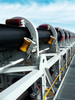
The pipe belt works in accordance with a specific operating principle: at the material feed point the conveyor belt is troughed and is fed at this point like a conventional conveyor belt. After the material feed point the conveyor belt is formed into a closed belt pipe by specially configured finger rollers. Further idlers set along the conveyor route guarantee that the belt is kept closed. As a result, the material conveyed remains protected by the closed belt system.

At the end of the belt run the closed belt is opened as a result of the configuration of the finger rollers and adopts a flat shape at the pulley. The material conveyed can then be discharged in the same way as with conventional belt systems.

Pipe Conveyor Belt – product range

Depending on requirements, the pipe belt is equipped with high-quality fabric or steel-cord strength members and a system of transverse reinforcement. This ensures a stable, durable tubular form. The high-tensile steel-cord pipe belts (kN > 5400 N/mm) offer new prospects, for example in surface and underground mining operations.

Pipe Conveyor Belt – Guide dimensions for design

  • Belt width B = 600 to 3200* mm
  • Outer diameter DA = 150 mm to 900* mm
  • Recommended max. fill level φF = 75%
  • Max. volumetric flow rate IV at conveyor speed vF = 1 m/s, max. outer diameter DA = 900* mm and fill level φF = 75% IVmax ≈ 1500* m3/h
  • Recommended max. conveyor speeds (depending on idler diameter) vF = 2,3 to 6,5* m/s
  • Max. lump size (depending on pipe inner diameter and operating data) 50 to 350* mm
  • Minimum radius of curve for horizontal and vertical curves
    R = Outer Ø x 300 for fabric belts
    R = Outer Ø x 600 for steel-cord belts
  • Minimum transition length
    x = Outer Ø x 30 for fabric belts
    x = Outer Ø x 60 for steel-cord belts
Supplier's Site

Technical Specifications

  ContiTech AG
Product Category Conveyor Belts
Product Number CONTI® PIPE
Product Name High-Speed Pipe Conveyor Belts
Application Heavy Industry
Unlock Full Specs
to access all available technical data

Similar Products

Conveyor Belt Types - 58 Cut Resistant - Dorner Manufacturing Corp.
Dorner Manufacturing Corp.
Specs
Application General Purpose; Manufacturing
Material Polyurethane
Features Anti-Static
View Details
Metal Drive Tapes for Robotics and Automation Systems -  - Belt Technologies, Inc.
Specs
Application General Purpose; Food & Beverage Processing; High Temperature; Manufacturing; Packaging
Features Rated for Sanitary (Food) Applications; Perforated; Anti-Static
View Details