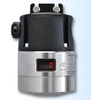
Compur Monitors, Inc. Compur Statox 501 IR

Description
Infrared gas detection theory of operation Some gases absorb light at a certain wavelength (colour). This absorption band is specific to the gas. The rate of the absorption depends not only on the substance to be detected but also on the number of gas molecules (i.e. the concentration of the gas). This premise is used to detect gases. For example, the C - H bond in hydrocarbon molecules will oscillate and absorb light at 3, 4 mm. This fact makes it so easy to detect fuels. Hexane, for instance has 14 C - H bonds compared to Methane that has only 4! A light beam is directed through a cuvette filled with the gas to be detected. The more hydrocarbons present, the more light will be absorbed. A photo detector at the other end of the cuvette measures the remaining light intensity. The difference between the original and remaining light intensity corresponds to the gas concentration. A reference beam with a different wavelength compensates for potential interferences of dust, humidity or variations of intensity from the light source. Fail-safe technology Failure of important components such as the light source or photo detector will trigger a "system fail" alarm. Most local authorities will accept this as a self-diagnostic feature. Systems including a self-check require less maintenance and calibration, saving time and money. Simple maintenance: Easy to read display and non-Vintrusive calibration The bright LED display of the Statox 501 IR shows the gas concentration in percent L.E.L. (Lower Explosion Limit). An important accessory is the calibration adapter, featuring control buttons operating Hall-sensors inside the Ex d housing. The service menu is password protected preventing unauthorised access. All parameters can be checked and changed, or a calibration can be done all without opening the transmitter. The adapter is also equipped with a gas outlet so that it can be used for flow-through applications. Impervious compact design The dimensions of the Statox 501 IR are small and compact. The sensor compartment is completely sealed, not allowing dust or insects to enter. It is located in the center of the sensor head. This allows heat radiation from the electronics and the infrared lamp to keep the unit a few degrees above the ambient temperature thus avoiding condensation. This innovative design makes any additional heating unnecessary, allowing the sensor head to be very energy efficient. This saves additional money by eliminating more expensive wiring and a bigger power supply that would otherwise be necessary. The sensor head is rated protection class IP 67 (6 = protection even against fine dust, 7 = submerged 1 m deep in water for 30 minutes). You can have confidence that this system will safely operate even in the harshest environment.
Description
Infrared gas detection theory of operation Some gases absorb light at a certain wavelength (colour). This absorption band is specific to the gas. The rate of the absorption depends not only on the substance to be detected but also on the number of gas molecules (i.e. the concentration of the gas). This premise is used to detect gases. For example, the C - H bond in hydrocarbon molecules will oscillate and absorb light at 3, 4 mm. This fact makes it so easy to detect fuels. Hexane, for instance has 14 C - H bonds compared to Methane that has only 4! A light beam is directed through a cuvette filled with the gas to be detected. The more hydrocarbons present, the more light will be absorbed. A photo detector at the other end of the cuvette measures the remaining light intensity. The difference between the original and remaining light intensity corresponds to the gas concentration. A reference beam with a different wavelength compensates for potential interferences of dust, humidity or variations of intensity from the light source. Fail-safe technology Failure of important components such as the light source or photo detector will trigger a "system fail" alarm. Most local authorities will accept this as a self-diagnostic feature. Systems including a self-check require less maintenance and calibration, saving time and money. Simple maintenance: Easy to read display and non-Vintrusive calibration The bright LED display of the Statox 501 IR shows the gas concentration in percent L.E.L. (Lower Explosion Limit). An important accessory is the calibration adapter, featuring control buttons operating Hall-sensors inside the Ex d housing. The service menu is password protected preventing unauthorised access. All parameters can be checked and changed, or a calibration can be done all without opening the transmitter. The adapter is also equipped with a gas outlet so that it can be used for flow-through applications. Impervious compact design The dimensions of the Statox 501 IR are small and compact. The sensor compartment is completely sealed, not allowing dust or insects to enter. It is located in the center of the sensor head. This allows heat radiation from the electronics and the infrared lamp to keep the unit a few degrees above the ambient temperature thus avoiding condensation. This innovative design makes any additional heating unnecessary, allowing the sensor head to be very energy efficient. This saves additional money by eliminating more expensive wiring and a bigger power supply that would otherwise be necessary. The sensor head is rated protection class IP 67 (6 = protection even against fine dust, 7 = submerged 1 m deep in water for 30 minutes). You can have confidence that this system will safely operate even in the harshest environment.

Suppliers

Company
Product
Description
Supplier Links
Infrared gas detection theory of operation Some gases absorb light at a certain wavelength (colour). This absorption band is specific to the gas. The rate of the absorption depends not only on the substance to be detected but also on the number of gas molecules (i.e. the concentration of the gas). This premise is used to detect gases. For example, the C - H bond in hydrocarbon molecules will oscillate and absorb light at 3, 4 mm. This fact makes it so easy to detect fuels. Hexane, for instance has 14 C - H bonds compared to Methane that has only 4! A light beam is directed through a cuvette filled with the gas to be detected. The more hydrocarbons present, the more light will be absorbed. A photo detector at the other end of the cuvette measures the remaining light intensity. The difference between the original and remaining light intensity corresponds to the gas concentration. A reference beam with a different wavelength compensates for potential interferences of dust, humidity or variations of intensity from the light source. Fail-safe technology Failure of important components such as the light source or photo detector will trigger a "system fail" alarm. Most local authorities will accept this as a self-diagnostic feature. Systems including a self-check require less maintenance and calibration, saving time and money. Simple maintenance: Easy to read display and non-Vintrusive calibration The bright LED display of the Statox 501 IR shows the gas concentration in percent L.E.L. (Lower Explosion Limit). An important accessory is the calibration adapter, featuring control buttons operating Hall-sensors inside the Ex d housing. The service menu is password protected preventing unauthorised access. All parameters can be checked and changed, or a calibration can be done all without opening the transmitter. The adapter is also equipped with a gas outlet so that it can be used for flow-through applications. Impervious compact design The dimensions of the Statox 501 IR are small and compact. The sensor compartment is completely sealed, not allowing dust or insects to enter. It is located in the center of the sensor head. This allows heat radiation from the electronics and the infrared lamp to keep the unit a few degrees above the ambient temperature thus avoiding condensation. This innovative design makes any additional heating unnecessary, allowing the sensor head to be very energy efficient. This saves additional money by eliminating more expensive wiring and a bigger power supply that would otherwise be necessary. The sensor head is rated protection class IP 67 (6 = protection even against fine dust, 7 = submerged 1 m deep in water for 30 minutes). You can have confidence that this system will safely operate even in the harshest environment.

Infrared gas detection theory of operation
Some gases absorb light at a certain wavelength (colour). This absorption band is specific to the gas. The rate of the absorption depends not only on the substance to be detected but also on the number of gas molecules (i.e. the concentration of the gas). This premise is used to detect gases. For example, the C - H bond in hydrocarbon molecules will oscillate and absorb light at 3, 4 mm. This fact makes it so easy to detect fuels. Hexane, for instance has 14 C - H bonds compared to Methane that has only 4!
A light beam is directed through a cuvette filled with the gas to be detected. The more hydrocarbons present, the more light will be absorbed. A photo detector at the other end of the cuvette measures the remaining light intensity. The difference between the original and remaining light intensity corresponds to the gas concentration.
A reference beam with a different wavelength compensates for potential interferences of dust, humidity or variations of intensity from the light source.
Fail-safe technology
Failure of important components such as the light source or photo detector will trigger a "system fail" alarm. Most local authorities will accept this as a self-diagnostic feature. Systems including a self-check require less maintenance and calibration, saving time and money.
Simple maintenance: Easy to read display and non-Vintrusive calibration
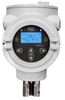
The bright LED display of the Statox 501 IR shows the gas concentration in percent L.E.L. (Lower Explosion Limit). An important accessory is the calibration adapter, featuring control buttons operating Hall-sensors inside the Ex d housing.
The service menu is password protected preventing unauthorised access. All parameters can be checked and changed, or a calibration can be done all without opening the transmitter. The adapter is also equipped with a gas outlet so that it can be used for flow-through applications.
Impervious compact design
The dimensions of the Statox 501 IR are small and compact. The sensor compartment is completely sealed, not allowing dust or insects to enter. It is located in the center of the sensor head. This allows heat radiation from the electronics and the infrared lamp to keep the unit a few degrees above the ambient temperature thus avoiding condensation. This innovative design makes any additional heating unnecessary, allowing the sensor head to be very energy efficient. This saves additional money by eliminating more expensive wiring and a bigger power supply that would otherwise be necessary.
The sensor head is rated protection class IP 67 (6 = protection even against fine dust, 7 = submerged 1 m deep in water for 30 minutes). You can have confidence that this system will safely operate even in the harshest environment.

Supplier's Site

Technical Specifications

  Compur Monitors, Inc.
Product Category Gas Instruments
Product Number Compur Statox 501 IR
Application Confined Space Entry
Unlock Full Specs
to access all available technical data

Similar Products

Thermal Conductivity Binary Gas Analyzer - XMTCpro - Panametrics
Specs
Measurement Type %Volume
Application Process Gas
Gas Types CO2; H2; Methane (CH4) / Natural Gas; O2; SO2; (He, N2, Ar)
View Details
Zirconia Oxygen Probe Module Kit -  - SST Sensing Ltd.
Specs
Application Ambient Air Monitoring
Gas Types (0.1–100% O₂ (2 mbar to 3 bar partial pressure) with electronics interface); O2; (0.1–100% O₂ (2 mbar to 3 bar partial pressure) with electronics interface)
Electrical Outputs Current (optional feature)
View Details
Nitrogen Dioxide NO2 Combustible Fixed Gas Detector (0-100ppm) -  - CO2Meter.com
Specs
Gas Types Combustible; NO2; (Combustible Fixed Gas Detectors - Nitrogen Dioxide NO2 Combustible Fixed Gas Detector (0-100ppm))
Number of Gases Monitored Single
Operating Temperature -30 to 122 F (-34 to 50 C)
View Details
Open Path Gas Detector - Senscient ELDS™ - MSA Safety
Specs
Measurement Type %Volume
Application Ambient Air Monitoring
Gas Types Toxic; NH3; CO2; HCl; HF; H2S; Methane (CH4) / Natural Gas
View Details