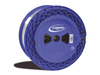
Newport MKS Photonic Crystal Fiber, Endlessly Singlemode, 8.5 µm Core F-SM8

Description
The F-SM8 (NKT P/N LMA-8) Endlessly Singlemode Photonic Crystal Fiber is an un-doped silica fiber that uses a triangular pattern of air holes to form the cladding. Since the index contrast between the core and the cladding, Δn, is determined only by the geometry of the air holes, it is possible to fabricate fibers with a very small and accurate Δn, and thus obtain very low numerical apertures and very large mode areas. This type of fiber is single-mode over a very broad wavelength range above 400 nm, with the mode-field diameter (MFD) of 7.2 ± 0.5 µm at 532 nm (1/e2) and 7.5 ± 1.0 µm at 1064 nm (1/e2) . At short wavelengths, the fibers' performance is limited by macro-bending losses, which determines the practical wavelength range for applications. The F-SM Series PCFs are typically used where single-mode, high-power delivery is required without introducing non-linear effects. Coupling light into and out of an F-SM fiber is as simple as for standard doped-glass optical fibers. In a free-space set-up, the optics should match the NA of the fiber and be diffraction limited in order to obtain a low-loss coupling. Since the MFD is practically constant, the NA is proportional to the wavelength, which should be considered in the design of coupling optics for a broad wavelength range. For adding fiber connectors and protective jackets, please contact Newport technical support. When ordered as a length of bare fiber the ends are left open and not sealed or fused closed. This bare fiber does not include a protective fiber jacket. Standard pricing is per meter. The following volume discount schedule is applied when ordering continuous lengths of optical fiber: 10 - 49 m: 15%, 50 - 99 m: 22%, 100 - 499 m: 25%, and ≥ 500 m: 28%. Singlemode Over a Very Broad Wavelength Range This type of fiber is single-mode over a very broad wavelength range, with a practically constant mode-field diameter (MFD). At short wavelengths, the fibers' performance is limited by macro-bending losses, which determines the practical wavelength range for applications. The F-SM series of fibers are optimized in order to obtain the largest possible MFD without introducing significant macro-bending losses on typical bending radii of more than 16 cm. End face image and weakly transmitted cladding modes profile of F-SM series micro-structured fiber. High Power Delivery is required Without Non-linear Effects The F-SM Series PCFs are typically used where single-mode, high-power delivery is required without introducing non-linear effects. Furthermore, they are the optimal choice for applications requiring single-mode guidance in a very broad wavelength range, e.g. in sensors, spectroscopy, interferometry or RGB displays. End face image and weakly transmitted cladding modes profile of F-SM series micro-structured fiber. Photonic Crystal Fiber Photonic Crystal Fiber (PCF) can provide characteristics that ordinary optical fiber do not exhibit, such as: single mode operation from the UV to IR with large mode-field diameters, highly nonlinear performance for super continuum generation, numerical aperture (NA) values ranging from very low to about 0.9, optimized dispersion properties, and air core guidance, among others. Free Space Coupling Coupling light into and out of an F-SM fiber is as simple as for standard optical fibers. In a free-space set-up, the optics should match the NA of the fiber and be diffraction limited in order to obtain a low-loss coupling. Since the MFD is practically constant, the NA is proportional to the wavelength, which should be considered in the design of coupling optics for a broad wavelength range. The F-SM Series may also be spliced to standard fibers, making them easy to integrate into existing systems or instruments. Optional beam expansion FC connectors enhance high power capabilities. Geometry and Strength In order to screen the fibers from microbending losses, the F-SM Series are fabricated with large cladding diameters for the largest core sizes. All fibers have a single-layer acrylate coating, and have been proof tested with a tension of at least 5.0 N.
Request a Quote Datasheet
Description
The F-SM8 (NKT P/N LMA-8) Endlessly Singlemode Photonic Crystal Fiber is an un-doped silica fiber that uses a triangular pattern of air holes to form the cladding. Since the index contrast between the core and the cladding, Δn, is determined only by the geometry of the air holes, it is possible to fabricate fibers with a very small and accurate Δn, and thus obtain very low numerical apertures and very large mode areas. This type of fiber is single-mode over a very broad wavelength range above 400 nm, with the mode-field diameter (MFD) of 7.2 ± 0.5 µm at 532 nm (1/e2) and 7.5 ± 1.0 µm at 1064 nm (1/e2) . At short wavelengths, the fibers' performance is limited by macro-bending losses, which determines the practical wavelength range for applications. The F-SM Series PCFs are typically used where single-mode, high-power delivery is required without introducing non-linear effects. Coupling light into and out of an F-SM fiber is as simple as for standard doped-glass optical fibers. In a free-space set-up, the optics should match the NA of the fiber and be diffraction limited in order to obtain a low-loss coupling. Since the MFD is practically constant, the NA is proportional to the wavelength, which should be considered in the design of coupling optics for a broad wavelength range. For adding fiber connectors and protective jackets, please contact Newport technical support. When ordered as a length of bare fiber the ends are left open and not sealed or fused closed. This bare fiber does not include a protective fiber jacket. Standard pricing is per meter. The following volume discount schedule is applied when ordering continuous lengths of optical fiber: 10 - 49 m: 15%, 50 - 99 m: 22%, 100 - 499 m: 25%, and ≥ 500 m: 28%. Singlemode Over a Very Broad Wavelength Range This type of fiber is single-mode over a very broad wavelength range, with a practically constant mode-field diameter (MFD). At short wavelengths, the fibers' performance is limited by macro-bending losses, which determines the practical wavelength range for applications. The F-SM series of fibers are optimized in order to obtain the largest possible MFD without introducing significant macro-bending losses on typical bending radii of more than 16 cm. End face image and weakly transmitted cladding modes profile of F-SM series micro-structured fiber. High Power Delivery is required Without Non-linear Effects The F-SM Series PCFs are typically used where single-mode, high-power delivery is required without introducing non-linear effects. Furthermore, they are the optimal choice for applications requiring single-mode guidance in a very broad wavelength range, e.g. in sensors, spectroscopy, interferometry or RGB displays. End face image and weakly transmitted cladding modes profile of F-SM series micro-structured fiber. Photonic Crystal Fiber Photonic Crystal Fiber (PCF) can provide characteristics that ordinary optical fiber do not exhibit, such as: single mode operation from the UV to IR with large mode-field diameters, highly nonlinear performance for super continuum generation, numerical aperture (NA) values ranging from very low to about 0.9, optimized dispersion properties, and air core guidance, among others. Free Space Coupling Coupling light into and out of an F-SM fiber is as simple as for standard optical fibers. In a free-space set-up, the optics should match the NA of the fiber and be diffraction limited in order to obtain a low-loss coupling. Since the MFD is practically constant, the NA is proportional to the wavelength, which should be considered in the design of coupling optics for a broad wavelength range. The F-SM Series may also be spliced to standard fibers, making them easy to integrate into existing systems or instruments. Optional beam expansion FC connectors enhance high power capabilities. Geometry and Strength In order to screen the fibers from microbending losses, the F-SM Series are fabricated with large cladding diameters for the largest core sizes. All fibers have a single-layer acrylate coating, and have been proof tested with a tension of at least 5.0 N.
Request a Quote Datasheet

Suppliers

Company
Product
Description
Supplier Links
Photonic Crystal Fiber, Endlessly Singlemode, 8.5 µm Core - F-SM8 - Newport MKS
Irvine, CA, United States
Photonic Crystal Fiber, Endlessly Singlemode, 8.5 µm Core
F-SM8
Photonic Crystal Fiber, Endlessly Singlemode, 8.5 µm Core F-SM8
The F-SM8 (NKT P/N LMA-8) Endlessly Singlemode Photonic Crystal Fiber is an un-doped silica fiber that uses a triangular pattern of air holes to form the cladding. Since the index contrast between the core and the cladding, Δn, is determined only by the geometry of the air holes, it is possible to fabricate fibers with a very small and accurate Δn, and thus obtain very low numerical apertures and very large mode areas. This type of fiber is single-mode over a very broad wavelength range above 400 nm, with the mode-field diameter (MFD) of 7.2 ± 0.5 µm at 532 nm (1/e2) and 7.5 ± 1.0 µm at 1064 nm (1/e2) . At short wavelengths, the fibers' performance is limited by macro-bending losses, which determines the practical wavelength range for applications. The F-SM Series PCFs are typically used where single-mode, high-power delivery is required without introducing non-linear effects. Coupling light into and out of an F-SM fiber is as simple as for standard doped-glass optical fibers. In a free-space set-up, the optics should match the NA of the fiber and be diffraction limited in order to obtain a low-loss coupling. Since the MFD is practically constant, the NA is proportional to the wavelength, which should be considered in the design of coupling optics for a broad wavelength range. For adding fiber connectors and protective jackets, please contact Newport technical support. When ordered as a length of bare fiber the ends are left open and not sealed or fused closed. This bare fiber does not include a protective fiber jacket. Standard pricing is per meter. The following volume discount schedule is applied when ordering continuous lengths of optical fiber: 10 - 49 m: 15%, 50 - 99 m: 22%, 100 - 499 m: 25%, and ≥ 500 m: 28%. Singlemode Over a Very Broad Wavelength Range This type of fiber is single-mode over a very broad wavelength range, with a practically constant mode-field diameter (MFD). At short wavelengths, the fibers' performance is limited by macro-bending losses, which determines the practical wavelength range for applications. The F-SM series of fibers are optimized in order to obtain the largest possible MFD without introducing significant macro-bending losses on typical bending radii of more than 16 cm. End face image and weakly transmitted cladding modes profile of F-SM series micro-structured fiber. High Power Delivery is required Without Non-linear Effects The F-SM Series PCFs are typically used where single-mode, high-power delivery is required without introducing non-linear effects. Furthermore, they are the optimal choice for applications requiring single-mode guidance in a very broad wavelength range, e.g. in sensors, spectroscopy, interferometry or RGB displays. End face image and weakly transmitted cladding modes profile of F-SM series micro-structured fiber. Photonic Crystal Fiber Photonic Crystal Fiber (PCF) can provide characteristics that ordinary optical fiber do not exhibit, such as: single mode operation from the UV to IR with large mode-field diameters, highly nonlinear performance for super continuum generation, numerical aperture (NA) values ranging from very low to about 0.9, optimized dispersion properties, and air core guidance, among others. Free Space Coupling Coupling light into and out of an F-SM fiber is as simple as for standard optical fibers. In a free-space set-up, the optics should match the NA of the fiber and be diffraction limited in order to obtain a low-loss coupling. Since the MFD is practically constant, the NA is proportional to the wavelength, which should be considered in the design of coupling optics for a broad wavelength range. The F-SM Series may also be spliced to standard fibers, making them easy to integrate into existing systems or instruments. Optional beam expansion FC connectors enhance high power capabilities. Geometry and Strength In order to screen the fibers from microbending losses, the F-SM Series are fabricated with large cladding diameters for the largest core sizes. All fibers have a single-layer acrylate coating, and have been proof tested with a tension of at least 5.0 N.

The F-SM8 (NKT P/N LMA-8) Endlessly Singlemode Photonic Crystal Fiber is an un-doped silica fiber that uses a triangular pattern of air holes to form the cladding. Since the index contrast between the core and the cladding, Δn, is determined only by the geometry of the air holes, it is possible to fabricate fibers with a very small and accurate Δn, and thus obtain very low numerical apertures and very large mode areas. This type of fiber is single-mode over a very broad wavelength range above 400 nm, with the mode-field diameter (MFD) of 7.2 ± 0.5 µm at 532 nm (1/e2) and 7.5 ± 1.0 µm at 1064 nm (1/e2) . At short wavelengths, the fibers' performance is limited by macro-bending losses, which determines the practical wavelength range for applications. The F-SM Series PCFs are typically used where single-mode, high-power delivery is required without introducing non-linear effects. Coupling light into and out of an F-SM fiber is as simple as for standard doped-glass optical fibers. In a free-space set-up, the optics should match the NA of the fiber and be diffraction limited in order to obtain a low-loss coupling. Since the MFD is practically constant, the NA is proportional to the wavelength, which should be considered in the design of coupling optics for a broad wavelength range. For adding fiber connectors and protective jackets, please contact Newport technical support. When ordered as a length of bare fiber the ends are left open and not sealed or fused closed.

This bare fiber does not include a protective fiber jacket. Standard pricing is per meter. The following volume discount schedule is applied when ordering continuous lengths of optical fiber: 10 - 49 m: 15%, 50 - 99 m: 22%, 100 - 499 m: 25%, and ≥ 500 m: 28%.

Singlemode Over a Very Broad Wavelength Range

This type of fiber is single-mode over a very broad wavelength range, with a practically constant mode-field diameter (MFD). At short wavelengths, the fibers' performance is limited by macro-bending losses, which determines the practical wavelength range for applications. The F-SM series of fibers are optimized in order to obtain the largest possible MFD without introducing significant macro-bending losses on typical bending radii of more than 16 cm.
End face image and weakly transmitted cladding modes profile of F-SM series micro-structured fiber.

High Power Delivery is required Without Non-linear Effects

The F-SM Series PCFs are typically used where single-mode, high-power delivery is required without introducing non-linear effects. Furthermore, they are the optimal choice for applications requiring single-mode guidance in a very broad wavelength range, e.g. in sensors, spectroscopy, interferometry or RGB displays.
End face image and weakly transmitted cladding modes profile of F-SM series micro-structured fiber.

Photonic Crystal Fiber

Photonic Crystal Fiber (PCF) can provide characteristics that ordinary optical fiber do not exhibit, such as: single mode operation from the UV to IR with large mode-field diameters, highly nonlinear performance for super continuum generation, numerical aperture (NA) values ranging from very low to about 0.9, optimized dispersion properties, and air core guidance, among others.

Free Space Coupling


Coupling light into and out of an F-SM fiber is as simple as for standard optical fibers. In a free-space set-up, the optics should match the NA of the fiber and be diffraction limited in order to obtain a low-loss coupling. Since the MFD is practically constant, the NA is proportional to the wavelength, which should be considered in the design of coupling optics for a broad wavelength range. The F-SM Series may also be spliced to standard fibers, making them easy to integrate into existing systems or instruments. Optional beam expansion FC connectors enhance high power capabilities.

Geometry and Strength


In order to screen the fibers from microbending losses, the F-SM Series are fabricated with large cladding diameters for the largest core sizes. All fibers have a single-layer acrylate coating, and have been proof tested with a tension of at least 5.0 N.

Supplier's Site Datasheet

Technical Specifications

  Newport MKS
Product Category Fiber Optic Cables
Product Number F-SM8
Product Name Photonic Crystal Fiber, Endlessly Singlemode, 8.5 µm Core
Fiber Mode SingleMode
Core Size 8.6 µm (0.3386 mils)
Cable Diameter 2.5 mm (0.0984 inch)
Unlock Full Specs
to access all available technical data

Similar Products

Fiber Patch Cord, Singlemode, 780nm, F-SE-C, 1m, FC/APC Connectors. - F-SE-C-1FCA - Newport MKS
Specs
Fiber Mode SingleMode
Core Size 5.4 µm (0.2126 mils)
Connector Type FC/APC Narrow Key
View Details
Photonic Crystal Fiber Patch Cord, Endlessly SM, 2 m, 8.5 µm, FC/APC - F-SM8-C-2FCA - Newport MKS
Specs
Fiber Mode SingleMode
Core Size 8.5 µm (0.3346 mils)
Connector Type FC; FC/APC
View Details
Optical Fiber, Pure Silica Core Single Mode, 405-532 nm, Non-photo darkening - F-SM400-SC - Newport MKS
Specs
Fiber Mode SingleMode
Wavelength 405 to 532 nm (4050 to 5320 Å)
Numerical Aperture 0.1200
View Details
Polarization Maintaining Optical Fiber, Panda, 980 nm, 0.10-0.13 NA - F-PM980 - Newport MKS
Specs
Wavelength 980 nm (9800 Å)
Numerical Aperture 0.1000 to 0.1300
Maximum Attenuation 2.5 dB/km (0.7620 dB/1000 ft)
View Details