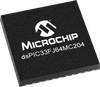
The dsPIC33F 16-bit device family employs a powerful 16-bit architecture, ideal for applications that rely on high-speed, repetitive computations, as well as control. The devices are pin compatible with the PIC24HJ family of devices, and share a very high degree of compatibility with the dsPIC30F family devices. This allows seamless migration options from/to PIC24F, dsPIC30F and dsPIC33F devices.
Additional Features
Operating Range:
Up to 40 MIPS operation (@ 3.0-3.6V)
Industrial temperature range (-40°C to +85°C)
Extended temperature range (-40°C to +125°C)
High temperature range (-40°C to +150°C)
High-Performance DSC CPU:
Modified Harvard architecture
C compiler optimized instruction set
16-bit wide data path
24-bit wide instructions
Linear program memory addressing up to 4M instruction words
Linear data memory addressing up to 64 Kbytes
83 base instructions: mostly 1 word/1 cycle
Two 40-bit accumulators with rounding and saturation options
Flexible and powerful addressing modes: Indirect, Modulo and Bit-reversed software stack
16 x 16 fractional/integer multiply operations
32/16 and 16/16 divide operations
Single-cycle multiply and accumulate:
Accumulator write back for DSP operations
Dual data fetch
Up to ±16-bit shifts for up to 40-bit data
On-Chip Flash and SRAM:
Flash program memory (up to 32 Kbytes)
Data SRAM (2 Kbytes)
Boot and General Security for program Flash
Direct Memory Access (DMA):
8-channel hardware DMA
Up to 2 Kbytes dual ported DMA buffer area (DMA RAM) to store data transferred via DMA
Allows data transfer between RAM and a peripheral while CPU is executing code (no cycle stealing)
Most peripherals support DMA
Timers/Capture/Compa
re/PWM:
Timer/Counters, up to three 16-bit timers
Can pair up to make one 32-bit timer, 1 timer runs as Real-Time Clock with external 32.768 kHz oscillator, and Programmable prescaler
Input Capture (up to 4 channels): Capture on up, down or both edges, 16-bit capture input functions and 4-deep FIFO on each capture
Output Compare (up to 2 channels): Single or Dual 16-Bit Compare mode and 16-bit Glitchless PWM mode
Interrupt Controller:
5-cycle latency, 118 interrupt vectors, Up to 26 available interrupt sources
Up to 3 external interrupts, 7 programmable priority levels, and 5 processor exceptions
Digital I/O:
Peripheral pin Select functionality
Up to 35 programmable digital I/O pins
Wake-up/Interrupt-on
-Change for up to 21 pins
Output pins can drive from 3.0V to 3.6V
Up to 5V output with open drain configuration
All digital input pins are 5V tolerant
4 mA sink on all I/O pins
System Management:
Flexible clock options: External, crystal, resonator, internal RC
Fully integrated Phase-Locked Loop (PLL) and Extremely low jitter PLL
Power-up Timer
Oscillator Start-up Timer/Stabilizer
Watchdog Timer with its own RC oscillator
Fail-Safe Clock Monitor
Reset by multiple sources
Power Management:
On-chip 2.5V voltage regulator
Switch between clock sources in real time
Idle, Sleep and Doze modes with fast wake-up
Analog-to-Digital Converters (ADCs):
10-bit, 1.1 Msps or 12-bit, 500 Ksps conversion
2 and 4 simultaneous samples (10-bit ADC)
Up to 6 input channels with auto-scanning
Conversion start can be manual or synchronized with 1 of 4 trigger sources
Conversion possible in Sleep mode
±2 LSb max integral nonlinearity
±1 LSb max differential nonlinearity
Comparator Module:
Two analog comparators with programmable input/output configuration
CMOS Flash Technology:
Low-power, high-speed Flash technology
Fully static design
3.3V (±10%) operating voltage
Industrial and Extended temperature
Low power consumption
Motor Control Peripherals:
6-channel 16-bit Motor Control PWM
3 duty cycle generators
Independent or Complementary mode
Programmable dead time and output polarity
Edge-aligned or center-aligned
Manual output override control
1 Fault input
Trigger for ADC conversions
PWM frequency for 16-bit resolution (@ 40 MIPS) = 1220 Hz for Edge-Aligned mode, 610 Hz for Center-Aligned mode
PWM frequency for 11-bit resolution (@ 40 MIPS) = 39.1 kHz for Edge-Aligned mode, 19.55 kHz for Center-Aligned mode
2-channel 16-bit Motor Control PWM:
1 duty cycle generator
Independent or Complementary mode
Programmable dead time and output polarity
Edge-aligned or center-aligned
Manual output override control
1 Fault input
Trigger for ADC conversions
PWM frequency for 16-bit resolution (@ 40 MIPS) = 1220 Hz for Edge-Aligned mode, 610 Hz for Center-Aligned mode
PWM frequency for 11-bit resolution (@ 40 MIPS) = 39.1 kHz for Edge-Aligned mode, 19.55 kHz for Center-Aligned mode
Quadrature Encoder Interface module
Phase A, Phase B and index pulse input
16-bit up/down position counter
The dsPIC33F 16-bit device family employs a powerful 16-bit architecture, ideal for applications that rely on high-speed, repetitive computations, as well as control. The devices are pin compatible with the PIC24HJ family of devices, and share a very high degree of compatibility with the dsPIC30F family devices. This allows seamless migration options from/to PIC24F, dsPIC30F and dsPIC33F devices.
Additional Features
- Operating Range:
- Up to 40 MIPS operation (@ 3.0-3.6V)
- Industrial temperature range (-40°C to +85°C)
- Extended temperature range (-40°C to +125°C)
- High temperature range (-40°C to +150°C)
- High-Performance DSC CPU:
- Modified Harvard architecture
- C compiler optimized instruction set
- 16-bit wide data path
- 24-bit wide instructions
- Linear program memory addressing up to 4M instruction words
- Linear data memory addressing up to 64 Kbytes
- 83 base instructions: mostly 1 word/1 cycle
- Two 40-bit accumulators with rounding and saturation options
- Flexible and powerful addressing modes: Indirect, Modulo and Bit-reversed software stack
- 16 x 16 fractional/integer multiply operations
- 32/16 and 16/16 divide operations
- Single-cycle multiply and accumulate:
- Accumulator write back for DSP operations
- Dual data fetch
- Up to ±16-bit shifts for up to 40-bit data
- On-Chip Flash and SRAM:
- Flash program memory (up to 32 Kbytes)
- Data SRAM (2 Kbytes)
- Boot and General Security for program Flash
- Direct Memory Access (DMA):
- 8-channel hardware DMA
- Up to 2 Kbytes dual ported DMA buffer area (DMA RAM) to store data transferred via DMA
- Allows data transfer between RAM and a peripheral while CPU is executing code (no cycle stealing)
- Most peripherals support DMA
- Timers/Capture/Compare/PWM:
- Timer/Counters, up to three 16-bit timers
- Can pair up to make one 32-bit timer, 1 timer runs as Real-Time Clock with external 32.768 kHz oscillator, and Programmable prescaler
- Input Capture (up to 4 channels): Capture on up, down or both edges, 16-bit capture input functions and 4-deep FIFO on each capture
- Output Compare (up to 2 channels): Single or Dual 16-Bit Compare mode and 16-bit Glitchless PWM mode
- Interrupt Controller:
- 5-cycle latency, 118 interrupt vectors, Up to 26 available interrupt sources
- Up to 3 external interrupts, 7 programmable priority levels, and 5 processor exceptions
- Digital I/O:
- Peripheral pin Select functionality
- Up to 35 programmable digital I/O pins
- Wake-up/Interrupt-on-Change for up to 21 pins
- Output pins can drive from 3.0V to 3.6V
- Up to 5V output with open drain configuration
- All digital input pins are 5V tolerant
- 4 mA sink on all I/O pins
- System Management:
- Flexible clock options: External, crystal, resonator, internal RC
- Fully integrated Phase-Locked Loop (PLL) and Extremely low jitter PLL
- Power-up Timer
- Oscillator Start-up Timer/Stabilizer
- Watchdog Timer with its own RC oscillator
- Fail-Safe Clock Monitor
- Reset by multiple sources
- Power Management:
- On-chip 2.5V voltage regulator
- Switch between clock sources in real time
- Idle, Sleep and Doze modes with fast wake-up
- Analog-to-Digital Converters (ADCs):
- 10-bit, 1.1 Msps or 12-bit, 500 Ksps conversion
- 2 and 4 simultaneous samples (10-bit ADC)
- Up to 6 input channels with auto-scanning
- Conversion start can be manual or synchronized with 1 of 4 trigger sources
- Conversion possible in Sleep mode
- ±2 LSb max integral nonlinearity
- ±1 LSb max differential nonlinearity
- Comparator Module:
- Two analog comparators with programmable input/output configuration
- CMOS Flash Technology:
- Low-power, high-speed Flash technology
- Fully static design
- 3.3V (±10%) operating voltage
- Industrial and Extended temperature
- Low power consumption
- Motor Control Peripherals:
- 6-channel 16-bit Motor Control PWM
- 3 duty cycle generators
- Independent or Complementary mode
- Programmable dead time and output polarity
- Edge-aligned or center-aligned
- Manual output override control
- 1 Fault input
- Trigger for ADC conversions
- PWM frequency for 16-bit resolution (@ 40 MIPS) = 1220 Hz for Edge-Aligned mode, 610 Hz for Center-Aligned mode
- PWM frequency for 11-bit resolution (@ 40 MIPS) = 39.1 kHz for Edge-Aligned mode, 19.55 kHz for Center-Aligned mode
- 2-channel 16-bit Motor Control PWM:
- 1 duty cycle generator
- Independent or Complementary mode
- Programmable dead time and output polarity
- Edge-aligned or center-aligned
- Manual output override control
- 1 Fault input
- Trigger for ADC conversions
- PWM frequency for 16-bit resolution (@ 40 MIPS) = 1220 Hz for Edge-Aligned mode, 610 Hz for Center-Aligned mode
- PWM frequency for 11-bit resolution (@ 40 MIPS) = 39.1 kHz for Edge-Aligned mode, 19.55 kHz for Center-Aligned mode
- Quadrature Encoder Interface module
- Phase A, Phase B and index pulse input
- 16-bit up/down position counter