DESCRIPTION
With battery cells loaded in the Leak Test vacuum chamber, should there be a leak the system can generate vaporization of the solvents and extract them from the cell, as well as quantify the extent of the leak using a suitable mass spectrometer version.
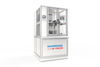
The Leak B-Tracer is features a robust main structure made of aluminium profiles and aluminium base plate. The station is enclosed with Lexan safety fences with a door on the load/unload side that has an interlocked safety switch. The electrical cabinet, the measure instrumentation and the leak test fixture are assembled on the main structure.
The automatic fixture is equipped with the following:
Two removable bottom trays (for manual retooling of different cell formats), able to receive a batch of battery cells. Both are equipped with a gasket to seal the vacuum chamber, reference features for precise part positioning and volume reduction components.
One pneumatically-actuat
ed horizontal slide for transferring the bottom trays from left to right, and vice versa (one bottom tray will be always in test position while the other will be in load/unload position, one on the left and one on the right side of the fixture).
One centrally-located bridge structure equipped with a removable upper cover (for manual retooling of different cell formats) to close the vacuum chamber when a bottom tray is lifted up.
A pneumatic lifter to lift and lower the bottom tray to the test position, as well as close and open the vacuum chamber against the upper cover.
The quantity, as well as the type of cells to be tested, can be easily modified in case of any new requirements by manual retooling of the two bottom trays, thus making the Leak B-Tracer able to test any type of cell (prismatic, cylindrical, button, pouch).
The system can easily work with any type of electrolyte (DMC, EMC, PP, ...)
Moreover, by using the AMU (Atomic Mass Unit) scanning procedure, this system can easily identify the correct AMU value to trace, without knowing the recipe of the solvent.
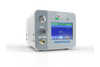
The Leak B-Tracer is equipped with a Marposs ”Fast Response System” solution, which consists of a mass spectrometer connected to an industrial Marposs Merlin Plus and Marposs “SOLT” software for the management of the measure cycles and for the local storage of the test data.
The IPC can also be used for local data storage and statistics.
For each part tested, the following data can be stored on the local storage of the IPC:
Test date and time
Result (good or reject)
Actual test pressure value
Leak value
Test parameters (test pressure and reject limit)
A periodic test of the seals and instrumentation integrity will be performed using a certified “Master Leak” part.
The Master Leak, designed with a leak value close to the required reject limit, will be filled with the same solvent used for the electrolyte tracing of the battery cells. It will be manually inserted by the operator when a master cycle is required to verify system functionality without needing to calibrate the measurement system.
The integration of a Gross Leak Detection System, for reducing cycle time on cells with big leaks, also protects the mass spectrometer against contamination due to high concentration of solvent during the test phase.
Intended Use:
• Leak Tests on prototypes and pilot lines
• Off-line testing and SPC analysis
• Re-check of a scrap batch from testing in mass production
Marposs’ competencies on Electrolyte Tracing Method combined with Automation expertise make it possible to offer solutions for integration of this technology into battery cell production lines that can meet the most stringent cycle time requirements.
BENEFITS
Test applies to any type of cell (button, cylindrical, prismatic or pouch), through an easy retooling system of the vacuum chamber
Test is applicable to any stage of the process, including after electrolyte filling and sealing
Appropriate test for different types of electrolyte
Fast-testing procedure
Gross leak test to prevent contamination
TECH SPECS
Max Chamber Size: Width 280 mm x Depth 160 mm x Height 250 mm
Typical cycle time: range from 15 to 60 (*) seconds
Electrolyte Type: DMC – EMC – DEC – MB – EA – EC – PP – PC – etc..
*depending on type, size and number of cells
DESCRIPTION
With battery cells loaded in the Leak Test vacuum chamber, should there be a leak the system can generate vaporization of the solvents and extract them from the cell, as well as quantify the extent of the leak using a suitable mass spectrometer version.
The Leak B-Tracer is features a robust main structure made of aluminium profiles and aluminium base plate. The station is enclosed with Lexan safety fences with a door on the load/unload side that has an interlocked safety switch. The electrical cabinet, the measure instrumentation and the leak test fixture are assembled on the main structure.
The automatic fixture is equipped with the following:
- Two removable bottom trays (for manual retooling of different cell formats), able to receive a batch of battery cells. Both are equipped with a gasket to seal the vacuum chamber, reference features for precise part positioning and volume reduction components.
- One pneumatically-actuated horizontal slide for transferring the bottom trays from left to right, and vice versa (one bottom tray will be always in test position while the other will be in load/unload position, one on the left and one on the right side of the fixture).
- One centrally-located bridge structure equipped with a removable upper cover (for manual retooling of different cell formats) to close the vacuum chamber when a bottom tray is lifted up.
- A pneumatic lifter to lift and lower the bottom tray to the test position, as well as close and open the vacuum chamber against the upper cover.
The quantity, as well as the type of cells to be tested, can be easily modified in case of any new requirements by manual retooling of the two bottom trays, thus making the Leak B-Tracer able to test any type of cell (prismatic, cylindrical, button, pouch).
The system can easily work with any type of electrolyte (DMC, EMC, PP, ...)
Moreover, by using the AMU (Atomic Mass Unit) scanning procedure, this system can easily identify the correct AMU value to trace, without knowing the recipe of the solvent.
The Leak B-Tracer is equipped with a Marposs ”Fast Response System” solution, which consists of a mass spectrometer connected to an industrial Marposs Merlin Plus and Marposs “SOLT” software for the management of the measure cycles and for the local storage of the test data.
The IPC can also be used for local data storage and statistics.
For each part tested, the following data can be stored on the local storage of the IPC:
- Test date and time
- Result (good or reject)
- Actual test pressure value
- Leak value
- Test parameters (test pressure and reject limit)
A periodic test of the seals and instrumentation integrity will be performed using a certified “Master Leak” part.
The Master Leak, designed with a leak value close to the required reject limit, will be filled with the same solvent used for the electrolyte tracing of the battery cells. It will be manually inserted by the operator when a master cycle is required to verify system functionality without needing to calibrate the measurement system.
The integration of a Gross Leak Detection System, for reducing cycle time on cells with big leaks, also protects the mass spectrometer against contamination due to high concentration of solvent during the test phase.
Intended Use:
• Leak Tests on prototypes and pilot lines
• Off-line testing and SPC analysis
• Re-check of a scrap batch from testing in mass production
Marposs’ competencies on Electrolyte Tracing Method combined with Automation expertise make it possible to offer solutions for integration of this technology into battery cell production lines that can meet the most stringent cycle time requirements.
BENEFITS
- Test applies to any type of cell (button, cylindrical, prismatic or pouch), through an easy retooling system of the vacuum chamber
- Test is applicable to any stage of the process, including after electrolyte filling and sealing
- Appropriate test for different types of electrolyte
- Fast-testing procedure
- Gross leak test to prevent contamination
TECH SPECS
- Max Chamber Size: Width 280 mm x Depth 160 mm x Height 250 mm
- Typical cycle time: range from 15 to 60 (*) seconds
- Electrolyte Type: DMC – EMC – DEC – MB – EA – EC – PP – PC – etc..
*depending on type, size and number of cells