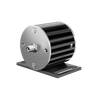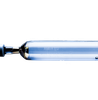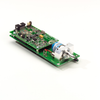
Excelitas Technologies Corp. Photoionization Detector Lamp PID Lamp

Description
Excelitas offers a complete range of DC and RF-operated Photoionization Detector (PID) lamps with the highest intensity, spectral purity, and long life, making them ideal for detecting Volatile Organic Compounds (VOCs). Our decades of experience in lamp design and manufacturing are leveraged to ensure our customers benefit from the highest product quality and reliability. Our DC and RF excited PID lamps are available with a selection of gas fills and window materials to cater to the specific requirements of your VOC sensor project. Photoionization detector lamps are most commonly used in VOC gas detection. Gas chromatography (GC) and sample ionization for mass spectrometry are other areas of use. The PID technique uses a lamp with known photon energies in the vacuum ultraviolet (VUV) region. The lamp output is used to photo-ionize gaseous molecules with ionization potentials lower than the photon energy emitted. Typical photoionization detectors measure VOCs and other gases in concentrations ranging from the ppm to ppb level.
Request a Quote Datasheet
Description
Excelitas offers a complete range of DC and RF-operated Photoionization Detector (PID) lamps with the highest intensity, spectral purity, and long life, making them ideal for detecting Volatile Organic Compounds (VOCs). Our decades of experience in lamp design and manufacturing are leveraged to ensure our customers benefit from the highest product quality and reliability. Our DC and RF excited PID lamps are available with a selection of gas fills and window materials to cater to the specific requirements of your VOC sensor project. Photoionization detector lamps are most commonly used in VOC gas detection. Gas chromatography (GC) and sample ionization for mass spectrometry are other areas of use. The PID technique uses a lamp with known photon energies in the vacuum ultraviolet (VUV) region. The lamp output is used to photo-ionize gaseous molecules with ionization potentials lower than the photon energy emitted. Typical photoionization detectors measure VOCs and other gases in concentrations ranging from the ppm to ppb level.
Request a Quote Datasheet

Suppliers

Company
Product
Description
Supplier Links
Photoionization Detector Lamp - PID Lamp - Excelitas Technologies Corp.
Gaithersburg, MD, United States
Photoionization Detector Lamp
PID Lamp
Photoionization Detector Lamp PID Lamp
Excelitas offers a complete range of DC and RF-operated Photoionization Detector (PID) lamps with the highest intensity, spectral purity, and long life, making them ideal for detecting Volatile Organic Compounds (VOCs). Our decades of experience in lamp design and manufacturing are leveraged to ensure our customers benefit from the highest product quality and reliability. Our DC and RF excited PID lamps are available with a selection of gas fills and window materials to cater to the specific requirements of your VOC sensor project. Photoionization detector lamps are most commonly used in VOC gas detection. Gas chromatography (GC) and sample ionization for mass spectrometry are other areas of use. The PID technique uses a lamp with known photon energies in the vacuum ultraviolet (VUV) region. The lamp output is used to photo-ionize gaseous molecules with ionization potentials lower than the photon energy emitted. Typical photoionization detectors measure VOCs and other gases in concentrations ranging from the ppm to ppb level.

Excelitas offers a complete range of DC and RF-operated Photoionization Detector (PID) lamps with the highest intensity, spectral purity, and long life, making them ideal for detecting Volatile Organic Compounds (VOCs). Our decades of experience in lamp design and manufacturing are leveraged to ensure our customers benefit from the highest product quality and reliability. Our DC and RF excited PID lamps are available with a selection of gas fills and window materials to cater to the specific requirements of your VOC sensor project.

Photoionization detector lamps are most commonly used in VOC gas detection. Gas chromatography (GC) and sample ionization for mass spectrometry are other areas of use. The PID technique uses a lamp with known photon energies in the vacuum ultraviolet (VUV) region. The lamp output is used to photo-ionize gaseous molecules with ionization potentials lower than the photon energy emitted. Typical photoionization detectors measure VOCs and other gases in concentrations ranging from the ppm to ppb level.

Supplier's Site Datasheet

Technical Specifications

  Excelitas Technologies Corp.
Product Category UV Lamps
Product Number PID Lamp
Product Name Photoionization Detector Lamp
Diameter 6 to 35 mm (0.2362 to 1.38 inch)
Unlock Full Specs
to access all available technical data

Similar Products

UV-Vis Light Source - FiberLight® D2 - Excelitas Technologies Corp.
Excelitas Technologies Corp.
Specs
Lamp Power 6 to 12 watts
Rated Average Life 2000 hours
View Details
UV Light Source For In-Field Spectroscopy - FiberLight® L3 - Excelitas Technologies Corp.
Specs
Lamp Power 1.5 watts
Rated Average Life 5000 hours
View Details
UV Light Source For In-Field Spectroscopy - FiberLight® L3 - Excelitas Technologies Corp.
Specs
Lamp Power 1.5 watts
Rated Average Life 5000 hours
View Details
Deuterium Lamps and Power Supplies -  - Excelitas Technologies Corp.
Specs
Wavelength Range 185 µm (1.85E6 Å)
Rated Average Life 2000 hours
View Details