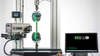
Epsilon Technology Corp. Laser Extensometer Model LE-05

Description
These extensometers are high precision non-contacting units for strain measurement in materials testing. They use a high speed laser scanner to measure the spacing between reflective tape strips on the sample. The measurement range is from 0.3 to 5 inches (8 to 127 mm) on the LE-05 and 0.3 to 15 inches (8 to 381 mm) on the LE-15. The gage length is determined by the user. This allows high elongation measurements when shorter gage lengths are used. The high resolution also allows accurate measurements of smaller strains. The self-contained extensometer uses state-of-the-art laser diode technology. A digital display is included. The analog output may be used to connect to existing test controls. The RS-232 serial communications interface provides two way communications. Operation may be local or remote. The scanning beam is always perpendicular to the specimen, unlike most laser extensometers. This eliminates errors when viewing through windows in chambers. It also minimizes sensitivity to the distance between the extensometer and the sample. Because the unit measures reflected light, no receiver is required behind the sample. Easy to use The visible laser light is simply aimed at the specimen, which has small reflective tape strips set at the gage length desired. The extensometer displays the actual measured gage length. If desired, the zero button will off set the output to zero. As the specimen is tested, the display will then read the elongation directly. The analog output and RS-232 interface are easily connected to existing controls or data acquisition systems. High temperature clip-on reflectors may be used as an alternate to tape reflectors. The reflective tape can be used at temperatures up to 300 °F (150 °C). These are re-useable and available as an option. They are rated for use to 800 °F (425 °C).
Request a Quote
Datasheet
Datasheet Summary
Powered by GS/AI

Model LE-05 is a non-contact laser extensometer for strain measurement in materials testing, using a diode laser to detect spacing between reflective tape marks on a specimen. It has a measurement range of 8 to 127 mm (0.3 to 5 inches) with a resolution of 0.001 mm and a maximum scan rate of 100 scans per second. The unit features a 16-bit ±10 VDC analog output and RS-232 serial interface, a backlit 16-character LCD display, and a target distance of 250 mm nominal (500 mm maximum). It is CDRH Certified Class II, operates on 115 VAC standard (230 VAC optional), and measures 381 x 180 x 114 mm (15 x 7.1 x 4.5 inches). Mounting is via four 1/4-20 UNC tapped holes in the base, and it weighs 6 kg (13 lbs).

Suppliers

Company
Product
Description
Supplier Links
Laser Extensometer - Model LE-05 - Epsilon Technology Corp.
Jackson, WY, United States
Laser Extensometer
Model LE-05
Laser Extensometer Model LE-05
These extensometers are high precision non-contacting units for strain measurement in materials testing. They use a high speed laser scanner to measure the spacing between reflective tape strips on the sample. The measurement range is from 0.3 to 5 inches (8 to 127 mm) on the LE-05 and 0.3 to 15 inches (8 to 381 mm) on the LE-15. The gage length is determined by the user. This allows high elongation measurements when shorter gage lengths are used. The high resolution also allows accurate measurements of smaller strains. The self-contained extensometer uses state-of-the-art laser diode technology. A digital display is included. The analog output may be used to connect to existing test controls. The RS-232 serial communications interface provides two way communications. Operation may be local or remote. The scanning beam is always perpendicular to the specimen, unlike most laser extensometers. This eliminates errors when viewing through windows in chambers. It also minimizes sensitivity to the distance between the extensometer and the sample. Because the unit measures reflected light, no receiver is required behind the sample. Easy to use The visible laser light is simply aimed at the specimen, which has small reflective tape strips set at the gage length desired. The extensometer displays the actual measured gage length. If desired, the zero button will off set the output to zero. As the specimen is tested, the display will then read the elongation directly. The analog output and RS-232 interface are easily connected to existing controls or data acquisition systems. High temperature clip-on reflectors may be used as an alternate to tape reflectors. The reflective tape can be used at temperatures up to 300 °F (150 °C). These are re-useable and available as an option. They are rated for use to 800 °F (425 °C).

These extensometers are high precision non-contacting units for strain measurement in materials testing. They use a high speed laser scanner to measure the spacing between reflective tape strips on the sample. The measurement range is from 0.3 to 5 inches (8 to 127 mm) on the LE-05 and 0.3 to 15 inches (8 to 381 mm) on the LE-15. The gage length is determined by the user. This allows high elongation measurements when shorter gage lengths are used. The high resolution also allows accurate measurements of smaller strains.

The self-contained extensometer uses state-of-the-art laser diode technology. A digital display is included. The analog output may be used to connect to existing test controls. The RS-232 serial communications interface provides two way communications. Operation may be local or remote.

The scanning beam is always perpendicular to the specimen, unlike most laser extensometers. This eliminates errors when viewing through windows in chambers. It also minimizes sensitivity to the distance between the extensometer and the sample. Because the unit measures reflected light, no receiver is required behind the sample.

Easy to use
The visible laser light is simply aimed at the specimen, which has small reflective tape strips set at the gage length desired. The extensometer displays the actual measured gage length. If desired, the zero button will off set the output to zero. As the specimen is tested, the display will then read the elongation directly.

The analog output and RS-232 interface are easily connected to existing controls or data acquisition systems.

High temperature clip-on reflectors may be used as an alternate to tape reflectors. The reflective tape can be used at temperatures up to 300 °F (150 °C). These are re-useable and available as an option. They are rated for use to 800 °F (425 °C).

Supplier's Site Datasheet

Technical Specifications

  Epsilon Technology Corp.
Product Category Deflectometers and Extensometers
Product Number Model LE-05
Product Name Laser Extensometer
Test Fixture Type Extensometer
Unlock Full Specs
to access all available technical data

Similar Products

High Temperature Clip-On Gage - Model 7641 - Epsilon Technology Corp.
Specs
Test Fixture Type Clip-On Gage
Application Fatigue
Test Standard ASTM
View Details
Precision Optical Extensometers– Epsilon ONE - ONE-52PT-SYSTEM - Epsilon Technology Corp.
Specs
Test Fixture Type Extensometer
Application Compression; Fatigue; Tensile; Strain controlled testing, deflectometer applications, and measuring crack opening displacements
Test Standard ASTM; ISO
View Details
High Temperature XY Planar Biaxial Extensometer - Model 7651 - Epsilon Technology Corp.
Specs
Test Fixture Type Extensometer
Application Compression; Fatigue; Tensile
Test Standard ASTM; ISO
View Details
Extensometer for Diametral Rock and concrete Testing - Model 3975 - Epsilon Technology Corp.
Specs
Test Fixture Type Extensometer
Application Compression; Tensile
Test Temperature -40 to 212 F (-40 to 100 C)
View Details