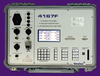
Tinsley Precision Instruments Portable Transformer Ratiometer 4167F

Description
Setting up the instrument is a simple case of typing in the vector group using the instrument front panel keypad and connecting to the offline transformer. All three phases are measured consecutively with connecting and short circuit procedures at the primary and secondary voltage terminals performed automatically before each measurement. It is also possible to measure just one phase if required. An adjustable set value permits the display of any error or deviation from the required transformation ratio. It is also possible for the 4167F to control the transformer tap changer and in this case all phases and taps are measured consecutively. Results can be stored internally using a transformer specific memory card, printed to an external printer or transferred to a PC via an RS232 interface. By using a memory card, pre-programmed for a specific transformer type, the instrument can be made to show a PASS / FAIL message with the actual reading. The transformer specific memory cards can be easily programmed via a personal computer using the built in card reader or by a cost efficient external card reader/writer directly connecting to a personal computer. A market unique feature is the automatic vector group detection. If all connections to the transformer have been made, the correct vector group will be detected. In case of missing a connection (1N or 2N e.g.) there will be up to three possible vector groups displayed to the user. Once the correct vector group has been selected the instruments learns this and that group will be presented first next time. The 4167F is connected to the H.V. and L.V. windings via four connections each. It also powers the transformer at a preset voltage supplied by an internal isolating transformer. However, external excitation using different voltages and frequencies is also possible. is its simplicity to set-up. The 4167F is housed in a robust carrying case. All connections are provided at the front panel of the instrument and are locked in order to avoid accidental disconnection during a measurement. An alarm-warning lamp is also available and will illuminate whilst a measurement is in progress.
Datasheet
Description
Setting up the instrument is a simple case of typing in the vector group using the instrument front panel keypad and connecting to the offline transformer. All three phases are measured consecutively with connecting and short circuit procedures at the primary and secondary voltage terminals performed automatically before each measurement. It is also possible to measure just one phase if required. An adjustable set value permits the display of any error or deviation from the required transformation ratio. It is also possible for the 4167F to control the transformer tap changer and in this case all phases and taps are measured consecutively. Results can be stored internally using a transformer specific memory card, printed to an external printer or transferred to a PC via an RS232 interface. By using a memory card, pre-programmed for a specific transformer type, the instrument can be made to show a PASS / FAIL message with the actual reading. The transformer specific memory cards can be easily programmed via a personal computer using the built in card reader or by a cost efficient external card reader/writer directly connecting to a personal computer. A market unique feature is the automatic vector group detection. If all connections to the transformer have been made, the correct vector group will be detected. In case of missing a connection (1N or 2N e.g.) there will be up to three possible vector groups displayed to the user. Once the correct vector group has been selected the instruments learns this and that group will be presented first next time. The 4167F is connected to the H.V. and L.V. windings via four connections each. It also powers the transformer at a preset voltage supplied by an internal isolating transformer. However, external excitation using different voltages and frequencies is also possible. is its simplicity to set-up. The 4167F is housed in a robust carrying case. All connections are provided at the front panel of the instrument and are locked in order to avoid accidental disconnection during a measurement. An alarm-warning lamp is also available and will illuminate whilst a measurement is in progress.
Datasheet

Suppliers

Company
Product
Description
Supplier Links
Portable Transformer Ratiometer - 4167F - Tinsley Precision Instruments
Braintree, United Kingdom
Portable Transformer Ratiometer
4167F
Portable Transformer Ratiometer 4167F
Setting up the instrument is a simple case of typing in the vector group using the instrument front panel keypad and connecting to the offline transformer. All three phases are measured consecutively with connecting and short circuit procedures at the primary and secondary voltage terminals performed automatically before each measurement. It is also possible to measure just one phase if required. An adjustable set value permits the display of any error or deviation from the required transformation ratio. It is also possible for the 4167F to control the transformer tap changer and in this case all phases and taps are measured consecutively. Results can be stored internally using a transformer specific memory card, printed to an external printer or transferred to a PC via an RS232 interface. By using a memory card, pre-programmed for a specific transformer type, the instrument can be made to show a PASS / FAIL message with the actual reading. The transformer specific memory cards can be easily programmed via a personal computer using the built in card reader or by a cost efficient external card reader/writer directly connecting to a personal computer. A market unique feature is the automatic vector group detection. If all connections to the transformer have been made, the correct vector group will be detected. In case of missing a connection (1N or 2N e.g.) there will be up to three possible vector groups displayed to the user. Once the correct vector group has been selected the instruments learns this and that group will be presented first next time. The 4167F is connected to the H.V. and L.V. windings via four connections each. It also powers the transformer at a preset voltage supplied by an internal isolating transformer. However, external excitation using different voltages and frequencies is also possible. is its simplicity to set-up. The 4167F is housed in a robust carrying case. All connections are provided at the front panel of the instrument and are locked in order to avoid accidental disconnection during a measurement. An alarm-warning lamp is also available and will illuminate whilst a measurement is in progress.

Setting up the instrument is a simple case of typing in the vector group using the instrument front panel keypad and connecting to the offline transformer. All three phases are measured consecutively
with connecting and short circuit procedures at the primary and secondary voltage terminals performed automatically before each measurement. It is also possible to measure just one phase if required.

An adjustable set value permits the display of any error or deviation from the required transformation ratio. It is also possible for the 4167F to control the transformer tap changer and in this case all phases and taps are measured consecutively. Results can be stored internally using a transformer specific memory card, printed to an external printer or transferred to a PC via an RS232 interface.

By using a memory card, pre-programmed for a specific transformer type, the instrument can be made to show a PASS / FAIL message with the actual reading.

The transformer specific memory cards can be easily programmed via a personal computer using the built in card reader or by a cost efficient external card reader/writer directly connecting to a personal computer.

A market unique feature is the automatic vector group detection. If all connections to the transformer have been made, the correct vector group will be detected. In case of missing a connection (1N or 2N e.g.) there will be up to three possible vector groups displayed to the user. Once the correct vector group has been selected the instruments learns this and that group will be presented first next time.

The 4167F is connected to the H.V. and L.V. windings via four connections each. It also powers the transformer at a preset voltage supplied by an internal isolating transformer. However, external excitation using different voltages and frequencies is also possible. is its simplicity to set-up.

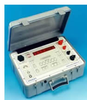
The 4167F is housed in a robust carrying case. All connections are provided at the front panel of the instrument and are locked in order to avoid accidental disconnection during a measurement. An alarm-warning lamp is also available and will illuminate whilst a measurement is in progress.

Supplier's Site Datasheet

Technical Specifications

  Tinsley Precision Instruments
Product Category Transformer Test Equipment
Product Number 4167F
Product Name Portable Transformer Ratiometer
Phase Three Phase
Form Factor Portable
Test Parameters Impedance Phase Angle; Turn Ratio; Deviance, Magnetising Current
Features Battery Powered; Computer Interface; Printer / Plotter Interface
Unlock Full Specs
to access all available technical data

Similar Products

Inductance Analyzer - 3255BQ - Wayne Kerr Electronics
Wayne Kerr Electronics
Specs
Phase SIngle Phase
Form Factor Stand Alone / Bench
Test Parameters Inductance
View Details
Current Transformer Test - CT Analyzer - OMICRON electronics Corp. USA
OMICRON electronics Corp. USA
Specs
Phase Three Phase
Form Factor Stand Alone / Bench
Test Parameters DC Resistance; Turn Ratio; Winding Polarity
View Details
Short Circuit Impedance Measurement Unit - ETP-4 - SMC International
Specs
Phase Three Phase
Form Factor Rack Mount
Test Parameters Impedance; Short Circuit Voltage Meter, Short Circuit Impedance
View Details
Comprehensive Transformer Testing System - 6235+7620 - Microtest Corporation
Specs
Form Factor Stand Alone / Bench
Test Parameters Capacitance; Impedance Phase Angle; Inductance; Quality Factor; Turn Ratio
Testing Frequency 1 MHz
View Details