AMETEK Brookfield Falling Ball Viscometer

Description
The Höppler principle is used to measure the viscosity of Newtonian liquid by measuring the time required for a ball to fall under gravity through a sample-filled tube that is inclined at an angle. The average time of three tests is taken; the result is converted into a viscosity value using a simple formula. FEATURES AND BENEFITS Pivot bearing allows for quick and easy tube rotation - ideal for repeat tests Connection to circulating bath for temperature control of sample Set of six balls to test a wide variety of samples Complete with temperature probe Accuracy 0.5% to 2.0% depending on ball being used
Datasheet
Description
The Höppler principle is used to measure the viscosity of Newtonian liquid by measuring the time required for a ball to fall under gravity through a sample-filled tube that is inclined at an angle. The average time of three tests is taken; the result is converted into a viscosity value using a simple formula. FEATURES AND BENEFITS Pivot bearing allows for quick and easy tube rotation - ideal for repeat tests Connection to circulating bath for temperature control of sample Set of six balls to test a wide variety of samples Complete with temperature probe Accuracy 0.5% to 2.0% depending on ball being used
Datasheet

Suppliers

Company
Product
Description
Supplier Links
Falling Ball Viscometer -  - AMETEK Brookfield
Middleboro, MA, USA
Falling Ball Viscometer
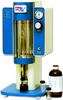
The Höppler principle is used to measure the viscosity of Newtonian liquid by measuring the time required for a ball to fall under gravity through a sample-filled tube that is inclined at an angle. The average time of three tests is taken; the result is converted into a viscosity value using a simple formula. FEATURES AND BENEFITS Pivot bearing allows for quick and easy tube rotation - ideal for repeat tests Connection to circulating bath for temperature control of sample Set of six balls to test a wide variety of samples Complete with temperature probe Accuracy 0.5% to 2.0% depending on ball being used

The Höppler principle is used to measure the viscosity of Newtonian liquid by measuring the time required for a ball to fall under gravity through a sample-filled tube that is inclined at an angle. The average time of three tests is taken; the result is converted into a viscosity value using a simple formula.

FEATURES AND BENEFITS

  • Pivot bearing allows for quick and easy tube rotation - ideal for repeat tests
  • Connection to circulating bath for temperature control of sample
  • Set of six balls to test a wide variety of samples
  • Complete with temperature probe
  • Accuracy 0.5% to 2.0% depending on ball being used
Supplier's Site Datasheet

Technical Specifications

  AMETEK Brookfield
Product Category Viscometers
Product Name Falling Ball Viscometer
Dynamic Viscosity Range 0.5000 to 70000 cps
Unlock Full Specs
to access all available technical data

Similar Products

Portable Kinematic Viscometer - MiniVisc 3000 - AMETEK Spectro Scientific
Specs
Kinematic Viscosity Range 1 to 700 cSt (1.08E-5 to 0.0075 ft²/sec)
Accuracy 3 ±% Full Scale
Display & Special Features Handheld, Portable or Field; Video
View Details
Continous Sensing Viscometer - DV2THB Extra - AMETEK Brookfield
Specs
Dynamic Viscosity Range 800 to 3.20E8 cps
Accuracy 1 ±% Full Scale
Technology / Test Method Rotational
View Details
Process Viscometer Sensor - SPC/L311 - Cambridge Viscosity by PAC
Cambridge Viscosity by PAC
Specs
Dynamic Viscosity Range 0.2000 to 20000 cps
Accuracy 1 ±% Full Scale
Technology / Test Method Electromagnetic Piston or Falling Ball; Other; Electromagnetically Driven Piston
View Details
B-One Touch Viscometer with L1-L4 Spindle Set -  - CSC Scientific Company, Inc.
Specs
Technology / Test Method Vibratory / Oscillating Viscometry
Display & Special Features PC Interface / Networkable
View Details