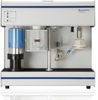
ZwickRoell LP Viscosity Measurement

Description
The term viscosity describes the flow behavior of fluid systems. By moving two fluid layers against each other the fluid movements create a resistance (stiffness and internal friction), referred to as flow resistance. Viscous forces are created by moving several layers of fluid at different velocities. This causes faster flowing layers to slow down and slower flowing layers to speed up. These processes follow the laws of physics and can be defined in equations whereby shear rate (velocity gradient) and shear modulus are factors. Viscosities are always dependent on temperature. For example, viscosity measurements are performed to optimize a paste-like substance with regard to consistency or to optimally adjust it for the production line.
Description
The term viscosity describes the flow behavior of fluid systems. By moving two fluid layers against each other the fluid movements create a resistance (stiffness and internal friction), referred to as flow resistance. Viscous forces are created by moving several layers of fluid at different velocities. This causes faster flowing layers to slow down and slower flowing layers to speed up. These processes follow the laws of physics and can be defined in equations whereby shear rate (velocity gradient) and shear modulus are factors. Viscosities are always dependent on temperature. For example, viscosity measurements are performed to optimize a paste-like substance with regard to consistency or to optimally adjust it for the production line.

Suppliers

Company
Product
Description
Supplier Links
Viscosity Measurement -  - ZwickRoell LP
Kennesaw, GA, United States
Viscosity Measurement
The term viscosity describes the flow behavior of fluid systems. By moving two fluid layers against each other the fluid movements create a resistance (stiffness and internal friction), referred to as flow resistance. Viscous forces are created by moving several layers of fluid at different velocities. This causes faster flowing layers to slow down and slower flowing layers to speed up. These processes follow the laws of physics and can be defined in equations whereby shear rate (velocity gradient) and shear modulus are factors. Viscosities are always dependent on temperature. For example, viscosity measurements are performed to optimize a paste-like substance with regard to consistency or to optimally adjust it for the production line.

The term viscosity describes the flow behavior of fluid systems. By moving two fluid layers against each other the fluid movements create a resistance (stiffness and internal friction), referred to as flow resistance. Viscous forces are created by moving several layers of fluid at different velocities. This causes faster flowing layers to slow down and slower flowing layers to speed up. These processes follow the laws of physics and can be defined in equations whereby shear rate (velocity gradient) and shear modulus are factors. Viscosities are always dependent on temperature. For example, viscosity measurements are performed to optimize a paste-like substance with regard to consistency or to optimally adjust it for the production line.

Supplier's Site

Technical Specifications

  ZwickRoell LP
Product Category Property Testing Equipment
Product Name Viscosity Measurement
Properties Analyzed Texture Analysis
Unlock Full Specs
to access all available technical data

Similar Products

Automatic Densometer - 4340N - Gurley Precision Instruments
Gurley Precision Instruments
Specs
Methods, Technology & Standards Mass flow and servo-regulator technology, automatic test feature, auto-drive mechanism
Properties Analyzed Texture Analysis; Flowability / Workability; Smoothness; Absorption / WaterAbsorption; Densometry / Pore Size
Test Media Textiles; Paper
View Details
Analytical Ferrography Laboratory - T2FM 500 - AMETEK Spectro Scientific
Specs
Properties Analyzed Wear / Abrasion
Test Media Fuel / Fuel Materials
Display & Special Features PC Interface / Networkable
View Details
PONTOS -  - Trilion Quality Systems
Trilion Quality Systems
View Details
Determination of Refractoriness Under Load (RUL) and Creep in Compression (CIC) of Refractory Ceramics: RUL/CIC 421 -  - NETZSCH-Gerätebau GmbH
Specs
Properties Analyzed Refractoriness Under Load (RUL), Creep in Compression (CIC)
Test Media Ceramics
Mounting / Loading Options Benchtop or Laboratory
View Details