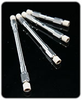
Western Analytical Products PolySULFOETHYL A Columns 102SE0501

Description
"This strong cation exchange (SCX) material was developed specifically for HPLC of peptides. At pH 2.7 - 3.0, peptides lose their (-) charges and have net (+) charge. They can be retained by a SCX column such as the PolySULFOETHY A. With a salt gradient, peptides elute in order of increasing number of basic residues. The selectivity complements that of Reversed-Phase (RPC). The capacity is 5 - 10 fold greater than that of RPC and when used in series SCX and RPC will yield sequenceable peptides from most crude mixtures. The hydrophilic aspartamide surface, when used with high organic mobile phases, allow mixed mode cation-exchange, combining SCX with hydrophilic interaction. Separation is achieved with electrostatic interaction and hydrophilic interaction. When To Use PolySULFOETHYL A: Mapping of peptides digests (tryptic, V-8, CNBR, etc) and isoforms. Purification of Synthetic peptides. Isolation of natural peptides from crude extracts. Specific isolation of disulfide-linked peptides from digests. Specific isolation of C-Terminal peptides. Assay of N-and C-terminal variant peptides and peptides with blocked termini. Quality control assay requiring a method orthogonal to RPC. Most SCX strong cation exchangers use Sulfopropyl (-SP) groups. The hydrophobic interactions are significant with such groups, often resulting in poor recovery and efficiency with hydrophobic peptides. By contrast, PolySULFOETHYL A is based on sulfoethyl groups, and recovery of peptides is generally high and quantitative."
Description
"This strong cation exchange (SCX) material was developed specifically for HPLC of peptides. At pH 2.7 - 3.0, peptides lose their (-) charges and have net (+) charge. They can be retained by a SCX column such as the PolySULFOETHY A. With a salt gradient, peptides elute in order of increasing number of basic residues. The selectivity complements that of Reversed-Phase (RPC). The capacity is 5 - 10 fold greater than that of RPC and when used in series SCX and RPC will yield sequenceable peptides from most crude mixtures. The hydrophilic aspartamide surface, when used with high organic mobile phases, allow mixed mode cation-exchange, combining SCX with hydrophilic interaction. Separation is achieved with electrostatic interaction and hydrophilic interaction. When To Use PolySULFOETHYL A: Mapping of peptides digests (tryptic, V-8, CNBR, etc) and isoforms. Purification of Synthetic peptides. Isolation of natural peptides from crude extracts. Specific isolation of disulfide-linked peptides from digests. Specific isolation of C-Terminal peptides. Assay of N-and C-terminal variant peptides and peptides with blocked termini. Quality control assay requiring a method orthogonal to RPC. Most SCX strong cation exchangers use Sulfopropyl (-SP) groups. The hydrophobic interactions are significant with such groups, often resulting in poor recovery and efficiency with hydrophobic peptides. By contrast, PolySULFOETHYL A is based on sulfoethyl groups, and recovery of peptides is generally high and quantitative."

Suppliers

Company
Product
Description
Supplier Links
Wildomar, CA, USA
PolySULFOETHYL A Columns
102SE0501
PolySULFOETHYL A Columns 102SE0501
"This strong cation exchange (SCX) material was developed specifically for HPLC of peptides. At pH 2.7 - 3.0, peptides lose their (-) charges and have net (+) charge. They can be retained by a SCX column such as the PolySULFOETHY A. With a salt gradient, peptides elute in order of increasing number of basic residues. The selectivity complements that of Reversed-Phase (RPC). The capacity is 5 - 10 fold greater than that of RPC and when used in series SCX and RPC will yield sequenceable peptides from most crude mixtures. The hydrophilic aspartamide surface, when used with high organic mobile phases, allow mixed mode cation-exchange, combining SCX with hydrophilic interaction. Separation is achieved with electrostatic interaction and hydrophilic interaction. When To Use PolySULFOETHYL A: Mapping of peptides digests (tryptic, V-8, CNBR, etc) and isoforms. Purification of Synthetic peptides. Isolation of natural peptides from crude extracts. Specific isolation of disulfide-linked peptides from digests. Specific isolation of C-Terminal peptides. Assay of N-and C-terminal variant peptides and peptides with blocked termini. Quality control assay requiring a method orthogonal to RPC. Most SCX strong cation exchangers use Sulfopropyl (-SP) groups. The hydrophobic interactions are significant with such groups, often resulting in poor recovery and efficiency with hydrophobic peptides. By contrast, PolySULFOETHYL A is based on sulfoethyl groups, and recovery of peptides is generally high and quantitative."

"This strong cation exchange (SCX) material was developed specifically for HPLC of peptides. At pH 2.7 - 3.0, peptides lose their (-) charges and have net (+) charge. They can be retained by a SCX column such as the PolySULFOETHY A. With a salt gradient, peptides elute in order of increasing number of basic residues. The selectivity complements that of Reversed-Phase (RPC). The capacity is 5 - 10 fold greater than that of RPC and when used in series SCX and RPC will yield sequenceable peptides from most crude mixtures.
The hydrophilic aspartamide surface, when used with high organic mobile phases, allow mixed mode cation-exchange, combining SCX with hydrophilic interaction. Separation is achieved with electrostatic interaction and hydrophilic interaction.
When To Use PolySULFOETHYL A:
Mapping of peptides digests (tryptic, V-8, CNBR, etc) and isoforms.
Purification of Synthetic peptides.
Isolation of natural peptides from crude extracts.
Specific isolation of disulfide-linked peptides from digests.
Specific isolation of C-Terminal peptides.
Assay of N-and C-terminal variant peptides and peptides with blocked termini.
Quality control assay requiring a method orthogonal to RPC.
Most SCX strong cation exchangers use Sulfopropyl (-SP) groups. The hydrophobic interactions are significant with such groups, often resulting in poor recovery and efficiency with hydrophobic peptides. By contrast, PolySULFOETHYL A is based on sulfoethyl groups, and recovery of peptides is generally high and quantitative."

Supplier's Site

Technical Specifications

  Western Analytical Products
Product Category HPLC Columns
Product Number 102SE0501
Product Name PolySULFOETHYL A Columns
Pore Diameter 0.0100 µm (3.94E-4 mils)
Unlock Full Specs
to access all available technical data

Similar Products

HxSil C18 Semiprep/Preparative Kit - 79137 - Hamilton Company
Specs
Column Type Guard
Stationary Phase/Separation Process Reversed Phase
Construction Material Stainless Steel
View Details
Specs
Packing Diameter 3 µm (0.1181 mils)
Pore Diameter 0.0120 µm (4.72E-4 mils)
Column Length 5 cm (1.97 inch)
View Details
Bio-Scale CHT20-I Column - 751-0027 - Bio-Rad Laboratories, Inc.
Bio-Rad Laboratories, Inc.
Specs
Column Type Analytical
View Details
4.6 mm Modular Column - 5041IV-05046-0033 - IDEX Health & Science
Specs
Column Type Analytical
Construction Material Stainless Steel
Column Length 3 cm (1.18 inch)
View Details