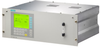

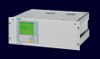
OXYMAT 64 can control the measurement of oxygen concentration in the smallest tracks, even down to the smallest measuring area of 0…10 ppm. This is for special interests in arrangements for the aerial decomposition, in the technical gas production and with the welding from high-alloy steel, titanium and others under protective atmosphere. Other application possibilities come up in hardening shops, in the chemical industry and the food industry.
OXYMAT 64 works with ZrO2 sensors, which is measuring gas with steady flow through a 650°C heated, pipe-shaped sensor. The outside of the sensor is put out in ambient air and works as an authoritative electrode. By the concentration differences on both sides rules a different partial pressure. Since ZrO2 is led electrically with 650°C, an ion wandering occurs in the direction of the lower partial pressure. A potential difference arises between both electrodes where a measurement of the oxygen concentration in the measuring gas is achieved.
Depending on the application a catalytic inactive ZrO2 sensor and a catalytic active ZrO2 sensor both available. Both sensors differ in the electrode material and react differently to ignitable accompanying components.
Both variations distinguish themselves in particular by their high linearity and, in addition, the series 6 offers all benefits, such as the intuitive operating draught and the open interface architecture.
Benefits
OXYMAT 64 | for trace oxygen
The OXYMAT 64 can measure oxygen concentrations in the smallest traces, even down to the minimal measuring range of 0...10 ppm. This is most relevant in air separation plants, in the technical gas production, and welding of high-alloy steels, titanium, and the like under a protective atmosphere. Further applications are realized in hardening shops, in the chemical industry, and in the food industry.
High linearity
The OXYMAT 64 operates with ZrO2 sensors. The sample gas flows through a tubular sensor which is heated to 650°C at a constant flow rate. The outside of the sensor is exposed to ambient air acting as a reference electrode. Due to the concentration differences on both sides, there is partial pressure that differs. Since ZrO2 is electrically conductive at 650 °C, an ion migration occurs towards of the lower partial pressure. This results in a potential difference between the two electrodes, which is a measure of the oxygen concentration in the sample gas.
Application-specific
Depending on the application, a catalytically inactive ZrO2 sensor and a catalytically active ZrO2 sensor are available. The two sensors differ in the electrode material and react differently to flammable accompanying components.
Both variants are characterized in particular by their high linearity and also offer all the advantages of the Series 6, such as the intuitive operating concept and the open interface architecture.
Benefits at a glance
| Siemens Analytical Products | Siemens Process Instrumentation | |
|---|---|---|
| Product Category | Gas Instruments | Gas Instruments |
| Product Number | OXYMAT 64 | OXYMAT 64 |
| Product Name | Extractive Gas Analyzer | Continuous Gas Analyzers |
| Measurement Type | Trace | |
| Application | Continuous Emissions Monitoring | Continuous Emissions Monitoring; Process Gas |
| Gas Types | O2; (0 to 100%) | O2; (Smallest measuring range 0–10 vpm) |
| Electrical Outputs | Current; Switch or Relay | Current |
| Display | Digital | Digital |