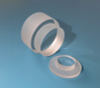
Shanghai Optics ZnSe Window

Description
A ZnSe window is an optical window formed of Zinc Selenide, a transparent, highly stable material. These windows feature extremely low IR absorption, and have a high resistance to thermal shock. Their transmission range is 0.5 μm – 22 μm. ZnSe optical windows are often used in Forward Looking Infrared (FLIR) and thermal imaging systems, and they can be used as resonator windows in high power CO2 laser systems at 10.6 microns. Zinc Selenide has a low dispersion and low absorption coefficient, and a density of 5.27 g/cm3. Its refractive index is near 2.4. It is non-hygroscopic, which means it won’t absorb moisture from the air. The Zinc Selenide ZnSe used in our windows is produced by a process called Chemical Vapor Deposition (CVD). This enables us to achieve the extreme purity needed for high powered optics: 99.999% purity. During the process, zinc vapor and H2Se gas react to form sheets of ZnSe on graphite susceptors. These polycrystalline ZnSe plates are then precisely tooled to form optical windows. Zinc Selenide optical windows must be handled with extreme care due to the materials softness: the Knoop number of ZnSe is 105. These optical components are not suitable for harsh environment. This same softness, however, makes them resilient to thermal shock. They can withstand thermally demanding environments and are chemically stable. This gives them importance in many applications including medical, industrial, and defense imaging. Handling and Cleaning of ZnSe Windows Because of the softness of the material, you should only handle a Zinc Selenide window by its edges. Apply uniform pressure to avoid warping. The utmost caution should be used while cleaning ZnSe optics to avoid scratching the soft surface. Dust or lint particles can typically be blown off with a dust free blower or air bulb. If further cleaning is needed, acetone or isopropyl alcohol may be used to clean the surface. While holding the optic by its edges, gently wipe the surface with a damp cotton ball. Do not rub, and do not exert pressure. Use only surgical-quality cotton balls. Zinc Selenide is toxic, and protective rubber gloves should be used whenever handling windows or lenses made of this substrate. Shanghai Optics Factory Standards for ZnSe Windows Our factory is subject to very high quality controls, and Zinc Selenide optics produced are carefully inspected to ensure it meets all standards. Our factory standard ensures a clear aperture of more than 85 %. Wavefront distortion is required to be no more than l/4 per 25mm. Shanghai Optics windows are available in a variety of different sizes and thicknesses. Diameter tolerance is defined as no more than +0.0, -0.05mm, and thickness tolerance no more than +/- 0.1mm. Both AR coated and noncoated options are available for Zinc Selenide windows. Our design team is experienced in working with clients in a wide variety of fields, and we would be happy to help you design the optical system that works best for your situation. Please contact us to discuss your custom specifications. Factory Standard Material: ZnSe Irregularity (fringe): l/4 Diameter Tolerance: +0.0, -0.05mm Thickness Tolerance: +/- 0.1mm Clear Aperture: >85% Parallelism: 5 arc min Surface Quality: 40-20 Wavefront Distortion: l/4 per 25mm Contact us for manufacturing limit or custom specifications.

Suppliers

Company
Product
Description
Supplier Links
ZnSe Window -  - Shanghai Optics
North Plainfield, NJ, United States
ZnSe Window
ZnSe Window
A ZnSe window is an optical window formed of Zinc Selenide, a transparent, highly stable material. These windows feature extremely low IR absorption, and have a high resistance to thermal shock. Their transmission range is 0.5 μm – 22 μm. ZnSe optical windows are often used in Forward Looking Infrared (FLIR) and thermal imaging systems, and they can be used as resonator windows in high power CO2 laser systems at 10.6 microns. Zinc Selenide has a low dispersion and low absorption coefficient, and a density of 5.27 g/cm3. Its refractive index is near 2.4. It is non-hygroscopic, which means it won’t absorb moisture from the air. The Zinc Selenide ZnSe used in our windows is produced by a process called Chemical Vapor Deposition (CVD). This enables us to achieve the extreme purity needed for high powered optics: 99.999% purity. During the process, zinc vapor and H2Se gas react to form sheets of ZnSe on graphite susceptors. These polycrystalline ZnSe plates are then precisely tooled to form optical windows. Zinc Selenide optical windows must be handled with extreme care due to the materials softness: the Knoop number of ZnSe is 105. These optical components are not suitable for harsh environment. This same softness, however, makes them resilient to thermal shock. They can withstand thermally demanding environments and are chemically stable. This gives them importance in many applications including medical, industrial, and defense imaging. Handling and Cleaning of ZnSe Windows Because of the softness of the material, you should only handle a Zinc Selenide window by its edges. Apply uniform pressure to avoid warping. The utmost caution should be used while cleaning ZnSe optics to avoid scratching the soft surface. Dust or lint particles can typically be blown off with a dust free blower or air bulb. If further cleaning is needed, acetone or isopropyl alcohol may be used to clean the surface. While holding the optic by its edges, gently wipe the surface with a damp cotton ball. Do not rub, and do not exert pressure. Use only surgical-quality cotton balls. Zinc Selenide is toxic, and protective rubber gloves should be used whenever handling windows or lenses made of this substrate. Shanghai Optics Factory Standards for ZnSe Windows Our factory is subject to very high quality controls, and Zinc Selenide optics produced are carefully inspected to ensure it meets all standards. Our factory standard ensures a clear aperture of more than 85 %. Wavefront distortion is required to be no more than l/4 per 25mm. Shanghai Optics windows are available in a variety of different sizes and thicknesses. Diameter tolerance is defined as no more than +0.0, -0.05mm, and thickness tolerance no more than +/- 0.1mm. Both AR coated and noncoated options are available for Zinc Selenide windows. Our design team is experienced in working with clients in a wide variety of fields, and we would be happy to help you design the optical system that works best for your situation. Please contact us to discuss your custom specifications. Factory Standard Material: ZnSe Irregularity (fringe): l/4 Diameter Tolerance: +0.0, -0.05mm Thickness Tolerance: +/- 0.1mm Clear Aperture: >85% Parallelism: 5 arc min Surface Quality: 40-20 Wavefront Distortion: l/4 per 25mm Contact us for manufacturing limit or custom specifications.

A ZnSe window is an optical window formed of Zinc Selenide, a transparent, highly stable material. These windows feature extremely low IR absorption, and have a high resistance to thermal shock. Their transmission range is 0.5 μm – 22 μm.

ZnSe optical windows are often used in Forward Looking Infrared (FLIR) and thermal imaging systems, and they can be used as resonator windows in high power CO2 laser systems at 10.6 microns. Zinc Selenide has a low dispersion and low absorption coefficient, and a density of 5.27 g/cm3. Its refractive index is near 2.4. It is non-hygroscopic, which means it won’t absorb moisture from the air.

The Zinc Selenide ZnSe used in our windows is produced by a process called Chemical Vapor Deposition (CVD). This enables us to achieve the extreme purity needed for high powered optics: 99.999% purity. During the process, zinc vapor and H2Se gas react to form sheets of ZnSe on graphite susceptors. These polycrystalline ZnSe plates are then precisely tooled to form optical windows.

Zinc Selenide optical windows must be handled with extreme care due to the materials softness: the Knoop number of ZnSe is 105. These optical components are not suitable for harsh environment. This same softness, however, makes them resilient to thermal shock. They can withstand thermally demanding environments and are chemically stable. This gives them importance in many applications including medical, industrial, and defense imaging.

Handling and Cleaning of ZnSe Windows

Because of the softness of the material, you should only handle a Zinc Selenide window by its edges. Apply uniform pressure to avoid warping. The utmost caution should be used while cleaning ZnSe optics to avoid scratching the soft surface. Dust or lint particles can typically be blown off with a dust free blower or air bulb. If further cleaning is needed, acetone or isopropyl alcohol may be used to clean the surface. While holding the optic by its edges, gently wipe the surface with a damp cotton ball. Do not rub, and do not exert pressure. Use only surgical-quality cotton balls.

Zinc Selenide is toxic, and protective rubber gloves should be used whenever handling windows or lenses made of this substrate.


Shanghai Optics Factory Standards for ZnSe Windows

Our factory is subject to very high quality controls, and Zinc Selenide optics produced are carefully inspected to ensure it meets all standards. Our factory standard ensures a clear aperture of more than 85 %. Wavefront distortion is required to be no more than l/4 per 25mm.

Shanghai Optics windows are available in a variety of different sizes and thicknesses. Diameter tolerance is defined as no more than +0.0, -0.05mm, and thickness tolerance no more than +/- 0.1mm. Both AR coated and noncoated options are available for Zinc Selenide windows.

Our design team is experienced in working with clients in a wide variety of fields, and we would be happy to help you design the optical system that works best for your situation. Please contact us to discuss your custom specifications.

Factory Standard

  • Material: ZnSe
  • Irregularity (fringe): l/4
  • Diameter Tolerance: +0.0, -0.05mm
  • Thickness Tolerance: +/- 0.1mm
  • Clear Aperture: >85%
  • Parallelism: 5 arc min
  • Surface Quality: 40-20
  • Wavefront Distortion: l/4 per 25mm

Contact us for manufacturing limit or custom specifications.

Supplier's Site

Technical Specifications

  Shanghai Optics
Product Category Optical Windows
Product Name ZnSe Window
Window Material Zinc Selenide
Unlock Full Specs
to access all available technical data

Similar Products

405nm Blue Laser Windows -  - Gurley Precision Instruments
Gurley Precision Instruments
Specs
Wavelength Range 405 nm (4050 Å)
Window Material Sapphire (optional feature); UV Grade Fused Silica (optional feature)
Windows Features No Coating
View Details
Optical Windows - Sapphire Windows - CeNing Optics Co., Ltd.
Specs
Window Type Plane
Window Material Sapphire
Windows Features Anti-Reflection Coating (optional feature)
View Details
BK7 Windows with Step -  - Changchun Yutai Optics Co., Ltd.
Changchun Yutai Optics Co., Ltd.
Specs
Window Material BK7 Glass
Parallelism or Wedge Angle 180 arcmin
Surface Quality 60-40 Scratch / Dig
View Details
Optical Window, Sapphire, 25.40 mm Diameter, 2.00 mm Thick - 10SW8-180 - Newport MKS
Specs
Window Material Sapphire; Sapphire
Windows Features No Coating
Coating Material Uncoated
View Details