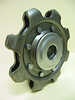
Renold Jeffrey Sprockets

Description
Renold manufacture a comprehensive range of stock sprockets for British Standard Chain up to two inch pitch. Other sizes of sprocket, including those to American Standard dimensions, are available on request. Special sprockets are also manufactured on request, in special materials or formats, normally to suit a specific application in harsh or difficult drive situations, examples being: Sprockets incorporating shafts Welded or detachable hubs Shear pin devices fitted Necklace sprockets made up of chain plates and individual tooth sections for turning large drums or tables. Combination sprockets (two or more sprockets combined having different pitch sizes and numbers of teeth). Sprockets in two or more sections, i.e. split sprockets or segmental sprockets. Sprocket and Chain Compatibility Most drives have an uneven number of pitches in the chain and by using a driver sprocket with an odd number of teeth, uniform wear distribution over both chain and sprocket teeth is ensured. Even numbers of teeth for both the driver and the driven sprockets can be used , but wear distribution on both the sprocket teeth and chain is poor. Number of Teeth The maximum number of teeth in any driven sprocket should not exceed 114. This limitation is due to the fact that for a given elongation of chain due to wear, the working pitch diameter of the chain on the sprocket increases in relation to the nominal pitch diameter, i.e. the chain assumes a higher position on the sprocket tooth. The allowable safe chain wear is considered to be in the order of 2% elongation over nominal length. A simple formula for determining how much chain elongation a sprocket can accommodate is 200/N expressed as a percentage where N is the number of teeth on the largest sprocket in the drive system.It is good practice to have the sum of teeth not less than 50 where both the driver and the driven sprockets are operated by the same chain, e.g. on a 1:1 ratio drive. Both sprockets should have 25 teeth each. Centre Distance For optimum wear life, centre distance between two sprockets should normally be within the range 30 to 50 times the chain pitch. On drive proposals with centre distances below 30 pitches or greater than 2m, we would recommend that the drive details are discussed with our technical staff. The minimum centre distance is sometimes governed by the amount of chain lap on the driver sprocket, our normal recommendation in this circumstance being not less than six teeth in engagement with the chain. The centre distance is also governed by the desirability of using a chain with an uneven number of pitches to avoid the use of a cranked link, a practice that is not recommended except in special circumstances. For a drive in the horizontal plane, the shortest centre distance possible should be used consonant with recommended chain lap (maximum six teeth) on the driver sprocket.
Description
Renold manufacture a comprehensive range of stock sprockets for British Standard Chain up to two inch pitch. Other sizes of sprocket, including those to American Standard dimensions, are available on request. Special sprockets are also manufactured on request, in special materials or formats, normally to suit a specific application in harsh or difficult drive situations, examples being: Sprockets incorporating shafts Welded or detachable hubs Shear pin devices fitted Necklace sprockets made up of chain plates and individual tooth sections for turning large drums or tables. Combination sprockets (two or more sprockets combined having different pitch sizes and numbers of teeth). Sprockets in two or more sections, i.e. split sprockets or segmental sprockets. Sprocket and Chain Compatibility Most drives have an uneven number of pitches in the chain and by using a driver sprocket with an odd number of teeth, uniform wear distribution over both chain and sprocket teeth is ensured. Even numbers of teeth for both the driver and the driven sprockets can be used , but wear distribution on both the sprocket teeth and chain is poor. Number of Teeth The maximum number of teeth in any driven sprocket should not exceed 114. This limitation is due to the fact that for a given elongation of chain due to wear, the working pitch diameter of the chain on the sprocket increases in relation to the nominal pitch diameter, i.e. the chain assumes a higher position on the sprocket tooth. The allowable safe chain wear is considered to be in the order of 2% elongation over nominal length. A simple formula for determining how much chain elongation a sprocket can accommodate is 200/N expressed as a percentage where N is the number of teeth on the largest sprocket in the drive system.It is good practice to have the sum of teeth not less than 50 where both the driver and the driven sprockets are operated by the same chain, e.g. on a 1:1 ratio drive. Both sprockets should have 25 teeth each. Centre Distance For optimum wear life, centre distance between two sprockets should normally be within the range 30 to 50 times the chain pitch. On drive proposals with centre distances below 30 pitches or greater than 2m, we would recommend that the drive details are discussed with our technical staff. The minimum centre distance is sometimes governed by the amount of chain lap on the driver sprocket, our normal recommendation in this circumstance being not less than six teeth in engagement with the chain. The centre distance is also governed by the desirability of using a chain with an uneven number of pitches to avoid the use of a cranked link, a practice that is not recommended except in special circumstances. For a drive in the horizontal plane, the shortest centre distance possible should be used consonant with recommended chain lap (maximum six teeth) on the driver sprocket.

Suppliers

Company
Product
Description
Supplier Links
Sprockets -  - Renold Jeffrey
Morristown, TN, USA
Sprockets
Sprockets
Renold manufacture a comprehensive range of stock sprockets for British Standard Chain up to two inch pitch. Other sizes of sprocket, including those to American Standard dimensions, are available on request. Special sprockets are also manufactured on request, in special materials or formats, normally to suit a specific application in harsh or difficult drive situations, examples being: Sprockets incorporating shafts Welded or detachable hubs Shear pin devices fitted Necklace sprockets made up of chain plates and individual tooth sections for turning large drums or tables. Combination sprockets (two or more sprockets combined having different pitch sizes and numbers of teeth). Sprockets in two or more sections, i.e. split sprockets or segmental sprockets. Sprocket and Chain Compatibility Most drives have an uneven number of pitches in the chain and by using a driver sprocket with an odd number of teeth, uniform wear distribution over both chain and sprocket teeth is ensured. Even numbers of teeth for both the driver and the driven sprockets can be used , but wear distribution on both the sprocket teeth and chain is poor. Number of Teeth The maximum number of teeth in any driven sprocket should not exceed 114. This limitation is due to the fact that for a given elongation of chain due to wear, the working pitch diameter of the chain on the sprocket increases in relation to the nominal pitch diameter, i.e. the chain assumes a higher position on the sprocket tooth. The allowable safe chain wear is considered to be in the order of 2% elongation over nominal length. A simple formula for determining how much chain elongation a sprocket can accommodate is 200/N expressed as a percentage where N is the number of teeth on the largest sprocket in the drive system.It is good practice to have the sum of teeth not less than 50 where both the driver and the driven sprockets are operated by the same chain, e.g. on a 1:1 ratio drive. Both sprockets should have 25 teeth each. Centre Distance For optimum wear life, centre distance between two sprockets should normally be within the range 30 to 50 times the chain pitch. On drive proposals with centre distances below 30 pitches or greater than 2m, we would recommend that the drive details are discussed with our technical staff. The minimum centre distance is sometimes governed by the amount of chain lap on the driver sprocket, our normal recommendation in this circumstance being not less than six teeth in engagement with the chain. The centre distance is also governed by the desirability of using a chain with an uneven number of pitches to avoid the use of a cranked link, a practice that is not recommended except in special circumstances. For a drive in the horizontal plane, the shortest centre distance possible should be used consonant with recommended chain lap (maximum six teeth) on the driver sprocket.
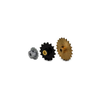
Renold manufacture a comprehensive range of stock sprockets for British Standard Chain up to two inch pitch. Other sizes of sprocket, including those to American Standard dimensions, are available on request. Special sprockets are also manufactured on request, in special materials or formats, normally to suit a specific application in harsh or difficult drive situations, examples being:

  • Sprockets incorporating shafts
  • Welded or detachable hubs
  • Shear pin devices fitted
  • Necklace sprockets made up of chain plates and individual tooth sections for turning large drums or tables.
  • Combination sprockets (two or more sprockets combined having different pitch sizes and numbers of teeth).
  • Sprockets in two or more sections, i.e. split sprockets or segmental sprockets.

Sprocket and Chain Compatibility
Most drives have an uneven number of pitches in the chain and by using a driver sprocket with an odd number of teeth, uniform wear distribution over both chain and sprocket teeth is ensured. Even numbers of teeth for both the driver and the driven sprockets can be used , but wear distribution on both the sprocket teeth and chain is poor.

Number of Teeth
The maximum number of teeth in any driven sprocket should not exceed
114. This limitation is due to the fact that for a given elongation of chain due to wear, the working pitch diameter of the chain on the sprocket increases in relation to the nominal pitch diameter, i.e. the chain assumes a higher position on the sprocket tooth. The allowable safe chain wear is considered to be in the order of 2% elongation over nominal length.

A simple formula for determining how much chain elongation a sprocket can accommodate is 200/N expressed as a percentage where N is the number of teeth on the largest sprocket in the drive system.It is good practice to have the sum of teeth not less than 50 where both the driver and the driven sprockets are operated by the same chain, e.g. on a 1:1 ratio drive. Both sprockets should have 25 teeth each.

Centre Distance

For optimum wear life, centre distance between two sprockets should normally be within the range 30 to 50 times the chain pitch. On drive proposals with centre distances below 30 pitches or greater than 2m, we would recommend that the drive details are discussed with our technical staff.
The minimum centre distance is sometimes governed by the amount of chain lap on the driver sprocket, our normal recommendation in this circumstance being not less than six teeth in engagement with the chain.

The centre distance is also governed by the desirability of using a chain with an uneven number of pitches to avoid the use of a cranked link, a practice that is not recommended except in special circumstances.
For a drive in the horizontal plane, the shortest centre distance possible should be used consonant with recommended chain lap (maximum six teeth) on the driver sprocket.
Supplier's Site

Technical Specifications

  Renold Jeffrey
Product Category ANSI Roller Chain Sprockets
Product Name Sprockets
Unlock Full Specs
to access all available technical data

Similar Products

0.25
Specs
Pitch 25 (1/4")
Material Carbon Steel
Number of Teeth 22
View Details
Stock Sprockets No.160 -  - Hangzhou Chinabase Machinery Co., Ltd.
Hangzhou Chinabase Machinery Co., Ltd.
Specs
Pitch 160 (2")
Hub Style Type A (Hubless); Type B (Hub One Side); Type C (Hub Both Sides)
Number of Teeth 8 to 80
View Details
Sprockets -  - Linn Gear Co.
Linn Gear Co.
Specs
Pitch Subminiature (<0.1475") (optional feature); Miniature (0.1475") (optional feature); 25 (1/4") (optional feature); 35 (3/8") (optional feature); 41 (1/2") (optional feature); 40 (1/2") (optional feature); 50 (5/8") (optional feature); 60 (3/4") (optional feature); 80 (1") (optional feature); 100 (1 1/4") (optional feature); 120 (1 1/2") (optional feature); 140 (1 3/4") (optional feature); 160 (2") (optional feature); 180 (2 1/4") (optional feature); 200 (2 1/2") (optional feature); 240 (3") (optional feature); 320 (4") (optional feature); 400 (5") (optional feature)
Material Steel - Hardened; Steel - Stainless; Steel
Hub Style Type A (Hubless) (optional feature); Type B (Hub One Side) (optional feature)
View Details
No. 100 - 1 1/4
U.S. Tsubaki Power Transmission, LLC
Specs
Pitch 100 (1 1/4")
Material Steel - Hardened
Hub Style Type B (Hub One Side)
View Details