Pyott-Boone Electronics (PBE Group) Gas Monitoring Model 931

Description
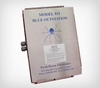
Present day coal mining usually involves either a longwall or multiple miners in several sections. The difference between the two is that the feeder for the belt in a miner section is usually located one to two breaks behind the face, while in a longwall mine the feeder is located at the face. This location is deemed a volatile location by MSHA and special precautions must be made in order to minimize the chance of any explosion. The use of a barrier type CO monitor in the past has been inconvenient to calibrate and the data cable often is damaged in the monorail causing distortions in the units signals. To avoid these problems Pyott-Boone developed an intrinsically safe barrier for the data signal and power supply for the Section CO monitor. The 931 / 932 or “Blue Outstation” permits the monitoring of Class G remotes situated in permissible areas (MSHA Approval #MMS-21-0). This unit is connected to the trunk line of the mine monitor system (MCS) and is available with 320 or 4800 BAUD communication. An input and output fiber optic board to separate Inby and Outby data signals. A U.P.S., with battery kill, to power the monitoring/warning device at the feeder. Barriers for the data power and shield cables. The ability to supply data and power to the 2100 series that have a communication port, to monitor the CO and/or Oxygen (MSHA approval pending) levels at the face. Use with the Pyott-Boone 320 BAUD (MSHA Approval #MMS-21-0) or 4800-BAUD (MSHA approval pending) systems. Compliance with MSHA regulations on a Blue type device for longwall sections. Isolation from damaged cable or units inby of Blue Outstation. Ease of installation. The ability to provide a section alarm with a digital display monitor. The additional sales from Pyott-Boone Electronics MSHA Approved (#P7K-SC-274109-MSHA ) Cable, installation fees, and/or other devices needed, such as, junction boxes, U.P.S. at the Headgate and/or a fiber optic link. Four Class G Barriers Works with the Model2103 MSHA Class G, Issue 113 CO Monitor 110 VAC Pennsylvania Approved (Pending) Model 931 320 BAUD Blue Outstation MSHA Evaluation #MMS-21-0 Model 932 4800 BAUD Blue Outstation MSHA Evaluation #MMS-21-0
Description
Present day coal mining usually involves either a longwall or multiple miners in several sections. The difference between the two is that the feeder for the belt in a miner section is usually located one to two breaks behind the face, while in a longwall mine the feeder is located at the face. This location is deemed a volatile location by MSHA and special precautions must be made in order to minimize the chance of any explosion. The use of a barrier type CO monitor in the past has been inconvenient to calibrate and the data cable often is damaged in the monorail causing distortions in the units signals. To avoid these problems Pyott-Boone developed an intrinsically safe barrier for the data signal and power supply for the Section CO monitor. The 931 / 932 or “Blue Outstation” permits the monitoring of Class G remotes situated in permissible areas (MSHA Approval #MMS-21-0). This unit is connected to the trunk line of the mine monitor system (MCS) and is available with 320 or 4800 BAUD communication. An input and output fiber optic board to separate Inby and Outby data signals. A U.P.S., with battery kill, to power the monitoring/warning device at the feeder. Barriers for the data power and shield cables. The ability to supply data and power to the 2100 series that have a communication port, to monitor the CO and/or Oxygen (MSHA approval pending) levels at the face. Use with the Pyott-Boone 320 BAUD (MSHA Approval #MMS-21-0) or 4800-BAUD (MSHA approval pending) systems. Compliance with MSHA regulations on a Blue type device for longwall sections. Isolation from damaged cable or units inby of Blue Outstation. Ease of installation. The ability to provide a section alarm with a digital display monitor. The additional sales from Pyott-Boone Electronics MSHA Approved (#P7K-SC-274109-MSHA ) Cable, installation fees, and/or other devices needed, such as, junction boxes, U.P.S. at the Headgate and/or a fiber optic link. Four Class G Barriers Works with the Model2103 MSHA Class G, Issue 113 CO Monitor 110 VAC Pennsylvania Approved (Pending) Model 931 320 BAUD Blue Outstation MSHA Evaluation #MMS-21-0 Model 932 4800 BAUD Blue Outstation MSHA Evaluation #MMS-21-0

Suppliers

Company
Product
Description
Supplier Links
Gas Monitoring - Model 931 - Pyott-Boone Electronics (PBE Group)
North Tazewell, VA, USA
Gas Monitoring
Model 931
Gas Monitoring Model 931
Present day coal mining usually involves either a longwall or multiple miners in several sections. The difference between the two is that the feeder for the belt in a miner section is usually located one to two breaks behind the face, while in a longwall mine the feeder is located at the face. This location is deemed a volatile location by MSHA and special precautions must be made in order to minimize the chance of any explosion. The use of a barrier type CO monitor in the past has been inconvenient to calibrate and the data cable often is damaged in the monorail causing distortions in the units signals. To avoid these problems Pyott-Boone developed an intrinsically safe barrier for the data signal and power supply for the Section CO monitor. The 931 / 932 or “Blue Outstation” permits the monitoring of Class G remotes situated in permissible areas (MSHA Approval #MMS-21-0). This unit is connected to the trunk line of the mine monitor system (MCS) and is available with 320 or 4800 BAUD communication. An input and output fiber optic board to separate Inby and Outby data signals. A U.P.S., with battery kill, to power the monitoring/warning device at the feeder. Barriers for the data power and shield cables. The ability to supply data and power to the 2100 series that have a communication port, to monitor the CO and/or Oxygen (MSHA approval pending) levels at the face. Use with the Pyott-Boone 320 BAUD (MSHA Approval #MMS-21-0) or 4800-BAUD (MSHA approval pending) systems. Compliance with MSHA regulations on a Blue type device for longwall sections. Isolation from damaged cable or units inby of Blue Outstation. Ease of installation. The ability to provide a section alarm with a digital display monitor. The additional sales from Pyott-Boone Electronics MSHA Approved (#P7K-SC-274109-MSHA ) Cable, installation fees, and/or other devices needed, such as, junction boxes, U.P.S. at the Headgate and/or a fiber optic link. Four Class G Barriers Works with the Model2103 MSHA Class G, Issue 113 CO Monitor 110 VAC Pennsylvania Approved (Pending) Model 931 320 BAUD Blue Outstation MSHA Evaluation #MMS-21-0 Model 932 4800 BAUD Blue Outstation MSHA Evaluation #MMS-21-0

Present day coal mining usually involves either a longwall or multiple miners in several sections. The difference between the two is that the feeder for the belt in a miner section is usually located one to two breaks behind the face, while in a longwall mine the feeder is located at the face. This location is deemed a volatile location by MSHA and special precautions must be made in order to minimize the chance of any explosion. The use of a barrier type CO monitor in the past has been inconvenient to calibrate and the data cable often is damaged in the monorail causing distortions in the units signals.

To avoid these problems Pyott-Boone developed an intrinsically safe barrier for the data signal and power supply for the Section CO monitor. The 931 / 932 or “Blue Outstation” permits the monitoring of Class G remotes situated in permissible areas (MSHA Approval #MMS-21-0). This unit is connected to the trunk line of the mine monitor system (MCS) and is available with 320 or 4800 BAUD communication.


  • An input and output fiber optic board to separate Inby and Outby data signals.
  • A U.P.S., with battery kill, to power the monitoring/warning device at the feeder.
  • Barriers for the data power and shield cables.
  • The ability to supply data and power to the 2100 series that have a communication port, to monitor the CO and/or Oxygen (MSHA approval pending) levels at the face.
  • Use with the Pyott-Boone 320 BAUD (MSHA Approval #MMS-21-0) or 4800-BAUD (MSHA approval pending) systems.
  • Compliance with MSHA regulations on a Blue type device for longwall sections.
  • Isolation from damaged cable or units inby of Blue Outstation.
  • Ease of installation.
  • The ability to provide a section alarm with a digital display monitor.
  • The additional sales from Pyott-Boone Electronics MSHA Approved (#P7K-SC-274109-MSHA) Cable, installation fees, and/or other devices needed, such as, junction boxes, U.P.S. at the Headgate and/or a fiber optic link.
  • Four Class G Barriers
  • Works with the Model2103 MSHA Class G, Issue 113 CO Monitor
  • 110 VAC
  • Pennsylvania Approved (Pending)

Model 931 320 BAUD

  • Blue Outstation
  • MSHA Evaluation
  • #MMS-21-0

Model 932 4800 BAUD

  • Blue Outstation
  • MSHA Evaluation
  • #MMS-21-0
Supplier's Site

Technical Specifications

  Pyott-Boone Electronics (PBE Group)
Product Category Gas Instruments
Product Number Model 931
Product Name Gas Monitoring
Application Confined Space Entry
Unlock Full Specs
to access all available technical data

Similar Products

Fixed Point Gas Detector - Vanguard WirelessHART® - United Electric Controls Company
Specs
Measurement Type %LEL or %LFL; Trace
Application Process Gas
Gas Types Toxic; Combustible; NH3; (0 - 100 ppm); CO; (0 - 500 ppm); H2S; (0 - 100 ppm); Methane (CH4) / Natural Gas; (0 to 100% LEL); (Propane (C3H8) 0 to 100% LEL)
View Details
Palm O2 Remote Handheld O2 Analyzer -  - Analytical Industries Inc.
Analytical Industries Inc.
Specs
Gas Types O2
Instrument Type Analyzer
Sensor Technology Electrochemical
View Details
BTU CalorVal Analyzer - Model 690 - Control Instruments Corp.
Control Instruments Corp.
Specs
Application Process Gas
Gas Types Combustible; Hydrocarbons; (0-1300 BTU/ft³)
Electrical Outputs Current
View Details
Advance Optima Series Continuous Gas Analyzer - AO2000 - ABB Measurement & Analytics
Specs
Measurement Type Trace
Gas Types CO2; (0-5/50 ppm); CO; (0-10/50 ppm); Hydrocarbons; (0-50/100/200/250/500 ppm); Methane (CH4) / Natural Gas; (0-50/100 ppm); NO; (0-75 ppm); NxOx; (0-20/50 ppm); SO2; (0-25/100 ppm); SF6; (0-1900/2000 ppm); Water Vapor; (0-500/1000 ppm)
Electrical Outputs Voltage
View Details