
OSI Optoelectronics X-Ray Photodiode XUV-005

Description
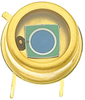
OSI Optoelectronics' 1990 R&D 100 award winning X-UV detector series are a unique class of silicon photodiodes designed for additional sensitivity in the X-Ray region of the electromagnetic spectrum without use of any scintillator crystals or screens. Over a wide range of sensitivity from 200 nm to 0.07 nm (6 eV to 17,600 eV), one electron-hole pair is created per 3.63eV of incident energy which corresponds to extremely high stable quantum efficiencies predicted by Eph/3.63eV (see graph below). For measurement of radiation energies above 17.6 keV, refer to the "fully Depleted High Speed and High Energy Radiation Detectors" section. A reverse bias can be applied to reduce the capacitance and increase speed of response. In the unbiased mode, these detectors can be used for applications requiring low noise and low drift. These detectors are also excellent choices for detecting light wavelengths between 350 to 100 nm. The detectors can be coupled to a charge sensitive preamplifier or low-noise op-amp as shown in the circuit on the opposite page.
Request a Quote Datasheet
Description
OSI Optoelectronics' 1990 R&D 100 award winning X-UV detector series are a unique class of silicon photodiodes designed for additional sensitivity in the X-Ray region of the electromagnetic spectrum without use of any scintillator crystals or screens. Over a wide range of sensitivity from 200 nm to 0.07 nm (6 eV to 17,600 eV), one electron-hole pair is created per 3.63eV of incident energy which corresponds to extremely high stable quantum efficiencies predicted by Eph/3.63eV (see graph below). For measurement of radiation energies above 17.6 keV, refer to the "fully Depleted High Speed and High Energy Radiation Detectors" section. A reverse bias can be applied to reduce the capacitance and increase speed of response. In the unbiased mode, these detectors can be used for applications requiring low noise and low drift. These detectors are also excellent choices for detecting light wavelengths between 350 to 100 nm. The detectors can be coupled to a charge sensitive preamplifier or low-noise op-amp as shown in the circuit on the opposite page.
Request a Quote Datasheet

Suppliers

Company
Product
Description
Supplier Links
X-Ray Photodiode - XUV-005 - OSI Optoelectronics
Hawthorne, CA, United States
X-Ray Photodiode
XUV-005
X-Ray Photodiode XUV-005
OSI Optoelectronics' 1990 R&D 100 award winning X-UV detector series are a unique class of silicon photodiodes designed for additional sensitivity in the X-Ray region of the electromagnetic spectrum without use of any scintillator crystals or screens. Over a wide range of sensitivity from 200 nm to 0.07 nm (6 eV to 17,600 eV), one electron-hole pair is created per 3.63eV of incident energy which corresponds to extremely high stable quantum efficiencies predicted by Eph/3.63eV (see graph below). For measurement of radiation energies above 17.6 keV, refer to the "fully Depleted High Speed and High Energy Radiation Detectors" section. A reverse bias can be applied to reduce the capacitance and increase speed of response. In the unbiased mode, these detectors can be used for applications requiring low noise and low drift. These detectors are also excellent choices for detecting light wavelengths between 350 to 100 nm. The detectors can be coupled to a charge sensitive preamplifier or low-noise op-amp as shown in the circuit on the opposite page.

OSI Optoelectronics' 1990 R&D 100 award winning X-UV detector series are a unique class of silicon photodiodes designed for additional sensitivity in the X-Ray region of the electromagnetic spectrum without use of any scintillator crystals or screens. Over a wide range of sensitivity from 200 nm to 0.07 nm (6 eV to 17,600 eV), one electron-hole pair is created per 3.63eV of incident energy which corresponds to extremely high stable quantum efficiencies predicted by Eph/3.63eV (see graph below). For measurement of radiation energies above 17.6 keV, refer to the "fully Depleted High Speed and High Energy Radiation Detectors" section. A reverse bias can be applied to reduce the capacitance and increase speed of response. In the unbiased mode, these detectors can be used for applications requiring low noise and low drift. These detectors are also excellent choices for detecting light wavelengths between 350 to 100 nm. The detectors can be coupled to a charge sensitive preamplifier or low-noise op-amp as shown in the circuit on the opposite page.

Supplier's Site Datasheet
Photodiodes - 2640-XUV-005-ND - DigiKey
Thief River Falls, MN, United States
Photodiodes
2640-XUV-005-ND
Photodiodes 2640-XUV-005-ND
SENSOR PHOTODIODE TO5

SENSOR PHOTODIODE TO5

Buy Now Datasheet

Technical Specifications

  OSI Optoelectronics DigiKey
Product Category Photodiodes Photodiodes
Product Number XUV-005 2640-XUV-005-ND
Product Name X-Ray Photodiode Photodiodes
Photodiode Type PIN Photodiode
Photodiode Spectral Response X-ray; UV
Spectral Response Range 200 to 1100 nm (2000 to 11000 Å) 350 to 1100 nm (3500 to 11000 Å)
Photodiode Material Silicon
Unlock Full Specs
to access all available technical data

Similar Products

Si photodiodes - S1226-8BK - Hamamatsu Photonics Europe
Hamamatsu Photonics Europe
Specs
Photodiode Spectral Response UV; Visible
Spectral Response Range 320 to 1000 nm (3200 to 10000 Å)
Peak Sensitivity Wavelength 720 nm (7200 Å)
View Details
Photodiodes - 2121833 - RS Components, Ltd.
RS Components, Ltd.
Specs
Photodiode Spectral Response IR
Peak Sensitivity Wavelength 5000 nm (50000 Å)
Photodiode Package Ceramic
View Details
Integrating Sphere Detector, Collimated Beam, 3.3 in., 800-1650 nm - 819C-IG-3.3-CAL2 - Newport MKS
Specs
Spectral Response Range 800 to 1650 nm (8000 to 16500 Å)
View Details
Photodiodes - 51-KPDA020P-H8-B-ND - DigiKey
California Eastern Laboratories - CEL
Specs
Photodiode Type Avalanche Photodiode
Spectral Response Range 400 to 1000 nm (4000 to 10000 Å)
Peak Sensitivity Wavelength 780 nm (7800 Å)
View Details