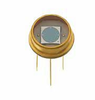
OSI Optoelectronics D Series, Metal Package PIN-3CDI

Description
The Photoconductive Detector Series are suitable for high speed and high sensitivity applications. The spectral range extends from 350 to 1100 nm, making these photodiodes ideal for visible and near IR applications, including such AC applications as detection of pulsed LASER sources, LEDs, or chopped light. To achieve high speeds, these detectors should be reverse biased. Typical response times from 10 ns can be achieved with a 10V reverse bias, for example. When a reverse bias is applied, capacitance decreases ( as seen in the figure below) corresponding directly to an increase in speed. As indicated in the specification table, the reverse bias should not exceed 30 volts. Higher bias voltages will result in permanent damage to the detector. Since a reverse bias generates additional dark current, the noise in the device will also increase with applied bias. For lower noise detectors, the Photovoltaic Series should be considered. Refer to the Photoconductive Mode (PC) paragraph in the "Photodiode Characteristics" section of this catalog for detailed information on electronics set up.
Request a Quote Datasheet
Description
The Photoconductive Detector Series are suitable for high speed and high sensitivity applications. The spectral range extends from 350 to 1100 nm, making these photodiodes ideal for visible and near IR applications, including such AC applications as detection of pulsed LASER sources, LEDs, or chopped light. To achieve high speeds, these detectors should be reverse biased. Typical response times from 10 ns can be achieved with a 10V reverse bias, for example. When a reverse bias is applied, capacitance decreases ( as seen in the figure below) corresponding directly to an increase in speed. As indicated in the specification table, the reverse bias should not exceed 30 volts. Higher bias voltages will result in permanent damage to the detector. Since a reverse bias generates additional dark current, the noise in the device will also increase with applied bias. For lower noise detectors, the Photovoltaic Series should be considered. Refer to the Photoconductive Mode (PC) paragraph in the "Photodiode Characteristics" section of this catalog for detailed information on electronics set up.
Request a Quote Datasheet

Suppliers

Company
Product
Description
Supplier Links
D Series, Metal Package - PIN-3CDI - OSI Optoelectronics
Hawthorne, CA, United States
D Series, Metal Package
PIN-3CDI
D Series, Metal Package PIN-3CDI
The Photoconductive Detector Series are suitable for high speed and high sensitivity applications. The spectral range extends from 350 to 1100 nm, making these photodiodes ideal for visible and near IR applications, including such AC applications as detection of pulsed LASER sources, LEDs, or chopped light. To achieve high speeds, these detectors should be reverse biased. Typical response times from 10 ns can be achieved with a 10V reverse bias, for example. When a reverse bias is applied, capacitance decreases ( as seen in the figure below) corresponding directly to an increase in speed. As indicated in the specification table, the reverse bias should not exceed 30 volts. Higher bias voltages will result in permanent damage to the detector. Since a reverse bias generates additional dark current, the noise in the device will also increase with applied bias. For lower noise detectors, the Photovoltaic Series should be considered. Refer to the Photoconductive Mode (PC) paragraph in the "Photodiode Characteristics" section of this catalog for detailed information on electronics set up.

The Photoconductive Detector Series are suitable for high speed and high sensitivity applications. The spectral range extends from 350 to 1100 nm, making these photodiodes ideal for visible and near IR applications, including such AC applications as detection of pulsed LASER sources, LEDs, or chopped light. To achieve high speeds, these detectors should be reverse biased. Typical response times from 10 ns can be achieved with a 10V reverse bias, for example. When a reverse bias is applied, capacitance decreases ( as seen in the figure below) corresponding directly to an increase in speed. As indicated in the specification table, the reverse bias should not exceed 30 volts. Higher bias voltages will result in permanent damage to the detector. Since a reverse bias generates additional dark current, the noise in the device will also increase with applied bias. For lower noise detectors, the Photovoltaic Series should be considered. Refer to the Photoconductive Mode (PC) paragraph in the "Photodiode Characteristics" section of this catalog for detailed information on electronics set up.

Supplier's Site Datasheet
Photodiodes - 1841647 - RS Components, Ltd.
Corby, Northants, United Kingdom
Photodiodes
1841647
Photodiodes 1841647
Photoconductive Si Photodiode,3.2mm2

Photoconductive Si Photodiode,3.2mm2

Supplier's Site
Photodiodes - 1841891 - RS Components, Ltd.
Corby, Northants, United Kingdom
Photodiodes
1841891
Photodiodes 1841891
Photoconductive Si Photodiode,3.2mm2

Photoconductive Si Photodiode,3.2mm2

Supplier's Site

Technical Specifications

  OSI Optoelectronics RS Components, Ltd. RS Components, Ltd.
Product Category Photodiodes Photodiodes Photodiodes
Product Number PIN-3CDI 1841647 1841891
Product Name D Series, Metal Package Photodiodes Photodiodes
Photodiode Type PIN Photodiode
Photodiode Spectral Response Visible; IR IR IR
Spectral Response Range 350 to 1100 nm (3500 to 11000 Å) 350 nm (3500 Å) 350 to 1100 nm (3500 to 11000 Å)
Peak Sensitivity Wavelength 970 nm (9700 Å) 970 nm (9700 Å) 970 nm (9700 Å)
Photodiode Material Silicon Silicon; Si
Unlock Full Specs
to access all available technical data

Similar Products

Photo IC for laser beam synchronous detection - S13114-01DT - Hamamatsu Photonics Europe
Specs
Photodiode Type PIN Photodiode
Number of Array Elements 1
View Details
Integrating Sphere Detector, Collimated Beam, 2.0 in., 400-1100 nm - 819C-SL-2-CAL2V2 - Newport MKS
Specs
Spectral Response Range 400 to 1100 nm (4000 to 11000 Å)
View Details
Photodiodes - 2121833 - RS Components, Ltd.
RS Components, Ltd.
Specs
Photodiode Spectral Response IR
Peak Sensitivity Wavelength 5000 nm (50000 Å)
Photodiode Package Ceramic
View Details
Photodiodes - 1125-1465-ND - DigiKey
Marktech Optoelectronics
Specs
Spectral Response Range 250 to 1750 nm (2500 to 17500 Å)
Photodiode Package THT; TO-39-3 Lens Top Metal Can
Sensitivity 0.4000 A/W
View Details