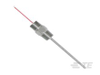
Nanmac Corporation High Temperature Probes w/ Tungsten Coating

Description
Often times a molybdenum sheathed thermocouple is used in a furnace with graphite liners or heating elements. At temperatures above 1,600 degrees Celsius, any graphite present emits dust molecules which attack the sheath and rapidly carburizes the sheath. This causes the sheath to become crystallized and porous. The thermal elements lose their protection and they also become crystallized and then break during cycling. Coating the protecting sheath with a thick layer of tungsten minimizes this Carburization process and extends the life of the probes significantly. Field tests at 2,000 degrees Celsius using the coated probes produced continuous temperature data up to 2 months (even during cycling) whereas the uncoated probes failed within hours of reaching temperature. Longer lifetimes were also experienced at temperatures below 2,000 degrees Celsius. note These thermocouples use #24 gauge (0.020”) size elements and molybdenum sheaths. Various adjustable compression fittings and mounting bushings are available. Duplex and multiple units also available (contact factory) When ordering, specify Part No. Length “L” and thermocouple type. Example: A12D-1-17-C Special designs available to suit your requirements.
Description
Often times a molybdenum sheathed thermocouple is used in a furnace with graphite liners or heating elements. At temperatures above 1,600 degrees Celsius, any graphite present emits dust molecules which attack the sheath and rapidly carburizes the sheath. This causes the sheath to become crystallized and porous. The thermal elements lose their protection and they also become crystallized and then break during cycling. Coating the protecting sheath with a thick layer of tungsten minimizes this Carburization process and extends the life of the probes significantly. Field tests at 2,000 degrees Celsius using the coated probes produced continuous temperature data up to 2 months (even during cycling) whereas the uncoated probes failed within hours of reaching temperature. Longer lifetimes were also experienced at temperatures below 2,000 degrees Celsius. note These thermocouples use #24 gauge (0.020”) size elements and molybdenum sheaths. Various adjustable compression fittings and mounting bushings are available. Duplex and multiple units also available (contact factory) When ordering, specify Part No. Length “L” and thermocouple type. Example: A12D-1-17-C Special designs available to suit your requirements.

Suppliers

Company
Product
Description
Supplier Links
High Temperature Probes w/ Tungsten Coating -  - Nanmac Corporation
Marlborough, MA, United States
High Temperature Probes w/ Tungsten Coating
Often times a molybdenum sheathed thermocouple is used in a furnace with graphite liners or heating elements. At temperatures above 1,600 degrees Celsius, any graphite present emits dust molecules which attack the sheath and rapidly carburizes the sheath. This causes the sheath to become crystallized and porous. The thermal elements lose their protection and they also become crystallized and then break during cycling. Coating the protecting sheath with a thick layer of tungsten minimizes this Carburization process and extends the life of the probes significantly. Field tests at 2,000 degrees Celsius using the coated probes produced continuous temperature data up to 2 months (even during cycling) whereas the uncoated probes failed within hours of reaching temperature. Longer lifetimes were also experienced at temperatures below 2,000 degrees Celsius. note These thermocouples use #24 gauge (0.020”) size elements and molybdenum sheaths. Various adjustable compression fittings and mounting bushings are available. Duplex and multiple units also available (contact factory) When ordering, specify Part No. Length “L” and thermocouple type. Example: A12D-1-17-C Special designs available to suit your requirements.

Often times a molybdenum sheathed thermocouple is used in a furnace with graphite liners or heating elements. At temperatures above 1,600 degrees Celsius, any graphite present emits dust molecules which attack the sheath and rapidly carburizes the sheath. This causes the sheath to become crystallized and porous. The thermal elements lose their protection and they also become crystallized and then break during cycling. Coating the protecting sheath with a thick layer of tungsten minimizes this Carburization process and extends the life of the probes significantly. Field tests at 2,000 degrees Celsius using the coated probes produced continuous temperature data up to 2 months (even during cycling) whereas the uncoated probes failed within hours of reaching temperature. Longer lifetimes were also experienced at temperatures below 2,000 degrees Celsius.


    note
  • These thermocouples use #24 gauge (0.020”) size elements and molybdenum sheaths.
  • Various adjustable compression fittings and mounting bushings are available.
  • Duplex and multiple units also available (contact factory)
  • When ordering, specify Part No. Length “L” and thermocouple type. Example: A12D-1-17-C
  • Special designs available to suit your requirements.
Supplier's Site

Technical Specifications

  Nanmac Corporation
Product Category Thermocouple Temperature Probes
Product Name High Temperature Probes w/ Tungsten Coating
Base, Noble and Refractory Metal Type B (optional feature); S (optional feature); R (optional feature); C (optional feature)
Unlock Full Specs
to access all available technical data

Similar Products

Thermocouple Sensors - R-13022-1 - TE Connectivity
Specs
Base, Noble and Refractory Metal Type T
View Details
Temperature Measurement in Liquids, Cooling water tube thermocouple -  - SAB BRÖCKSKES GmbH & Co. KG
Specs
Base, Noble and Refractory Metal Type J; K
Diameter or Width Range 0.0591 inch (1.5 mm)
View Details
Spike Thermocouple -  - Conax Technologies
Conax Technologies
Specs
Base, Noble and Refractory Metal Type K; N; B; S; R
Probe Configuration Straight Probe
Probe Features Available as an Assembly
View Details
Industrial Thermocouples Sheath with Teflon or Fiberglass Leadwire and Stripped Ends - THERMOCOUPLE STYLES 02, 04, 28 - United Electric Controls Company
Specs
Configuration Grounded Thermocouple (optional feature); Ungrounded Thermocouple (optional feature); Exposed Thermocouple (optional feature)
Base, Noble and Refractory Metal Type E (optional feature); J (optional feature); K (optional feature); T (optional feature)
Element Configuration Double Element (optional feature)
View Details