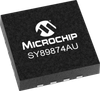
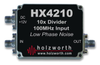
This low-skew, low-jitter device can accept a high-speed (622MHz or higher) LVTTL, LVCMOS, CML, LVPECL, LVDS or HSTL clock input signal and divide down the frequency using a programmable divider ratio to create a frequency-locked, lower speed version of the input clock. Available divider ratios are 2, 4, 8, and 16, or straight pass-through. In a typical 622MHz clock system this would provide availability of 311MHz, 155MHz, 77MHz, or 38MHz auxiliary clock components. The differential input buffer has a unique internal termination design that allows access to the termination network through a VT pin. This feature allows the device to easily interface to different logic standards. A VREF-AC reference is included for AC-coupled applications.The /RESET input asynchronously resets the divider. In the pass-through function (divide by 1) the /RESET synchronously enables or disables the outputs on the next falling edge of IN (rising edge of /N).Use the SY89874U version, which has a wider input range, to DC-couple low offset differential signals.
Additional Features
Integrated programmable clock divider and 1:2 fanout buffer
Guaranteed AC performance over temperature and voltage:
>2.5GHz fMAX
<250ps tr/tf
<15ps within-device skew
Low jitter design
<1psRMS cycle-to-cycle jitter
<10psPP total jitter
Unique input termination and VT pin for DC-coupled and AC-coupled Inputs; LVCMOS, LVTTL, CML, PECL, LVDS, and HSTL
TTL/CMOS inputs for select and reset
100k EP-compatible LVPECL outputs
Parallel programming capability
Programmable divider ratios of 1, 2, 4, 8, and 16
Low-voltage operation 2.5V or 3.3V
Output disable function
-40°C to +85°C temperature range
Available in 16-pin (3mm x 3mm) QFN package
This low-skew, low-jitter device can accept a high-speed (622MHz or higher) LVTTL, LVCMOS, CML, LVPECL, LVDS or HSTL clock input signal and divide down the frequency using a programmable divider ratio to create a frequency-locked, lower speed version of the input clock. Available divider ratios are 2, 4, 8, and 16, or straight pass-through. In a typical 622MHz clock system this would provide availability of 311MHz, 155MHz, 77MHz, or 38MHz auxiliary clock components.
The differential input buffer has a unique internal termination design that allows access to the termination network through a VT pin. This feature allows the device to easily interface to different logic standards. A VREF-AC reference is included for AC-coupled applications.The /RESET input asynchronously resets the divider. In the pass-through function (divide by 1) the /RESET synchronously enables or disables the outputs on the next falling edge of IN (rising edge of /N).Use the SY89874U version, which has a wider input range, to DC-couple low offset differential signals.
Additional Features
- Integrated programmable clock divider and 1:2 fanout buffer
- Guaranteed AC performance over temperature and voltage:
- >2.5GHz fMAX
- <250ps tr/tf
- <15ps within-device skew
- Low jitter design
- <1psRMS cycle-to-cycle jitter
- <10psPP total jitter
- Unique input termination and VT pin for DC-coupled and AC-coupled Inputs; LVCMOS, LVTTL, CML, PECL, LVDS, and HSTL
- TTL/CMOS inputs for select and reset
- 100k EP-compatible LVPECL outputs
- Parallel programming capability
- Programmable divider ratios of 1, 2, 4, 8, and 16
- Low-voltage operation 2.5V or 3.3V
- Output disable function
- -40°C to +85°C temperature range
- Available in 16-pin (3mm x 3mm) QFN package