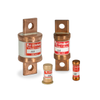
Littelfuse, Inc. UL Class T Fast-Acting Fuse JLLS100P

Description
Space-saving Class T fuses are the most compact fuses available in ratings above 30 amperes — less than one-third the size of comparable Class R fuses. When rated in accordance with the NEC, Class T fuses provide fast-acting overload and short circuit protection for non-inductive circuits and equipment. Used in inductive circuits, the ampere rating of Class T fuses must be increased to prevent opening on inrush currents. In such instances, Class T fuses may provide only short circuit protection. For motor and general purpose circuits where space is not critical, we recommend POWR-PRO™ JTD_ID Indicator series, LLNRK/LLSRK series, or FLSR_ID Indicator series.Space Saving: Typical three-pole Class T fuse blocks require less than 50% of the panel area required for Class R fuse blocks. Switch enclosures, fuse pullouts, and other equipment using Class T fuses are often correspondingly more compact. Safety: 200,000 A.I.R. — Reliable interruption of all overcurrents up to 200,000 amperes. Extremely current limiting — Stops damaging short circuit current faster than any mechanical protective device. Fast-Acting — Provides fast-acting overload protection to equipment such as variable speed drives, rectifiers and other equipment containing surge-sensitive components. Longer Equipment Life: Current limiting design greatly reduces damage to equipment caused by heating and magnetic effects of short circuit currents. Economical: Extremely current limiting design often permits use of readily available, less costly equipment. Used as input or output fuses for surge-sensitive components, such as variable speed drives and rectifiers, fast-acting Class T JLLS fuses may prevent opening of expensive semiconductor fuses protecting individual components.
Datasheet
Description
Space-saving Class T fuses are the most compact fuses available in ratings above 30 amperes — less than one-third the size of comparable Class R fuses. When rated in accordance with the NEC, Class T fuses provide fast-acting overload and short circuit protection for non-inductive circuits and equipment. Used in inductive circuits, the ampere rating of Class T fuses must be increased to prevent opening on inrush currents. In such instances, Class T fuses may provide only short circuit protection. For motor and general purpose circuits where space is not critical, we recommend POWR-PRO™ JTD_ID Indicator series, LLNRK/LLSRK series, or FLSR_ID Indicator series.Space Saving: Typical three-pole Class T fuse blocks require less than 50% of the panel area required for Class R fuse blocks. Switch enclosures, fuse pullouts, and other equipment using Class T fuses are often correspondingly more compact. Safety: 200,000 A.I.R. — Reliable interruption of all overcurrents up to 200,000 amperes. Extremely current limiting — Stops damaging short circuit current faster than any mechanical protective device. Fast-Acting — Provides fast-acting overload protection to equipment such as variable speed drives, rectifiers and other equipment containing surge-sensitive components. Longer Equipment Life: Current limiting design greatly reduces damage to equipment caused by heating and magnetic effects of short circuit currents. Economical: Extremely current limiting design often permits use of readily available, less costly equipment. Used as input or output fuses for surge-sensitive components, such as variable speed drives and rectifiers, fast-acting Class T JLLS fuses may prevent opening of expensive semiconductor fuses protecting individual components.
Datasheet

Suppliers

Company
Product
Description
Supplier Links
UL Class T Fast-Acting Fuse - JLLS100P - Littelfuse, Inc.
Rosemont, IL, United States
UL Class T Fast-Acting Fuse
JLLS100P
UL Class T Fast-Acting Fuse JLLS100P
Space-saving Class T fuses are the most compact fuses available in ratings above 30 amperes — less than one-third the size of comparable Class R fuses. When rated in accordance with the NEC, Class T fuses provide fast-acting overload and short circuit protection for non-inductive circuits and equipment. Used in inductive circuits, the ampere rating of Class T fuses must be increased to prevent opening on inrush currents. In such instances, Class T fuses may provide only short circuit protection. For motor and general purpose circuits where space is not critical, we recommend POWR-PRO™ JTD_ID Indicator series, LLNRK/LLSRK series, or FLSR_ID Indicator series.Space Saving: Typical three-pole Class T fuse blocks require less than 50% of the panel area required for Class R fuse blocks. Switch enclosures, fuse pullouts, and other equipment using Class T fuses are often correspondingly more compact. Safety: 200,000 A.I.R. — Reliable interruption of all overcurrents up to 200,000 amperes. Extremely current limiting — Stops damaging short circuit current faster than any mechanical protective device. Fast-Acting — Provides fast-acting overload protection to equipment such as variable speed drives, rectifiers and other equipment containing surge-sensitive components. Longer Equipment Life: Current limiting design greatly reduces damage to equipment caused by heating and magnetic effects of short circuit currents. Economical: Extremely current limiting design often permits use of readily available, less costly equipment. Used as input or output fuses for surge-sensitive components, such as variable speed drives and rectifiers, fast-acting Class T JLLS fuses may prevent opening of expensive semiconductor fuses protecting individual components.

Space-saving Class T fuses are the most compact fuses available in ratings above 30 amperes — less than one-third the size of comparable Class R fuses. When rated in accordance with the NEC, Class T fuses provide fast-acting overload and short circuit protection for non-inductive circuits and equipment. Used in inductive circuits, the ampere rating of Class T fuses must be increased to prevent opening on inrush currents. In such instances, Class T fuses may provide only short circuit protection. For motor and general purpose circuits where space is not critical, we recommend POWR-PRO™ JTD_ID Indicator series, LLNRK/LLSRK series, or FLSR_ID Indicator series.Space Saving: Typical three-pole Class T fuse blocks require less than 50% of the panel area required for Class R fuse blocks. Switch enclosures, fuse pullouts, and other equipment using Class T fuses are often correspondingly more compact. Safety: 200,000 A.I.R. — Reliable interruption of all overcurrents up to 200,000 amperes. Extremely current limiting — Stops damaging short circuit current faster than any mechanical protective device. Fast-Acting — Provides fast-acting overload protection to equipment such as variable speed drives, rectifiers and other equipment containing surge-sensitive components. Longer Equipment Life: Current limiting design greatly reduces damage to equipment caused by heating and magnetic effects of short circuit currents. Economical: Extremely current limiting design often permits use of readily available, less costly equipment. Used as input or output fuses for surge-sensitive components, such as variable speed drives and rectifiers, fast-acting Class T JLLS fuses may prevent opening of expensive semiconductor fuses protecting individual components.

Datasheet

Technical Specifications

  Littelfuse, Inc.
Product Category Fuses
Product Number JLLS100P
Product Name UL Class T Fast-Acting Fuse
Mounting Fuse Block / Clip / Holder
Unlock Full Specs
to access all available technical data

Similar Products

Power supply module for electronic circuit breaker - DF2101 - ifm efector inc.
Specs
Mounting Mounting on DIN rail; (TH35 (EN 60715))
Operating Temperature -25 to 60 C (-13 to 140 F)
Rated Voltage 30 volts
View Details
International Fuse Time Lag 63mA - 81412161 - Interpower
Specs
Fuse Material Glass; Glass
Features Time Lag
Operating Temperature -25 to 70 C (-13 to 158 F)
View Details