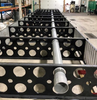

Duct Bank Spacers are used to maintain conduit spacing during the installation of underground telecommunications, utilities, and power lines (duct banks). They also help support the conduits to prevent slumping/bowing, reducing the friction caused when pulling the telecom, utility, and power line. They often are concrete encased to prevent future diggers from accidentally hitting, cutting, or damaging them. When they are concrete encased, they require rebar and forming to help support the concrete (slurry). Concrete encasement is especially important when installing uninterrupted power supply (UPS). UPS is required in any building that cannot afford to lose power, telecom, or utilities. Common examples are Data Centers, Jails, Water Treatment Plants, Manufacturing Facilities, Hospitals, Schools.
They also can be directly buried or DB. DB duct banks are just duct banks that are backfilled with dirt vs using concrete.
There are different types of duct bank spacers, but the most common are called chairs or intermediate and base spacers. These spacers require you to snap together, band or tie. They are very tedious and often snap under the pressure of the concrete.
Require less time to assemble than traditional chairs, can be made to fit any engineered layout, reduces the number of hours spent in hazardous environments such as the trench, can be pre-assembled which can reduce expensive mistakes or labor costs, and increases accuracy with correct conduit configurations, spacing, and sizes.
Duct Bank Spacers are used to maintain conduit spacing during installation of underground telecommunications, utilities, and power lines (duct banks). They also help support the conduits to prevent slumping / bowing, reducing friction caused when pulling the telecom, utility, and power line.
| Laird Plastics, Inc. | |
|---|---|
| Product Category | Fabricated Plastic Parts and Semi-Finished Shapes |
| Product Name | TrenchSafe: Duct Spacers |
| Industry |
Duct Bank Spacers are used to maintain conduit spacing during installation of underground telecommunications, utilities, and power lines. |