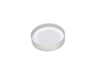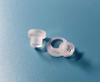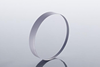
Knight Optical (UK) Ltd Sapphire (Random Cut) Window 50mmdia x 1mmthk WHS5011

Description
Sapphire (Al2O3) is one of the hardest minerals and optical materials available for use in the range from UV up to 5µm. Sapphire is birefringent and if its use is for critical optical application then the crystal might have to be cut along the zero degree plane, or C-Cut. Random cut is usually cut along a plane that is 60° off-axis as the growth in this direction is the easiest to grow. Random cut is anything that is not the C-Cut angle. Sapphire can fluoresce depending upon the concentration of other minerals within the lattice, for example Iron (Fe) or Chromium (Cr). Clear Sapphire might fluoresce orange when illuminated by UV light if impurities are in the crystal. Fluorescent free Sapphire has to be grown from 'pure' feedstock and seed and in an environment that cannot place impurities into the lattice ... Sapphire is grown by various methods from seed samples. Sapphire can be polished to a high standard, but as it is the second hardest mineral on Earth it must be subject to high forces to polish. Therefore, windows made from Sapphire must have a thickness to diameter ratio of at least 10:1, that is, greater than 10mm thick for a 100mm diameter disk. Sapphire is inert and resistant to attack from most processing environments, such as hydrofluoric acid. Sapphire has a melting point over 2000°C with a high thermal conductivity makes it suitable for use in harsh environments. Sapphire is ideal for use as a window where high radiation resistance is required from the UV to about 5µm. It can be used to form doublet lenses with Silicon and Zinc Selenide for the MWIR (3 to 5µm). These optics can be used to, for example, detect missile plumes that emit the 3-5 µm range and shorter, wavelengths. The detection of muzzle flash from a sniper can be 'seen' by use of optics in this MWIR waveband. The detection of snipers is of great importance in, for example, Afghanistan, as many military lives are being lost to snipers. The gun flash from a rifle has a distinct spectral distribution from the hot gases that are emitted. These gasses are, for example, CO and H2 together with CO2, N2 and H2O that produce distinct emissions in the 3 to 5µm band. For more information on our stock range of sapphire windows, or to enquire about a custom quotation, please contact our technical sales team. Read more
Datasheet
Description
Sapphire (Al2O3) is one of the hardest minerals and optical materials available for use in the range from UV up to 5µm. Sapphire is birefringent and if its use is for critical optical application then the crystal might have to be cut along the zero degree plane, or C-Cut. Random cut is usually cut along a plane that is 60° off-axis as the growth in this direction is the easiest to grow. Random cut is anything that is not the C-Cut angle. Sapphire can fluoresce depending upon the concentration of other minerals within the lattice, for example Iron (Fe) or Chromium (Cr). Clear Sapphire might fluoresce orange when illuminated by UV light if impurities are in the crystal. Fluorescent free Sapphire has to be grown from 'pure' feedstock and seed and in an environment that cannot place impurities into the lattice ... Sapphire is grown by various methods from seed samples. Sapphire can be polished to a high standard, but as it is the second hardest mineral on Earth it must be subject to high forces to polish. Therefore, windows made from Sapphire must have a thickness to diameter ratio of at least 10:1, that is, greater than 10mm thick for a 100mm diameter disk. Sapphire is inert and resistant to attack from most processing environments, such as hydrofluoric acid. Sapphire has a melting point over 2000°C with a high thermal conductivity makes it suitable for use in harsh environments. Sapphire is ideal for use as a window where high radiation resistance is required from the UV to about 5µm. It can be used to form doublet lenses with Silicon and Zinc Selenide for the MWIR (3 to 5µm). These optics can be used to, for example, detect missile plumes that emit the 3-5 µm range and shorter, wavelengths. The detection of muzzle flash from a sniper can be 'seen' by use of optics in this MWIR waveband. The detection of snipers is of great importance in, for example, Afghanistan, as many military lives are being lost to snipers. The gun flash from a rifle has a distinct spectral distribution from the hot gases that are emitted. These gasses are, for example, CO and H2 together with CO2, N2 and H2O that produce distinct emissions in the 3 to 5µm band. For more information on our stock range of sapphire windows, or to enquire about a custom quotation, please contact our technical sales team. Read more
Datasheet

Suppliers

Company
Product
Description
Supplier Links
Sapphire (Random Cut) Window 50mmdia x 1mmthk - WHS5011 - Knight Optical (UK) Ltd
Harrietsham, United Kingdom
Sapphire (Random Cut) Window 50mmdia x 1mmthk
WHS5011
Sapphire (Random Cut) Window 50mmdia x 1mmthk WHS5011
Sapphire (Al2O3) is one of the hardest minerals and optical materials available for use in the range from UV up to 5µm. Sapphire is birefringent and if its use is for critical optical application then the crystal might have to be cut along the zero degree plane, or C-Cut. Random cut is usually cut along a plane that is 60° off-axis as the growth in this direction is the easiest to grow. Random cut is anything that is not the C-Cut angle. Sapphire can fluoresce depending upon the concentration of other minerals within the lattice, for example Iron (Fe) or Chromium (Cr). Clear Sapphire might fluoresce orange when illuminated by UV light if impurities are in the crystal. Fluorescent free Sapphire has to be grown from 'pure' feedstock and seed and in an environment that cannot place impurities into the lattice ... Sapphire is grown by various methods from seed samples. Sapphire can be polished to a high standard, but as it is the second hardest mineral on Earth it must be subject to high forces to polish. Therefore, windows made from Sapphire must have a thickness to diameter ratio of at least 10:1, that is, greater than 10mm thick for a 100mm diameter disk. Sapphire is inert and resistant to attack from most processing environments, such as hydrofluoric acid. Sapphire has a melting point over 2000°C with a high thermal conductivity makes it suitable for use in harsh environments. Sapphire is ideal for use as a window where high radiation resistance is required from the UV to about 5µm. It can be used to form doublet lenses with Silicon and Zinc Selenide for the MWIR (3 to 5µm). These optics can be used to, for example, detect missile plumes that emit the 3-5 µm range and shorter, wavelengths. The detection of muzzle flash from a sniper can be 'seen' by use of optics in this MWIR waveband. The detection of snipers is of great importance in, for example, Afghanistan, as many military lives are being lost to snipers. The gun flash from a rifle has a distinct spectral distribution from the hot gases that are emitted. These gasses are, for example, CO and H2 together with CO2, N2 and H2O that produce distinct emissions in the 3 to 5µm band. For more information on our stock range of sapphire windows, or to enquire about a custom quotation, please contact our technical sales team. Read more

Sapphire (Al2O3) is one of the hardest minerals and optical materials available for use in the range from UV up to 5µm. Sapphire is birefringent and if its use is for critical optical application then the crystal might have to be cut along the zero degree plane, or C-Cut. Random cut is usually cut along a plane that is 60° off-axis as the growth in this direction is the easiest to grow. Random cut is anything that is not the C-Cut angle. Sapphire can fluoresce depending upon the concentration of other minerals within the lattice, for example Iron (Fe) or Chromium (Cr). Clear Sapphire might fluoresce orange when illuminated by UV light if impurities are in the crystal. Fluorescent free Sapphire has to be grown from 'pure' feedstock and seed and in an environment that cannot place impurities into the lattice ...

Sapphire is grown by various methods from seed samples. Sapphire can be polished to a high standard, but as it is the second hardest mineral on Earth it must be subject to high forces to polish. Therefore, windows made from Sapphire must have a thickness to diameter ratio of at least 10:1, that is, greater than 10mm thick for a 100mm diameter disk. Sapphire is inert and resistant to attack from most processing environments, such as hydrofluoric acid. Sapphire has a melting point over 2000°C with a high thermal conductivity makes it suitable for use in harsh environments.
Sapphire is ideal for use as a window where high radiation resistance is required from the UV to about 5µm. It can be used to form doublet lenses with Silicon and Zinc Selenide for the MWIR (3 to 5µm). These optics can be used to, for example, detect missile plumes that emit the 3-5 µm range and shorter, wavelengths. The detection of muzzle flash from a sniper can be 'seen' by use of optics in this MWIR waveband. The detection of snipers is of great importance in, for example, Afghanistan, as many military lives are being lost to snipers. The gun flash from a rifle has a distinct spectral distribution from the hot gases that are emitted. These gasses are, for example, CO and H2 together with CO2, N2 and H2O that produce distinct emissions in the 3 to 5µm band.
For more information on our stock range of sapphire windows, or to enquire about a custom quotation, please contact our technical sales team.
Read more

Supplier's Site Datasheet

Technical Specifications

  Knight Optical (UK) Ltd
Product Category Optical Windows
Product Number WHS5011
Product Name Sapphire (Random Cut) Window 50mmdia x 1mmthk
Window Shape Circular
Unlock Full Specs
to access all available technical data

Similar Products

405nm Blue Laser Windows -  - Gurley Precision Instruments
Gurley Precision Instruments
Specs
Wavelength Range 405 nm (4050 Å)
Window Material Sapphire (optional feature); UV Grade Fused Silica (optional feature)
Windows Features No Coating
View Details
Optical Windows - UV Fused Silica Windows - CeNing Optics Co., Ltd.
Specs
Window Type Plane
Window Material UV Grade Fused Silica
Windows Features Anti-Reflection Coating (optional feature)
View Details
Parallel Optical Window, UV Fused Silica, 15.0 mm, λ/10, 425-675 nm - FSW13AR.14 - Newport MKS
Specs
Window Material UV Grade Fused Silica; UV Grade Fused Silica
Windows Features Anti-Reflection Coating
Coating Material 425-675 nm
View Details
Anti-Reflect Coated on Toughened Windows -  - Suzhou Jiujon Optics Co., Ltd
Suzhou Jiujon Optics Co., Ltd
Specs
Windows Features Anti-Reflection Coating
Window Shape Circular
Wedged or Parallel? Parallel
View Details