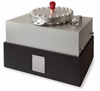
Agilent Miniature VacIon pumps, often called appendage ion pumps, are offered in a diode or noble diode configuration and provide a pumping speed of 0.4 L/s. These small ion pumps are lightweight, emit a very low magnetic field, and have a maximum baking temperature of 400 °C. Since the invention of the ion pump by Agilent (Varian) in the late 1950s, Agilent mini pumps have set the pace in the industrial field in a wide range of applications such as defense, space, telecommunications, research, and medical devices. They are often used to maintain electron tubes for their operational lifetime at high or ultrahigh vacuum pressure.
0.4 L/s appendage pumps commonly used to maintain ultrahigh vacuum on sealed devices
Low leakage current provides stable vacuum pressure reading
Customizable with different high-voltage feedthroughs, body geometries, and pumping cell arrangements to meet your needs
Low magnetic field minimizes system interference
Vacuum processed at >400 °C and pinched off under vacuum to ensure cleanliness and vacuum integrity prior to installation
Special testing procedures for your specific requirements can be added
Agilent Miniature VacIon pumps, often called appendage ion pumps, are offered in a diode or noble diode configuration and provide a pumping speed of 0.4 L/s. These small ion pumps are lightweight, emit a very low magnetic field, and have a maximum baking temperature of 400 °C.
Since the invention of the ion pump by Agilent (Varian) in the late 1950s, Agilent mini pumps have set the pace in the industrial field in a wide range of applications such as defense, space, telecommunications, research, and medical devices. They are often used to maintain electron tubes for their operational lifetime at high or ultrahigh vacuum pressure.
- 0.4 L/s appendage pumps commonly used to maintain ultrahigh vacuum on sealed devices
- Low leakage current provides stable vacuum pressure reading
- Customizable with different high-voltage feedthroughs, body geometries, and pumping cell arrangements to meet your needs
- Low magnetic field minimizes system interference
- Vacuum processed at >400 °C and pinched off under vacuum to ensure cleanliness and vacuum integrity prior to installation
- Special testing procedures for your specific requirements can be added