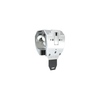
Dual Axis Linear Stepper Motors are ideal for open loop positioning applications with light payloads. They can be used at speeds up to 80 in /sec [2m/sec] and strokes up to 40” x 60” [1 m x 1.5 m]. Linear stepper motors are capable of very precise position, velocity and acceleration control when coupled with a microstepping drive and indexer. The moving assembly called the “forcer” is supported by magnetically preloaded air-bearings imbedded in the active surface of the forcer between the forcer and platen. The bearings are designed to support the customer’s payload and to maintain the required .001” [0.025 mm] gap between the platen and the forcer. The two axis step and direction signal from a microstepping drive, to the 2 or 4 phase forcer is supplied via a power cable. The motion achieved with a full step is .010” [250 microns] and with a microstep it’s .00004” [1 micron]. The Dual Axis linear stepper motor is a complete positioning stage with the motor, the bearings and the positioning system all built into one compact package. Integrating a linear encoder with the stepper motor provides a closed loop system.
Advantages:
Low profile and small cross section
High Speed
Low cost positioning stage solution
No servo tuning required
Multiple forcers on a single platen
Applications:
Pick and Place
Wire bonders
Parts transfer
Fiber optic The Dual Axis Linear Stepper Motor consists of 2 main parts
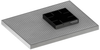
Moving Forcer Assembly: The forcer is made up of an aluminum housing that contains the motor windings, lamination stacks, and permanent magnets. The active surface of the lamination is slotted to form teeth with a pitch of .040" [1 mm]. The ends of the coil are brought out to either a "D" connector or to flying leads. Mounting holes on the top surface of the forcer are for attaching the customer's payload. The forcer comes in different widths and lengths, depending on the required force. Multiple forcers can be supplied with a single platen to allow for independent moving heads.
Platen: The platen is a precision ground steel plate that is slotted to form 0.02” x 0.02” [0.50x 0.50 mm] square teeth on the surface. The spaces between the platen teeth are filled with epoxy to provide a flat air-bearing surface for the forcer. The stroke of the forcer is a function of the length and width of the platen. Platens can be manufactured in different shapes with a multitude of mounting configurations.
Dual Axis Linear Stepper Motors can be ordered for any stroke up to 40 “ x 60” (1 m x 1.5 m) and continuous forces up to 30 [133 N]. Platens are available as solid steel or cast iron plates. Model # DTS-AAB-CX AA is for the continuous force in (06 is 6) B is the number of phases (2 or 4 phase) C is for the bearing type (A for air bearing) - standard for this model X is for special options (lead termination and conectors) (i.e. DST-022-A is a 2.0 continuous force dual axis linear stepper motor, two phase, air bearing and no special options)
Dual Axis Linear Stepper Motors are ideal for open loop positioning applications with light payloads. They can be used at speeds up to 80 in /sec [2m/sec] and strokes up to 40” x 60” [1 m x 1.5 m]. Linear stepper motors are capable of very precise position, velocity and acceleration control when coupled with a microstepping drive and indexer.
The moving assembly called the “forcer” is supported by magnetically preloaded air-bearings imbedded in the active surface of the forcer between the forcer and platen. The bearings are designed to support the customer’s payload and to maintain the required .001” [0.025 mm] gap between the platen and the forcer.
The two axis step and direction signal from a microstepping drive, to the 2 or 4 phase forcer is supplied via a power cable. The motion achieved with a full step is .010” [250 microns] and with a microstep it’s .00004” [1 micron].
The Dual Axis linear stepper motor is a complete positioning stage with the motor, the bearings and the positioning system all built into one compact package.
Integrating a linear encoder with the stepper motor provides a closed loop system.
Advantages:
- Low profile and small cross section
- High Speed
- Low cost positioning stage solution
- No servo tuning required
- Multiple forcers on a single platen
Applications:
- Pick and Place
- Wire bonders
- Parts transfer
- Fiber optic
The Dual Axis Linear Stepper Motor consists of 2 main parts
- Moving Forcer Assembly: The forcer is made up of an aluminum housing that contains the motor windings, lamination stacks, and permanent magnets. The active surface of the lamination is slotted to form teeth with a pitch of .040" [1 mm]. The ends of the coil are brought out to either a "D" connector or to flying leads. Mounting holes on the top surface of the forcer are for attaching the customer's payload. The forcer comes in different widths and lengths, depending on the required force. Multiple forcers can be supplied with a single platen to allow for independent moving heads.
- Platen: The platen is a precision ground steel plate that is slotted to form 0.02” x 0.02” [0.50x 0.50 mm] square teeth on the surface. The spaces between the platen teeth are filled with epoxy to provide a flat air-bearing surface for the forcer. The stroke of the forcer is a function of the length and width of the platen. Platens can be manufactured in different shapes with a multitude of mounting configurations.
Dual Axis Linear Stepper Motors can be ordered for any stroke up to 40 “ x 60” (1 m x 1.5 m) and continuous forces up to 30 [133 N]. Platens are available as solid steel or cast iron plates.
Model # DTS-AAB-CX
AA is for the continuous force in (06 is 6) B is the number of phases (2 or 4 phase) C is for the bearing type (A for air bearing) - standard for this model X is for special options (lead termination and conectors) (i.e. DST-022-A is a 2.0 continuous force dual axis linear stepper motor, two phase, air bearing and no special options)