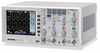
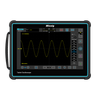
The GDS-2064 is a 60 MHz, 4 channel digital oscilloscope from Instek. Measure voltage or current signals over time in an electronic circuit or component to display amplitude, frequency and rise times, etc. Applications include troubleshooting, production test, and design.
Additional Features:
Bandwidth: 60 MHz
4 Channels
Sample Rate: 1GSa/s Real-Time
25GSa/s Equivalent-Time Sampling
25k Points Record Length Maximum
Large 5.6-in TFT Color Display
USB Host/Device: Support USB Printer and USB Flash Drive
Color Printout
Applications:
Education Lab and Training Institution
Production Test and Quality Inspection
Repair and After-Service
Circuit Design and Debug
The Instek GDS-2064 picks up signals even in the most extreme cases, powered by 1GSa/s real time and 25GSa/s equivalent sampling rate combined with 3 types of acquisition modes: sample, peak detect, and average. 25k points of deep memory collects more information of a given waveform, guiding us into further signal details. 4 types of flexible triggers add another signal capturing flexibility: edge, video (NTSC, PAL, SECAM) with line selection, and pulse-width.
The GDS-2064 is a 60 MHz, 4 channel digital oscilloscope from Instek. Measure voltage or current signals over time in an electronic circuit or component to display amplitude, frequency and rise times, etc. Applications include troubleshooting, production test, and design.
Additional Features:
- Bandwidth: 60 MHz
- 4 Channels
- Sample Rate: 1GSa/s Real-Time
- 25GSa/s Equivalent-Time Sampling
- 25k Points Record Length Maximum
- Large 5.6-in TFT Color Display
- USB Host/Device: Support USB Printer and USB Flash Drive
- Color Printout
Applications:
- Education Lab and Training Institution
- Production Test and Quality Inspection
- Repair and After-Service
- Circuit Design and Debug
The Instek GDS-2064 picks up signals even in the most extreme cases, powered by 1GSa/s real time and 25GSa/s equivalent sampling rate combined with 3 types of acquisition modes: sample, peak detect, and average. 25k points of deep memory collects more information of a given waveform, guiding us into further signal details. 4 types of flexible triggers add another signal capturing flexibility: edge, video (NTSC, PAL, SECAM) with line selection, and pulse-width.