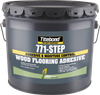
Titebond 771-Step Adhesive, Moisture & Sound Control combines the superior properties of a moisture cure adhesive with the ability to be used as a moisture and sound control system, primarily for wood floor installations. This product enables the installer to protect the floor from subfloor moisture and glue it down in one application, saving labor and time. Once cured, the product is water resistant and is not adversely affected by exposure to moisture or water. It provides a tough, flexible, and tenacious bond to a variety of substrates. Alternatively, Titebond 771-Step can be used just as a one-part adhesive simply by using a different size trowel.Please see specific application guidelines in this document for details and instructions. The elastomeric characteristics allow the adhesive to move with the wood as it expands and contracts over the life of the floor. Titebond 771-Step has unparalleled green grab and strength development, spreads easily, and cleans up better than urethanes. Titebond 771-Step is most often used to secure solid wood, bamboo, cork, and engineered hardwood flooring. It can also be used to install plywood, ceramic tile, marble, and stone inlays for residential and commercial applications.
For use as an adhesive, moisture and sound control system in one application
Outstanding green grab
Achieves IIC rating of 67 and STC rating of 69
Non-slump formula
Fast strength development saves time
VOC-compliant
Highly moisture-resistant
Will not cause dimensional changes in wood flooring
Excellent bond strength
Ideal for above, on and below-grade installations
Unaffected by freezing temperatures
Mold & mildew resistant
100% solids advanced polymer formula - No water or solvent
Rapid cure rate
Spreads and cleans up easily
Subfloor Preparation
All substrates must be clean, dry, structurally sound, properly cured and free of dirt, oil, paint, old adhesive, wax, sealers and curing agents. General scouring with 20 grit or #3 1/2 open-coat sandpaper will remove most compounds. All loose materials must be vacuumed from the surface after scouring. The subfloor must be flat to a tolerance of 3/16" in a 10' radius. Hollow spots, popping spots and squeaks are related to unevenness in the subfloor. Grinding concrete floors is preferred over the use of filling compounds. If flattening/leveling compounds are used, they must be portland based cementious materials and have a compressive strength equal to or greater than 3000 psi when cured. Use of adhesive over light weight concrete and all gypsum based materials requires the use of Titebond Concrete Primer or equivalent prior to application of adhesive. For further information on Titebond Concrete Primer, contact Franklin Technical Service at 1-800-347-4583. Remove all existing base, shoe molding and door thresholds prior to continuing the installation. All door casings must be undercut with either a jamb saw or a hand saw. Use a piece of the flooring as a guide to determine the thickness needed.
Subfloor Moisture Check
Titebond 771-Step may be used for above-, on- and below-grade applications and on all substrates listed in Specifications Guide section. All applications are susceptible to moisture and should be tested for moisture prior to installation in several locations within the installation area. When using the one-step application method for moisture control, concrete subfloor cannot exceed 15 lbs./1000 sq. ft./24 hours per a Calcium Chloride Test (ASTM F1869) or 85% relative humidity (RH) when tested with an in situ probe (ASTM F2170). For use as an adhesive ONLY, acceptable conditions of concrete for above-, on- and below-grade applications are: • Less than 3 lbs./1000 sq.ft./24 hours on a Calcium Chloride Test (ASTM F1869) • Less than a reading of 4.5 on a Tramex Concrete Moisture Encounter • Relative humidity (RH) of 75% or less when tested with an in situ probe (ASTM F2170) Acceptable conditions of wood substrates are a moisture reading of less than 12% or be no more than 4% different from the flooring being installed when using a Tramex, Delmhorst or equivalent wood moisture meter. If subfloor moisture conditions do not meet above guidelines at the time of flooring installation or they could exceed them at any time after installation then a Titebond Moisture Control system should be used. For more information concerning these products and moisture conditions, call Franklin Technical Service at 1-800-347-4583.
Installation 771-Step as a one-step adhesive, moisture and sound control
Follow all instructions for subfloor preparation. Trowel 771-Step with the correct trowel (see trowel recommendations) and immediately install the wood flooring into the wet adhesive. To reduce slipping, secure the first two starter rows with starting blocks fastened to the substrate or wedges against starting wall. Remaining planks must be placed firmly into adhesive. Planks that are not flat should be weighted for several hours. Be sure to cover entire area to be installed. Remember Titebond 771-Step is a rapid cure adhesive. Open time is 25-45 minutes, depending on relative humidity. Be sure to seat the flooring into the adhesive firmly. Any low or high spots may cause voids in the adhesive preventing complete coverage and moisture control, therefore voiding the warranty. Roll the floor with a 150 lb. roller within 30 minutes of application to assist in creating a continuous layer to ensure total coverage and protection for moisture control. To ensure protection against subfloor moisture, 100% substrate coverage and adhesive transfer is required.
Installation 771-Step as adhesive only (no moisture or sound control)
Follow all instructions for subfloor preparations. Titebond 771-Step must be installed using the "wet lay" method. This product cures and builds strength very quickly. Open time is approximately 30 minutes depending on humidity and temperature. Do not trowel more adhesive than can be installed within 30 minutes. Use recommended trowel for installation (see trowel recommendations). In the "wet lay" method you do not flash the adhesive; you begin laying the wood flooring immediately after troweling the adhesive. Once the adhesive has been troweled, the wood flooring may be installed immediately into the wet adhesive. To reduce slippage, secure the first two starter rows with starting blocks fastened to the substrate or wedges against starting wall. Remaining planks must be placed firmly into adhesive. Planks which are not flat should be weighted for several hours. Normally, ultimate strength will be reached within 24 hours. Wait at least 1 day before finishing an unfinished floor. Do not walk on the floor during installation. NOTE: Do not trowel more adhesive than can be covered within 30 minutes. In the wet lay method, you should not work on top of the wood.
Re-sealing and Re-opening Partial Pail
Scrape sides of pail (this will aid in removal of adhesive later). Place plastic trash bag over unused adhesive, working out any air pockets. Replace lid on pail and tightly seal. Upon re-opening pail, remove trash bag. Material should be ready for use.
Gluing Plywood Over Concrete
1. Use 5/8" CD Exposure 1 Plywood subfloor panels, 4' x 8' sheets; cut sheets into 2' x 8' or 4' x 4' sections 2. Score the back of the panels half the thickness of the panel on a 12" x 12" grid in order to relieve tension in plywood 3. Use a 1/4" x 1/4" square-notched trowel to apply adhesive to concrete 4. Lay sections in a staggered joint pattern in the adhesive, with 1/8" spacing between sheets, and 3/4" minimum expansion space at walls and all vertical obstructions 5. Add weight as necessary to ensure adhesive remains in contact with plywood as it cures 6. Allow adhesive to dry overnight before proceeding with flooring installation
Cleanup
Wet adhesive may be cleaned up or removed using a solvent such as alcohol or mineral spirits. Do not allow adhesive to cure on surface of the flooring, tools, or equipment. Follow solvent manufacturer's directions when working with solvents. Cured adhesive will be difficult to remove. For specific cleaning instructions, call Franklin Technical Service at 1-800-347-4583.
This product cures very quickly!
Open time is 25-45 minutes depending on temperature and humidity
Do not install solid wood below-grade
Do not use on concrete with curing agents or sealers (except for recommended Titebond or Franklin products)
Avoid allowing adhesive to cure on wood flooring surface
Do not allow foot traffic for 3 hours after installation
Concrete Moisture Vapor Limits
To ensure protection against subfloor moisture,100% substrate coverage and adhesive transfer is required.
Adhesive, moisture and sound control application: ≤ 15 lbs/1000 ft.2/24 hrs. (≤ 85% RH).
Adhesive only application: ≤ 3 lbs/1000 ft.2/24 hrs. (≤ 75% RH)
Do not use a leveler
Installations in dry or cool environments or over dry subfloors will take longer to cure
Titebond 771-Step Adhesive, Moisture & Sound Control combines the superior properties of a moisture cure adhesive with the ability to be used as a moisture and sound control system, primarily for wood floor installations. This product enables the installer to protect the floor from subfloor moisture and glue it down in one application, saving labor and time. Once cured, the product is water resistant and is not adversely affected by exposure to moisture or water. It provides a tough, flexible, and tenacious bond to a variety of substrates. Alternatively, Titebond 771-Step can be used just as a one-part adhesive simply by using a different size trowel.Please see specific application guidelines in this document for details and instructions.
The elastomeric characteristics allow the adhesive to move with the wood as it expands and contracts over the life of the floor. Titebond 771-Step has unparalleled green grab and strength development, spreads easily, and cleans up better than urethanes. Titebond 771-Step is most often used to secure solid wood, bamboo, cork, and engineered hardwood flooring. It can also be used to install plywood, ceramic tile, marble, and stone inlays for residential and commercial applications.
- For use as an adhesive, moisture and sound control system in one application
- Outstanding green grab
- Achieves IIC rating of 67 and STC rating of 69
- Non-slump formula
- Fast strength development saves time
- VOC-compliant
- Highly moisture-resistant
- Will not cause dimensional changes in wood flooring
- Excellent bond strength
- Ideal for above, on and below-grade installations
- Unaffected by freezing temperatures
- Mold & mildew resistant
- 100% solids advanced polymer formula - No water or solvent
- Rapid cure rate
- Spreads and cleans up easily
Subfloor Preparation
All substrates must be clean, dry, structurally sound, properly cured and free of dirt, oil, paint, old adhesive, wax, sealers and curing agents. General scouring with 20 grit or #3 1/2 open-coat sandpaper will remove most compounds. All loose materials must be vacuumed from the surface after scouring. The subfloor must be flat to a tolerance of 3/16" in a 10' radius. Hollow spots, popping spots and squeaks are related to unevenness in the subfloor. Grinding concrete floors is preferred over the use of filling compounds. If flattening/leveling compounds are used, they must be portland based cementious materials and have a compressive strength equal to or greater than 3000 psi when cured. Use of adhesive over light weight concrete and all gypsum based materials requires the use of Titebond Concrete Primer or equivalent prior to application of adhesive. For further information on Titebond Concrete Primer, contact Franklin Technical Service at 1-800-347-4583. Remove all existing base, shoe molding and door thresholds prior to continuing the installation. All door casings must be undercut with either a jamb saw or a hand saw. Use a piece of the flooring as a guide to determine the thickness needed.
Subfloor Moisture Check
Titebond 771-Step may be used for above-, on- and below-grade applications and on all substrates listed in Specifications Guide section. All applications are susceptible to moisture and should be tested for moisture prior to installation in several locations within the installation area. When using the one-step application method for moisture control, concrete subfloor cannot exceed 15 lbs./1000 sq. ft./24 hours per a Calcium Chloride Test (ASTM F1869) or 85% relative humidity (RH) when tested with an in situ probe (ASTM F2170).
For use as an adhesive ONLY, acceptable conditions of concrete for above-, on- and below-grade applications are:
• Less than 3 lbs./1000 sq.ft./24 hours on a Calcium Chloride Test (ASTM F1869)
• Less than a reading of 4.5 on a Tramex Concrete Moisture Encounter
• Relative humidity (RH) of 75% or less when tested with an in situ probe (ASTM F2170)
Acceptable conditions of wood substrates are a moisture reading of less than 12% or be no more than 4% different from the flooring being installed when using a Tramex, Delmhorst or equivalent wood moisture meter.
If subfloor moisture conditions do not meet above guidelines at the time of flooring installation or they could exceed them at any time after installation then a Titebond Moisture Control system should be used. For more information concerning these products and moisture conditions, call Franklin Technical Service at 1-800-347-4583.
Installation 771-Step as a one-step adhesive, moisture and sound control
Follow all instructions for subfloor preparation. Trowel 771-Step with the correct trowel (see trowel recommendations) and immediately install the wood flooring into the wet adhesive. To reduce slipping, secure the first two starter rows with starting blocks fastened to the substrate or wedges against starting wall. Remaining planks must be placed firmly into adhesive. Planks that are not flat should be weighted for several hours. Be sure to cover entire area to be installed. Remember Titebond 771-Step is a rapid cure adhesive. Open time is 25-45 minutes, depending on relative humidity. Be sure to seat the flooring into the adhesive firmly. Any low or high spots may cause voids in the adhesive preventing complete coverage and moisture control, therefore voiding the warranty. Roll the floor with a 150 lb. roller within 30 minutes of application to assist in creating a continuous layer to ensure total coverage and protection for moisture control. To ensure protection against subfloor moisture, 100% substrate coverage and adhesive transfer is required.
Installation 771-Step as adhesive only (no moisture or sound control)
Follow all instructions for subfloor preparations. Titebond 771-Step must be installed using the "wet lay" method. This product cures and builds strength very quickly. Open time is approximately 30 minutes depending on humidity and temperature. Do not trowel more adhesive than can be installed within 30 minutes. Use recommended trowel for installation (see trowel recommendations). In the "wet lay" method you do not flash the adhesive; you begin laying the wood flooring immediately after troweling the adhesive. Once the adhesive has been troweled, the wood flooring may be installed immediately into the wet adhesive. To reduce slippage, secure the first two starter rows with starting blocks fastened to the substrate or wedges against starting wall. Remaining planks must be placed firmly into adhesive. Planks which are not flat should be weighted for several hours. Normally, ultimate strength will be reached within 24 hours. Wait at least 1 day before finishing an unfinished floor. Do not walk on the floor during installation. NOTE: Do not trowel more adhesive than can be covered within 30 minutes. In the wet lay method, you should not work on top of the wood.
Re-sealing and Re-opening Partial Pail
Scrape sides of pail (this will aid in removal of adhesive later). Place plastic trash bag over unused adhesive, working out any air pockets. Replace lid on pail and tightly seal. Upon re-opening pail, remove trash bag. Material should be ready for use.
Gluing Plywood Over Concrete
1. Use 5/8" CD Exposure 1 Plywood subfloor panels, 4' x 8' sheets; cut sheets into 2' x 8' or 4' x 4' sections
2. Score the back of the panels half the thickness of the panel on a 12" x 12" grid in order to relieve tension in plywood
3. Use a 1/4" x 1/4" square-notched trowel to apply adhesive to concrete
4. Lay sections in a staggered joint pattern in the adhesive, with 1/8" spacing between sheets, and 3/4" minimum expansion space at walls and all vertical obstructions
5. Add weight as necessary to ensure adhesive remains in contact with plywood as it cures
6. Allow adhesive to dry overnight before proceeding with flooring installation
Cleanup
Wet adhesive may be cleaned up or removed using a solvent such as alcohol or mineral spirits. Do not allow adhesive to cure on surface of the flooring, tools, or equipment. Follow solvent manufacturer's directions when working with solvents. Cured adhesive will be difficult to remove. For specific cleaning instructions, call Franklin Technical Service at 1-800-347-4583.
- This product cures very quickly!
- Open time is 25-45 minutes depending on temperature and humidity
- Do not install solid wood below-grade
- Do not use on concrete with curing agents or sealers (except for recommended Titebond or Franklin products)
- Avoid allowing adhesive to cure on wood flooring surface
- Do not allow foot traffic for 3 hours after installation
Concrete Moisture Vapor Limits
- To ensure protection against subfloor moisture,100% substrate coverage and adhesive transfer is required.
- Adhesive, moisture and sound control application: ≤ 15 lbs/1000 ft.2/24 hrs. (≤ 85% RH).
- Adhesive only application: ≤ 3 lbs/1000 ft.2/24 hrs. (≤ 75% RH)
- Do not use a leveler
- Installations in dry or cool environments or over dry subfloors will take longer to cure