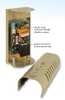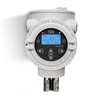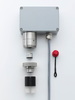
Compur Monitors, Inc. Statox 501 PID - the Allrounder

Description
PIDs (Photo â€" Ionisation â€" Detectors) detect VOCs (Volatile Organic Compounds) in the ppm range, which other sensor types are unable to monitor, like solvents and fuels. A PID sensor uses high energy ultra violet light radiation to break gas molecules into radicals, which are discharged while passing a condenser. The discharge current increases proportional to the number of molecules, i. e. the gas concentration. The standard Statox 501 PID will detect all substances with a ionization energy below 10,6 eV PIDs are normally calibrated with Isobutene. Other gases will be detected with different sensitivity. These so - called response factors must be multiplied with the displayed concentration when adjusting span. Compur Monitors will adjust your Statox 501 PID individually to your application ex works. A magnetic pin gives access to simple parameter setting and calibration menu. A multi - color LED signalises the status of the system. The Statox 501 PID voltage output signal is similar the the signal of a catalytic sensor. The Statox 501 control module displays the measured value and provides an analog output and 3 powerful relay outputs for alarm devices or pcs.
Description
PIDs (Photo â€" Ionisation â€" Detectors) detect VOCs (Volatile Organic Compounds) in the ppm range, which other sensor types are unable to monitor, like solvents and fuels. A PID sensor uses high energy ultra violet light radiation to break gas molecules into radicals, which are discharged while passing a condenser. The discharge current increases proportional to the number of molecules, i. e. the gas concentration. The standard Statox 501 PID will detect all substances with a ionization energy below 10,6 eV PIDs are normally calibrated with Isobutene. Other gases will be detected with different sensitivity. These so - called response factors must be multiplied with the displayed concentration when adjusting span. Compur Monitors will adjust your Statox 501 PID individually to your application ex works. A magnetic pin gives access to simple parameter setting and calibration menu. A multi - color LED signalises the status of the system. The Statox 501 PID voltage output signal is similar the the signal of a catalytic sensor. The Statox 501 control module displays the measured value and provides an analog output and 3 powerful relay outputs for alarm devices or pcs.

Suppliers

Company
Product
Description
Supplier Links
PIDs (Photo â€" Ionisation â€" Detectors) detect VOCs (Volatile Organic Compounds) in the ppm range, which other sensor types are unable to monitor, like solvents and fuels. A PID sensor uses high energy ultra violet light radiation to break gas molecules into radicals, which are discharged while passing a condenser. The discharge current increases proportional to the number of molecules, i. e. the gas concentration. The standard Statox 501 PID will detect all substances with a ionization energy below 10,6 eV PIDs are normally calibrated with Isobutene. Other gases will be detected with different sensitivity. These so - called response factors must be multiplied with the displayed concentration when adjusting span. Compur Monitors will adjust your Statox 501 PID individually to your application ex works. A magnetic pin gives access to simple parameter setting and calibration menu. A multi - color LED signalises the status of the system. The Statox 501 PID voltage output signal is similar the the signal of a catalytic sensor. The Statox 501 control module displays the measured value and provides an analog output and 3 powerful relay outputs for alarm devices or pcs.

PIDs (Photo â€" Ionisation â€" Detectors) detect VOCs (Volatile Organic Compounds) in the ppm range, which other sensor types are unable to monitor, like solvents and fuels.
A PID sensor uses high energy ultra violet light radiation to break gas molecules into radicals, which are discharged while passing a condenser. The discharge current increases proportional to the number of molecules, i. e. the gas concentration. The standard Statox 501 PID will detect all substances with a ionization energy below 10,6 eV
PIDs are normally calibrated with Isobutene. Other gases will be detected with different sensitivity. These so - called response factors must be multiplied with the displayed concentration when adjusting span. Compur Monitors will adjust your Statox 501 PID individually to your application ex works.
A magnetic pin gives access to simple parameter setting and calibration menu. A multi - color LED signalises the status of the system.
The Statox 501 PID voltage output signal is similar the the signal of a catalytic sensor. The Statox 501 control module displays the measured value and provides an analog output and 3 powerful relay outputs for alarm devices or pcs.

Supplier's Site

Technical Specifications

  Compur Monitors, Inc.
Product Category Gas Instruments
Product Number Statox 501 PID - the Allrounder
Application Confined Space Entry
Unlock Full Specs
to access all available technical data

Similar Products

New Generation Process Oxygen Analyzer - XMO2pro - Panametrics
Specs
Measurement Type %Volume
Application Process Gas
Gas Types O2; (from 0.01% to 100%)
View Details
Gas Detector - PCE-WMM 50 - PCE Instruments / PCE Americas Inc.
PCE Instruments / PCE Americas Inc.
Specs
Measurement Type Trace
Application Confined Space Entry
Gas Types CO2
View Details
Gas Monitor - ULTIMA® X5000 - MSA Safety
Specs
Measurement Type %LEL or %LFL; %Volume; Trace
Application Ambient Air Monitoring
Gas Types Toxic; Combustible; NH3; (0-100 ppm, 0-1000 ppm); CO2; (0-2%, 0-5% Vol); CO; (0-100, 0-500, 0-1000 ppm); Cl2; (0-5, 0-10. 0-20 ppm); Hydrocarbons; (0-100% LEL); H2; (0-1000 ppm); HCl; (0-50ppm); H2S; (0-10, 0-50, 0-100 ppm); Methane (CH4) / Natural Gas; (0-100% LEL); NO; (0-100ppm); NO2; (0-10 ppm); O2; (0-25%); SO2; (0-25 ppm, 0-100 ppm)
View Details
4001 Trimix Analyzer Power Cord -  - Analytical Industries Inc.
Analytical Industries Inc.
Specs
Instrument Type Analyzer
View Details