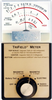
AlphaLab, Inc. RF Field Strength Meter

Description
This is an extremely sensitive meter which can accurately measure RF background even in rural areas far from any transmitters. The meter reads true power density directly on the display. Unlike other low-cost field strength meters, this meter's frequency response does not depend on the characteristics of an external antenna; the internal detection system yields a flat response over a very wide range of frequencies.Accuracy in the FM, TV and cell tower frequency range (30 MHz - 2.4 GHz) is +/-25%. Sensitivity is low by 50% (-3 dB) at the frequency limits .5 MHz and 3 GHz. (Sensitivity is 25% at 5 GHz. That is, you must multiply the reading by 4 when measuring microwaves at that high a frequency. At 10 GHz, sensitivity is about 10%.)A High-Pass selector switch allows you to measure either the full bandwidth ("Wide" = 0.5 MHz - 3 GHz) or to apply a high-pass filter ("Narrow" = 6 dB/ octive rolloff with a knee at 100 MHz) that effectively allows only 100 MHz to 3 GHz through. In practice, this high-pass selector function can be used to estimate one additional parameter: the average frequency of the RF (if it is in the range 10 MHz - 500 MHz).The RF Field Strength Meter is directional and it detects only the component of the electric field which has the same polarization as the long axis of the meter. That is, if only a vertically-polarized RF wave is present, but you turn the meter in the horizontal direction, it will essentially read zero. If you subsequently rotate the meter to vertical, it will then read the full power density of the RF wave. Most RF radiation has only vertical electric field, so the full strength can be read by holding the meter vertically. (At the end of this page is more information on how to read radio waves with other polarizations).
Description
This is an extremely sensitive meter which can accurately measure RF background even in rural areas far from any transmitters. The meter reads true power density directly on the display. Unlike other low-cost field strength meters, this meter's frequency response does not depend on the characteristics of an external antenna; the internal detection system yields a flat response over a very wide range of frequencies.Accuracy in the FM, TV and cell tower frequency range (30 MHz - 2.4 GHz) is +/-25%. Sensitivity is low by 50% (-3 dB) at the frequency limits .5 MHz and 3 GHz. (Sensitivity is 25% at 5 GHz. That is, you must multiply the reading by 4 when measuring microwaves at that high a frequency. At 10 GHz, sensitivity is about 10%.)A High-Pass selector switch allows you to measure either the full bandwidth ("Wide" = 0.5 MHz - 3 GHz) or to apply a high-pass filter ("Narrow" = 6 dB/ octive rolloff with a knee at 100 MHz) that effectively allows only 100 MHz to 3 GHz through. In practice, this high-pass selector function can be used to estimate one additional parameter: the average frequency of the RF (if it is in the range 10 MHz - 500 MHz).The RF Field Strength Meter is directional and it detects only the component of the electric field which has the same polarization as the long axis of the meter. That is, if only a vertically-polarized RF wave is present, but you turn the meter in the horizontal direction, it will essentially read zero. If you subsequently rotate the meter to vertical, it will then read the full power density of the RF wave. Most RF radiation has only vertical electric field, so the full strength can be read by holding the meter vertically. (At the end of this page is more information on how to read radio waves with other polarizations).

Suppliers

Company
Product
Description
Supplier Links
RF Field Strength Meter -  - AlphaLab, Inc.
Salt Lake City, UT, USA
RF Field Strength Meter
This is an extremely sensitive meter which can accurately measure RF background even in rural areas far from any transmitters. The meter reads true power density directly on the display. Unlike other low-cost field strength meters, this meter's frequency response does not depend on the characteristics of an external antenna; the internal detection system yields a flat response over a very wide range of frequencies.Accuracy in the FM, TV and cell tower frequency range (30 MHz - 2.4 GHz) is +/-25%. Sensitivity is low by 50% (-3 dB) at the frequency limits .5 MHz and 3 GHz. (Sensitivity is 25% at 5 GHz. That is, you must multiply the reading by 4 when measuring microwaves at that high a frequency. At 10 GHz, sensitivity is about 10%.)A High-Pass selector switch allows you to measure either the full bandwidth ("Wide" = 0.5 MHz - 3 GHz) or to apply a high-pass filter ("Narrow" = 6 dB/ octive rolloff with a knee at 100 MHz) that effectively allows only 100 MHz to 3 GHz through. In practice, this high-pass selector function can be used to estimate one additional parameter: the average frequency of the RF (if it is in the range 10 MHz - 500 MHz).The RF Field Strength Meter is directional and it detects only the component of the electric field which has the same polarization as the long axis of the meter. That is, if only a vertically-polarized RF wave is present, but you turn the meter in the horizontal direction, it will essentially read zero. If you subsequently rotate the meter to vertical, it will then read the full power density of the RF wave. Most RF radiation has only vertical electric field, so the full strength can be read by holding the meter vertically. (At the end of this page is more information on how to read radio waves with other polarizations).

This is an extremely sensitive meter which can accurately measure RF background even in rural areas far from any transmitters. The meter reads true power density directly on the display. Unlike other low-cost field strength meters, this meter's frequency response does not depend on the characteristics of an external antenna; the internal detection system yields a flat response over a very wide range of frequencies.Accuracy in the FM, TV and cell tower frequency range (30 MHz - 2.4 GHz) is +/-25%. Sensitivity is low by 50% (-3 dB) at the frequency limits .5 MHz and 3 GHz. (Sensitivity is 25% at 5 GHz. That is, you must multiply the reading by 4 when measuring microwaves at that high a frequency. At 10 GHz, sensitivity is about 10%.)A High-Pass selector switch allows you to measure either the full bandwidth ("Wide" = 0.5 MHz - 3 GHz) or to apply a high-pass filter ("Narrow" = 6 dB/ octive rolloff with a knee at 100 MHz) that effectively allows only 100 MHz to 3 GHz through. In practice, this high-pass selector function can be used to estimate one additional parameter: the average frequency of the RF (if it is in the range 10 MHz - 500 MHz).The RF Field Strength Meter is directional and it detects only the component of the electric field which has the same polarization as the long axis of the meter. That is, if only a vertically-polarized RF wave is present, but you turn the meter in the horizontal direction, it will essentially read zero. If you subsequently rotate the meter to vertical, it will then read the full power density of the RF wave. Most RF radiation has only vertical electric field, so the full strength can be read by holding the meter vertically. (At the end of this page is more information on how to read radio waves with other polarizations).

Supplier's Site

Technical Specifications

  AlphaLab, Inc.
Product Category RF Power Meters
Product Name RF Field Strength Meter
Form Factor Handheld
Unlock Full Specs
to access all available technical data

Similar Products

True RMS Power Sensors - LB5918A - LadyBug Technologies LLC
LadyBug Technologies LLC
Specs
Output Interface Universal Serial Bus
dBm Measurement Range -60 to 26 dBm
Frequency Range 1.00E6 to 1.80E10 Hz
View Details
RF High Power Calorimeter with Chiller - 1314 - TEGAM, Inc.
Specs
Form Factor Bench top; Rack mount
Display Type Digital
Real Power 10 to 250 watts
View Details
RF Power Meter - 4220 - ValueTronics International, Inc.
Boonton Electronics Corporation
View Details
STEMlab 125-14 Ultimate Kit -  - Red Pitaya, d.o.o.
Specs
Form Factor Bench top; Rack mount (optional feature); Handheld (optional feature); Computer Board
Display Type Webpage
Options & Features Has Application Software for Host Computer; Auto-ranging; Battery powered (optional feature); Data Acquisition; Data storage/ logging; dB readings; Has Integrating Functions (optional feature); Programmable; Removable data storage; Has Scaling Function; Temperature Compensated (optional feature); Triggering
View Details