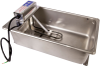
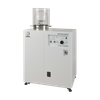
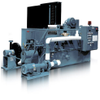
EVA, Sample Preparation System - Final Volume 1 mL, 100-110 V / 50-60 Hz
AUTOMATED EVAPORATOR FOR SERIAL CONCENTRATORS
At the heart of the EVA is a uniquely designed evaporation chamber that uses laser controls for accuracy and reproducibility. Utilizing the best features of rotary vacuum evaporation design, this chamber has been optimized for final volume accuracy and variable evaporation speeds.
The rotary evaporator design uses centrifugal force and frictional force between the wall of the rotating fl ask and the liquid sample to form a thin film of warm solvent spread over a large surface area. The forces created by the rotation suppress violent, unpredicted boiling or bumping. The rotational design combines a silicon oil bath for consistent heat transfer with a laser-directed volume control to allow for precision in either fast or gentle evaporation of solvents.
The shape of the evaporation chamber has a unique, wide upper chamber and a narrow, tube-shape lower chamber. The width of the upper chamber allows solvent to spread around the walls, which optimizes heat transfer and maximizes surface area for evaporation. The narrow lower chamber acts as a collection tube and enables very accurate, level measurements with a laser at the end stages of evaporation.
Utilizing the easy-to-use Vario PC software or the keypad, the system can customize evaporation profiles for each individual sample and be setup for unattended operation overnight or through weekends. Matched with several autosampler rack configurations, the EVA offers the flexibility and precision required in today’s busy laboratories.
FEATURE HIGHLIGHTS
Reliable – Durable – Quiet
Sample Carry-Over Eliminated
Unattended Operation
Custom Evaporation Profile
POPULAR APPLICATIONS INCLUDE
Pesticides and Polychlorinated Biphenyls (PCB) – EN 1528, EPA 8082a
Pesticide Residues – EN 12393
Polycyclic Aromatic Hydrocarbon (PAH) – EPA 8310
Organochlorine Pesticide Residues – AOAC 984.21
Phthalates – EPA 8270c
…And Many More, Including USGS And USDA Methods
EVA, Sample Preparation System - Final Volume 1 mL, 100-110 V / 50-60 Hz
| AUTOMATED EVAPORATOR FOR SERIAL CONCENTRATORS
At the heart of the EVA is a uniquely designed evaporation chamber that uses laser controls for accuracy and reproducibility. Utilizing the best features of rotary vacuum evaporation design, this chamber has been optimized for final volume accuracy and variable evaporation speeds.
The rotary evaporator design uses centrifugal force and frictional force between the wall of the rotating fl ask and the liquid sample to form a thin film of warm solvent spread over a large surface area. The forces created by the rotation suppress violent, unpredicted boiling or bumping. The rotational design combines a silicon oil bath for consistent heat transfer with a laser-directed volume control to allow for precision in either fast or gentle evaporation of solvents.
The shape of the evaporation chamber has a unique, wide upper chamber and a narrow, tube-shape lower chamber. The width of the upper chamber allows solvent to spread around the walls, which optimizes heat transfer and maximizes surface area for evaporation. The narrow lower chamber acts as a collection tube and enables very accurate, level measurements with a laser at the end stages of evaporation.
Utilizing the easy-to-use Vario PC software or the keypad, the system can customize evaporation profiles for each individual sample and be setup for unattended operation overnight or through weekends. Matched with several autosampler rack configurations, the EVA offers the flexibility and precision required in today’s busy laboratories. | |
FEATURE HIGHLIGHTS
- Reliable – Durable – Quiet
- Sample Carry-Over Eliminated
- Unattended Operation
- Custom Evaporation Profile
POPULAR APPLICATIONS INCLUDE
- Pesticides and Polychlorinated Biphenyls (PCB) – EN 1528, EPA 8082a
- Pesticide Residues – EN 12393
- Polycyclic Aromatic Hydrocarbon (PAH) – EPA 8310
- Organochlorine Pesticide Residues – AOAC 984.21
- Phthalates – EPA 8270c
- …And Many More, Including USGS And USDA Methods
|