Deposition Sciences, Inc. Sputter Deposition

Description
MICRODYN TECHNOLOGY MicroDyn is DSI’s proprietary version of magnetron sputtering optimized for high throughput. MicroDyn utilizes an octagonally shaped chamber, where electrically conductive (metal or semiconductor) coating targets are arranged around the periphery, and the parts to be coated are held on a cylindrical rotating drum concentric within the chamber. Unlike other optical coating methods, sputtering does not require heating the coated parts. This allows the technique to be used on a wide range of substrate materials, as well as on assemblies that may incorporate plastic parts. KEY MICRODYN ADVANTAGES Compatible with a wide range of substrate materials Produces dense coatings that are unaffected by temperature and humidity changes Enables complex multilayer coatings with sophisticated functionality TYPICAL MICRODYN APPLICATIONS Hot mirrors Cold mirrors Dark mirrors Bandpass filters Short and long wave pass filters Antireflection coatings High reflection coatings Beamsplitters In magnetron sputtering, the chamber is first evacuated, and then filled with a low pressure of a sputter gas, typically argon. The targets are biased with a negative voltage and immersed in a magnetic field. Electrons leaving the target are contained in the vicinity due to this magnetic field. The electrons collide with the sputter gas atoms and ionize them, and these ions are accelerated towards the target(s) because of their negative electrical potential. When these ions impact the target, they cause atoms or molecules to be ejected (sputtered). Due to the low gas pressure, the sputtered particles have a long mean free path length, and they stream away from the source and are deposited on the revolving substrates. In MicroDyn sputtering, a small amount of a reactive gas (usually oxygen) is also introduced into the machine during this process and microwaves are utilized to turn it into a plasma. These oxygen ions react with the material deposited on the substrates to create oxides. This reaction is very thorough, yielding oxide layer coatings which have very well controlled index of refraction characteristics. This enhances the ability to accurately achieve the designed spectral performance in the real world coating. Because the sputtered target atoms are ejected with a large amount of energy, they pack densely into the thin film. The result is that MicroDyn coatings are inherently harder and less porous than evaporated films. A dense film is advantageous because it doesn’t readily absorb water; this, in turn, makes the coating performance more stable when subjected to large shifts in ambient humidity and temperature. It also means that the film will retain its mechanical integrity through numerous cycles of temperature and humidity. MicroDyn coatings can also routinely handle exposure of up to 550°C; coatings that can withstand temperatures of up to 1000°C have been produced through a special, patented process. Another advantage of DSI’s MicroDyn sputtering process is that more than one sputtering target can be active at once. Co-sputtering two materials (a high index and low index) simultaneously allows the creation of a mixed layer with a controllable intermediate index. This extra degree of freedom gives the coating designer significantly greater flexibility, and enables the production of more sophisticated thin films. The same factors that make MicroDyn films so thermally and mechanically durable also allow the fabrication of stable films containing very large numbers of layers, which further enhances the designer’s power. For example, DSI’s Super HeatBuster hot mirror consists of over 90 separate layers.
Datasheet
Description
MICRODYN TECHNOLOGY MicroDyn is DSI’s proprietary version of magnetron sputtering optimized for high throughput. MicroDyn utilizes an octagonally shaped chamber, where electrically conductive (metal or semiconductor) coating targets are arranged around the periphery, and the parts to be coated are held on a cylindrical rotating drum concentric within the chamber. Unlike other optical coating methods, sputtering does not require heating the coated parts. This allows the technique to be used on a wide range of substrate materials, as well as on assemblies that may incorporate plastic parts. KEY MICRODYN ADVANTAGES Compatible with a wide range of substrate materials Produces dense coatings that are unaffected by temperature and humidity changes Enables complex multilayer coatings with sophisticated functionality TYPICAL MICRODYN APPLICATIONS Hot mirrors Cold mirrors Dark mirrors Bandpass filters Short and long wave pass filters Antireflection coatings High reflection coatings Beamsplitters In magnetron sputtering, the chamber is first evacuated, and then filled with a low pressure of a sputter gas, typically argon. The targets are biased with a negative voltage and immersed in a magnetic field. Electrons leaving the target are contained in the vicinity due to this magnetic field. The electrons collide with the sputter gas atoms and ionize them, and these ions are accelerated towards the target(s) because of their negative electrical potential. When these ions impact the target, they cause atoms or molecules to be ejected (sputtered). Due to the low gas pressure, the sputtered particles have a long mean free path length, and they stream away from the source and are deposited on the revolving substrates. In MicroDyn sputtering, a small amount of a reactive gas (usually oxygen) is also introduced into the machine during this process and microwaves are utilized to turn it into a plasma. These oxygen ions react with the material deposited on the substrates to create oxides. This reaction is very thorough, yielding oxide layer coatings which have very well controlled index of refraction characteristics. This enhances the ability to accurately achieve the designed spectral performance in the real world coating. Because the sputtered target atoms are ejected with a large amount of energy, they pack densely into the thin film. The result is that MicroDyn coatings are inherently harder and less porous than evaporated films. A dense film is advantageous because it doesn’t readily absorb water; this, in turn, makes the coating performance more stable when subjected to large shifts in ambient humidity and temperature. It also means that the film will retain its mechanical integrity through numerous cycles of temperature and humidity. MicroDyn coatings can also routinely handle exposure of up to 550°C; coatings that can withstand temperatures of up to 1000°C have been produced through a special, patented process. Another advantage of DSI’s MicroDyn sputtering process is that more than one sputtering target can be active at once. Co-sputtering two materials (a high index and low index) simultaneously allows the creation of a mixed layer with a controllable intermediate index. This extra degree of freedom gives the coating designer significantly greater flexibility, and enables the production of more sophisticated thin films. The same factors that make MicroDyn films so thermally and mechanically durable also allow the fabrication of stable films containing very large numbers of layers, which further enhances the designer’s power. For example, DSI’s Super HeatBuster hot mirror consists of over 90 separate layers.
Datasheet

Suppliers

Company
Product
Description
Supplier Links
Sputter Deposition -  - Deposition Sciences, Inc.
Santa Rosa, CA, United States
Sputter Deposition
Sputter Deposition
MICRODYN TECHNOLOGY MicroDyn is DSI’s proprietary version of magnetron sputtering optimized for high throughput. MicroDyn utilizes an octagonally shaped chamber, where electrically conductive (metal or semiconductor) coating targets are arranged around the periphery, and the parts to be coated are held on a cylindrical rotating drum concentric within the chamber. Unlike other optical coating methods, sputtering does not require heating the coated parts. This allows the technique to be used on a wide range of substrate materials, as well as on assemblies that may incorporate plastic parts. KEY MICRODYN ADVANTAGES Compatible with a wide range of substrate materials Produces dense coatings that are unaffected by temperature and humidity changes Enables complex multilayer coatings with sophisticated functionality TYPICAL MICRODYN APPLICATIONS Hot mirrors Cold mirrors Dark mirrors Bandpass filters Short and long wave pass filters Antireflection coatings High reflection coatings Beamsplitters In magnetron sputtering, the chamber is first evacuated, and then filled with a low pressure of a sputter gas, typically argon. The targets are biased with a negative voltage and immersed in a magnetic field. Electrons leaving the target are contained in the vicinity due to this magnetic field. The electrons collide with the sputter gas atoms and ionize them, and these ions are accelerated towards the target(s) because of their negative electrical potential. When these ions impact the target, they cause atoms or molecules to be ejected (sputtered). Due to the low gas pressure, the sputtered particles have a long mean free path length, and they stream away from the source and are deposited on the revolving substrates. In MicroDyn sputtering, a small amount of a reactive gas (usually oxygen) is also introduced into the machine during this process and microwaves are utilized to turn it into a plasma. These oxygen ions react with the material deposited on the substrates to create oxides. This reaction is very thorough, yielding oxide layer coatings which have very well controlled index of refraction characteristics. This enhances the ability to accurately achieve the designed spectral performance in the real world coating. Because the sputtered target atoms are ejected with a large amount of energy, they pack densely into the thin film. The result is that MicroDyn coatings are inherently harder and less porous than evaporated films. A dense film is advantageous because it doesn’t readily absorb water; this, in turn, makes the coating performance more stable when subjected to large shifts in ambient humidity and temperature. It also means that the film will retain its mechanical integrity through numerous cycles of temperature and humidity. MicroDyn coatings can also routinely handle exposure of up to 550°C; coatings that can withstand temperatures of up to 1000°C have been produced through a special, patented process. Another advantage of DSI’s MicroDyn sputtering process is that more than one sputtering target can be active at once. Co-sputtering two materials (a high index and low index) simultaneously allows the creation of a mixed layer with a controllable intermediate index. This extra degree of freedom gives the coating designer significantly greater flexibility, and enables the production of more sophisticated thin films. The same factors that make MicroDyn films so thermally and mechanically durable also allow the fabrication of stable films containing very large numbers of layers, which further enhances the designer’s power. For example, DSI’s Super HeatBuster hot mirror consists of over 90 separate layers.

MICRODYN TECHNOLOGY

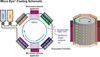
MicroDyn is DSI’s proprietary version of magnetron sputtering optimized for high throughput. MicroDyn utilizes an octagonally shaped chamber, where electrically conductive (metal or semiconductor) coating targets are arranged around the periphery, and the parts to be coated are held on a cylindrical rotating drum concentric within the chamber. Unlike other optical coating methods, sputtering does not require heating the coated parts. This allows the technique to be used on a wide range of substrate materials, as well as on assemblies that may incorporate plastic parts.

KEY MICRODYN ADVANTAGES

  • Compatible with a wide range of substrate materials
  • Produces dense coatings that are unaffected by temperature and humidity changes
  • Enables complex multilayer coatings with sophisticated functionality

TYPICAL MICRODYN APPLICATIONS

  • Hot mirrors
  • Cold mirrors
  • Dark mirrors
  • Bandpass filters
  • Short and long wave pass filters
  • Antireflection coatings
  • High reflection coatings
  • Beamsplitters

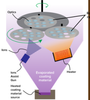
In magnetron sputtering, the chamber is first evacuated, and then filled with a low pressure of a sputter gas, typically argon. The targets are biased with a negative voltage and immersed in a magnetic field. Electrons leaving the target are contained in the vicinity due to this magnetic field.

The electrons collide with the sputter gas atoms and ionize them, and these ions are accelerated towards the target(s) because of their negative electrical potential. When these ions impact the target, they cause atoms or molecules to be ejected (sputtered). Due to the low gas pressure, the sputtered particles have a long mean free path length, and they stream away from the source and are deposited on the revolving substrates.

In MicroDyn sputtering, a small amount of a reactive gas (usually oxygen) is also introduced into the machine during this process and microwaves are utilized to turn it into a plasma. These oxygen ions react with the material deposited on the substrates to create oxides. This reaction is very thorough, yielding oxide layer coatings which have very well controlled index of refraction characteristics. This enhances the ability to accurately achieve the designed spectral performance in the real world coating.

Because the sputtered target atoms are ejected with a large amount of energy, they pack densely into the thin film. The result is that MicroDyn coatings are inherently harder and less porous than evaporated films. A dense film is advantageous because it doesn’t readily absorb water; this, in turn, makes the coating performance more stable when subjected to large shifts in ambient humidity and temperature. It also means that the film will retain its mechanical integrity through numerous cycles of temperature and humidity. MicroDyn coatings can also routinely handle exposure of up to 550°C; coatings that can withstand temperatures of up to 1000°C have been produced through a special, patented process.

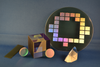
Another advantage of DSI’s MicroDyn sputtering process is that more than one sputtering target can be active at once. Co-sputtering two materials (a high index and low index) simultaneously allows the creation of a mixed layer with a controllable intermediate index. This extra degree of freedom gives the coating designer significantly greater flexibility, and enables the production of more sophisticated thin films. The same factors that make MicroDyn films so thermally and mechanically durable also allow the fabrication of stable films containing very large numbers of layers, which further enhances the designer’s power. For example, DSI’s Super HeatBuster hot mirror consists of over 90 separate layers.

Supplier's Site Datasheet

Technical Specifications

  Deposition Sciences, Inc.
Product Category Thin Film Coating Services
Product Name Sputter Deposition
Company Information Deposition Sciences, Inc. (DSI®), a wholly owned subsidiary of Lockheed Martin, provides innovative, durable optical coating solutions for aerospace, commercial, and military customers. Applications include automotive, biomedical, astronomy, homeland security, imaging, telecommunications, scientific research, and industrial R&D. With lean manufacturing standards and talented engineers, we meet the diverse needs of customers who require cost-effective thin film coating solutions.
Capabilities Material Selection / Design Assistance; Research & Development (optional feature); Physical Vapor Deposition (PVD); Plasma Etching / Cleaning; Hard Coating
Certifications / Standards ISO 9001:2015 Certified, ITAR Registered and Compliant
Materials Titanium; Exotic Metals; Aluminum; Nickel / Nickel alloys; Precious Metals; Nb2O5, Si, SiO2, Ta2O5, TiO2
Unlock Full Specs
to access all available technical data

Similar Products

 - ACG - Evaporated Metal Films (EMF)
Evaporated Metal Films (EMF)
Specs
Company Information ACG is a 50+ year old, former Bausch & Lomb Division offering low cost, tight tolerance, large format (up to 35" diameter) optical filters and reflectors. We offer fast design/prototype/production cycle time coupled with significant production capacity.
Capabilities Material Selection / Design Assistance; Research & Development; Physical Vapor Deposition (PVD); Hard Coating; Sputtering
Certifications / Standards ISO 9001:2000
View Details
Thin Film Coating Service -  - MINTEQ® International Inc, Pyrogenics Group
MINTEQ® International Inc, Pyrogenics Group
Specs
Company Information Pyrogenics Group is a technological leader in the production of very specialized, high-purity carbon products with unique thermal, electrical, physical and chemical properties that have application advantages where extreme temperatures and stress exist.
Capabilities Research & Development; Chemical Vapor Deposition (CVD); Ion Implantation; Plasma Etching / Cleaning; Hard Coating; JIC on Composite
Certifications / Standards AS9100D and ISO 9001:2015
View Details
Evaporation Deposition -  - Deposition Sciences, Inc.
Deposition Sciences, Inc.
Specs
Company Information Deposition Sciences, Inc. (DSI®), a wholly owned subsidiary of Lockheed Martin, provides innovative, durable optical coating solutions for aerospace, commercial, and military customers. Applications include automotive, biomedical, astronomy, homeland security, imaging, telecommunications, scientific research, and industrial R&D. With lean manufacturing standards and talented engineers, we meet the diverse needs of customers who require cost-effective thin film coating solutions.
Capabilities Material Selection / Design Assistance; Physical Vapor Deposition (PVD); Plasma Etching / Cleaning
Certifications / Standards ISO 9001:2015 Certified, ITAR Registered and Compliant
View Details
Thin Film Coating -  - Cascade Optical Corp.
Cascade Optical Corp.
Specs
Company Information Offering optical thin film coatings for a diversity of industries, Cascade Optical Corporation is your complete one-stop coating design and manufacturing services provider. Offering very short lead times, and engineering department design assistance.
Capabilities Physical Vapor Deposition (PVD); Ion Implantation; IOPLAS-II™ Ion-Assisted Deposition
Certifications / Standards MIL-SPEC / MIL-STD; OEM Specific
View Details