Deposition Sciences, Inc. Evaporation Deposition

Description
EVAPORATION TECHNOLOGY In a typical evaporative coating chamber, one or more racks hold the substrate material to be coated. The first step in the process is to pump all the air out of the chamber to achieve a very high vacuum (10-6 Torr or better). A succession of coating materials is then evaporated, typically using either resistive heating or electron beam bombardment. EVAPORATION ADVANTAGES Rapid, high precision process Compatible with numerous different coating and substrate materials Enables complex multilayer coatings with sophisticated functionality TYPICAL EVAPORATION APPLICATIONS Antireflection coatings High reflection coatings Short and long wave pass filters Bandpass filters Beamsplitters Because the chamber is in high vacuum, the mean free path of evaporated atoms or molecules is several meters. They stream out and condense onto any surface that has a direct line of sight to the source. Consequently the deposition rate is highly dependent upon the distance and relative angular orientation from the source to the substrate surface. In order to maximize layer uniformity, the racks are rotated during coating such that every part experiences the same “time-averaged” distance from the source. Complex internal masking is also often used to enhance deposition uniformity throughout the chamber and, since only one side of the component faces the material source, it is necessary to repeat this entire process in order to coat both the front and back surfaces of a single component. However, evaporation remains a method best suited for optics that are either planar or have a relatively long radius of curvature. Because of this, highly curved parts, such as the deep parabolic and ellipsoidal reflectors often used to concentrate high power light sources, are usually best coated using the IsoDyn method. One of the advantages of evaporation over other methods is that deposition rates are high, and therefore, even very thick coatings can be coated in hours rather than the days that might be required with other processes. Evaporation is also compatible with a very broad range of coating materials, from the fluorides often used for UV coatings, to oxides used throughout the visible and mid-IR, to semiconductors and sulfides which are frequently utilized for mid-IR through far-IR coatings. Because of the relatively low energy with which atoms or molecules are ejected from the material source, evaporative coatings are somewhat porous as compared to the films produced using our MicroDyn or IsoDyn processes. Porosity can negatively impact the hardness and mechanical durability of the resultant film, although most all-dielectric coatings produced at DSI through evaporation are still sufficiently hard to meet most MIL-SPEC durability and environmental requirements. Two important adjuncts are used in DSI’s evaporation chambers to improve the resultant films it produces. First, parts are usually heated to provide energy to the deposition process, which is one way that DSI increases the hardness of its evaporated coatings. Second, DSI selectively employs Ion Assisted Deposition (IAD). Specifically, a high energy ion beam is included within the chamber, and is directed towards the optics to be coated where they physically impact the component surfaces. This is used to pre-clean substrate surfaces, which improves film adhesion, and can be used during deposition, to improve film durability. Put our coating technology to work for your next application. Simply drop us a note or request a quote today.
Description
EVAPORATION TECHNOLOGY In a typical evaporative coating chamber, one or more racks hold the substrate material to be coated. The first step in the process is to pump all the air out of the chamber to achieve a very high vacuum (10-6 Torr or better). A succession of coating materials is then evaporated, typically using either resistive heating or electron beam bombardment. EVAPORATION ADVANTAGES Rapid, high precision process Compatible with numerous different coating and substrate materials Enables complex multilayer coatings with sophisticated functionality TYPICAL EVAPORATION APPLICATIONS Antireflection coatings High reflection coatings Short and long wave pass filters Bandpass filters Beamsplitters Because the chamber is in high vacuum, the mean free path of evaporated atoms or molecules is several meters. They stream out and condense onto any surface that has a direct line of sight to the source. Consequently the deposition rate is highly dependent upon the distance and relative angular orientation from the source to the substrate surface. In order to maximize layer uniformity, the racks are rotated during coating such that every part experiences the same “time-averaged” distance from the source. Complex internal masking is also often used to enhance deposition uniformity throughout the chamber and, since only one side of the component faces the material source, it is necessary to repeat this entire process in order to coat both the front and back surfaces of a single component. However, evaporation remains a method best suited for optics that are either planar or have a relatively long radius of curvature. Because of this, highly curved parts, such as the deep parabolic and ellipsoidal reflectors often used to concentrate high power light sources, are usually best coated using the IsoDyn method. One of the advantages of evaporation over other methods is that deposition rates are high, and therefore, even very thick coatings can be coated in hours rather than the days that might be required with other processes. Evaporation is also compatible with a very broad range of coating materials, from the fluorides often used for UV coatings, to oxides used throughout the visible and mid-IR, to semiconductors and sulfides which are frequently utilized for mid-IR through far-IR coatings. Because of the relatively low energy with which atoms or molecules are ejected from the material source, evaporative coatings are somewhat porous as compared to the films produced using our MicroDyn or IsoDyn processes. Porosity can negatively impact the hardness and mechanical durability of the resultant film, although most all-dielectric coatings produced at DSI through evaporation are still sufficiently hard to meet most MIL-SPEC durability and environmental requirements. Two important adjuncts are used in DSI’s evaporation chambers to improve the resultant films it produces. First, parts are usually heated to provide energy to the deposition process, which is one way that DSI increases the hardness of its evaporated coatings. Second, DSI selectively employs Ion Assisted Deposition (IAD). Specifically, a high energy ion beam is included within the chamber, and is directed towards the optics to be coated where they physically impact the component surfaces. This is used to pre-clean substrate surfaces, which improves film adhesion, and can be used during deposition, to improve film durability. Put our coating technology to work for your next application. Simply drop us a note or request a quote today.

Suppliers

Company
Product
Description
Supplier Links
Evaporation Deposition -  - Deposition Sciences, Inc.
Santa Rosa, CA, United States
Evaporation Deposition
EVAPORATION TECHNOLOGY In a typical evaporative coating chamber, one or more racks hold the substrate material to be coated. The first step in the process is to pump all the air out of the chamber to achieve a very high vacuum (10-6 Torr or better). A succession of coating materials is then evaporated, typically using either resistive heating or electron beam bombardment. EVAPORATION ADVANTAGES Rapid, high precision process Compatible with numerous different coating and substrate materials Enables complex multilayer coatings with sophisticated functionality TYPICAL EVAPORATION APPLICATIONS Antireflection coatings High reflection coatings Short and long wave pass filters Bandpass filters Beamsplitters Because the chamber is in high vacuum, the mean free path of evaporated atoms or molecules is several meters. They stream out and condense onto any surface that has a direct line of sight to the source. Consequently the deposition rate is highly dependent upon the distance and relative angular orientation from the source to the substrate surface. In order to maximize layer uniformity, the racks are rotated during coating such that every part experiences the same “time-averaged” distance from the source. Complex internal masking is also often used to enhance deposition uniformity throughout the chamber and, since only one side of the component faces the material source, it is necessary to repeat this entire process in order to coat both the front and back surfaces of a single component. However, evaporation remains a method best suited for optics that are either planar or have a relatively long radius of curvature. Because of this, highly curved parts, such as the deep parabolic and ellipsoidal reflectors often used to concentrate high power light sources, are usually best coated using the IsoDyn method. One of the advantages of evaporation over other methods is that deposition rates are high, and therefore, even very thick coatings can be coated in hours rather than the days that might be required with other processes. Evaporation is also compatible with a very broad range of coating materials, from the fluorides often used for UV coatings, to oxides used throughout the visible and mid-IR, to semiconductors and sulfides which are frequently utilized for mid-IR through far-IR coatings. Because of the relatively low energy with which atoms or molecules are ejected from the material source, evaporative coatings are somewhat porous as compared to the films produced using our MicroDyn or IsoDyn processes. Porosity can negatively impact the hardness and mechanical durability of the resultant film, although most all-dielectric coatings produced at DSI through evaporation are still sufficiently hard to meet most MIL-SPEC durability and environmental requirements. Two important adjuncts are used in DSI’s evaporation chambers to improve the resultant films it produces. First, parts are usually heated to provide energy to the deposition process, which is one way that DSI increases the hardness of its evaporated coatings. Second, DSI selectively employs Ion Assisted Deposition (IAD). Specifically, a high energy ion beam is included within the chamber, and is directed towards the optics to be coated where they physically impact the component surfaces. This is used to pre-clean substrate surfaces, which improves film adhesion, and can be used during deposition, to improve film durability. Put our coating technology to work for your next application. Simply drop us a note or request a quote today.

EVAPORATION TECHNOLOGY

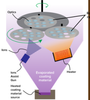
In a typical evaporative coating chamber, one or more racks hold the substrate material to be coated. The first step in the process is to pump all the air out of the chamber to achieve a very high vacuum (10-6 Torr or better). A succession of coating materials is then evaporated, typically using either resistive heating or electron beam bombardment.

EVAPORATION ADVANTAGES

  • Rapid, high precision process
  • Compatible with numerous different coating and substrate materials
  • Enables complex multilayer coatings with sophisticated functionality

TYPICAL EVAPORATION APPLICATIONS

  • Antireflection coatings
  • High reflection coatings
  • Short and long wave pass filters
  • Bandpass filters
  • Beamsplitters

Because the chamber is in high vacuum, the mean free path of evaporated atoms or molecules is several meters. They stream out and condense onto any surface that has a direct line of sight to the source. Consequently the deposition rate is highly dependent upon the distance and relative angular orientation from the source to the substrate surface. In order to maximize layer uniformity, the racks are rotated during coating such that every part experiences the same “time-averaged” distance from the source. Complex internal masking is also often used to enhance deposition uniformity throughout the chamber and, since only one side of the component faces the material source, it is necessary to repeat this entire process in order to coat both the front and back surfaces of a single component. However, evaporation remains a method best suited for optics that are either planar or have a relatively long radius of curvature. Because of this, highly curved parts, such as the deep parabolic and ellipsoidal reflectors often used to concentrate high power light sources, are usually best coated using the IsoDyn method.

One of the advantages of evaporation over other methods is that deposition rates are high, and therefore, even very thick coatings can be coated in hours rather than the days that might be required with other processes. Evaporation is also compatible with a very broad range of coating materials, from the fluorides often used for UV coatings, to oxides used throughout the visible and mid-IR, to semiconductors and sulfides which are frequently utilized for mid-IR through far-IR coatings.

Because of the relatively low energy with which atoms or molecules are ejected from the material source, evaporative coatings are somewhat porous as compared to the films produced using our

MicroDyn or IsoDyn processes. Porosity can negatively impact the hardness and mechanical durability of the resultant film, although most all-dielectric coatings produced at DSI through evaporation are still sufficiently hard to meet most MIL-SPEC durability and environmental requirements.

Two important adjuncts are used in DSI’s evaporation chambers to improve the resultant films it produces. First, parts are usually heated to provide energy to the deposition process, which is one way that DSI increases the hardness of its evaporated coatings. Second, DSI selectively employs Ion Assisted Deposition (IAD). Specifically, a high energy ion beam is included within the chamber, and is directed towards the optics to be coated where they physically impact the component surfaces. This is used to pre-clean substrate surfaces, which improves film adhesion, and can be used during deposition, to improve film durability.

Put our coating technology to work for your next application. Simply drop us a note or request a quote today.

Supplier's Site

Technical Specifications

  Deposition Sciences, Inc.
Product Category Thin Film Coating Services
Product Name Evaporation Deposition
Company Information Deposition Sciences, Inc. (DSI®), a wholly owned subsidiary of Lockheed Martin, provides innovative, durable optical coating solutions for aerospace, commercial, and military customers. Applications include automotive, biomedical, astronomy, homeland security, imaging, telecommunications, scientific research, and industrial R&D. With lean manufacturing standards and talented engineers, we meet the diverse needs of customers who require cost-effective thin film coating solutions.
Capabilities Material Selection / Design Assistance; Physical Vapor Deposition (PVD); Plasma Etching / Cleaning
Certifications / Standards ISO 9001:2015 Certified, ITAR Registered and Compliant
Materials Exotic Metals; Precious Metals; Ge, Si, SiO, ZnS
Unlock Full Specs
to access all available technical data

Similar Products

 - ACG - Evaporated Metal Films (EMF)
Evaporated Metal Films (EMF)
Specs
Company Information ACG is a 50+ year old, former Bausch & Lomb Division offering low cost, tight tolerance, large format (up to 35" diameter) optical filters and reflectors. We offer fast design/prototype/production cycle time coupled with significant production capacity.
Capabilities Material Selection / Design Assistance; Research & Development; Physical Vapor Deposition (PVD); Hard Coating; Sputtering
Certifications / Standards ISO 9001:2000
View Details
Thin Film Coating Service -  - MINTEQ® International Inc, Pyrogenics Group
MINTEQ® International Inc, Pyrogenics Group
Specs
Company Information Pyrogenics Group is a technological leader in the production of very specialized, high-purity carbon products with unique thermal, electrical, physical and chemical properties that have application advantages where extreme temperatures and stress exist.
Capabilities Research & Development; Chemical Vapor Deposition (CVD); Ion Implantation; Plasma Etching / Cleaning; Hard Coating; JIC on Composite
Certifications / Standards AS9100D and ISO 9001:2015
View Details
Sputter Deposition -  - Deposition Sciences, Inc.
Deposition Sciences, Inc.
Specs
Company Information Deposition Sciences, Inc. (DSI®), a wholly owned subsidiary of Lockheed Martin, provides innovative, durable optical coating solutions for aerospace, commercial, and military customers. Applications include automotive, biomedical, astronomy, homeland security, imaging, telecommunications, scientific research, and industrial R&D. With lean manufacturing standards and talented engineers, we meet the diverse needs of customers who require cost-effective thin film coating solutions.
Capabilities Material Selection / Design Assistance; Research & Development (optional feature); Physical Vapor Deposition (PVD); Plasma Etching / Cleaning; Hard Coating
Certifications / Standards ISO 9001:2015 Certified, ITAR Registered and Compliant
View Details
Thin Film Coating -  - Cascade Optical Corp.
Cascade Optical Corp.
Specs
Company Information Offering optical thin film coatings for a diversity of industries, Cascade Optical Corporation is your complete one-stop coating design and manufacturing services provider. Offering very short lead times, and engineering department design assistance.
Capabilities Physical Vapor Deposition (PVD); Ion Implantation; IOPLAS-II™ Ion-Assisted Deposition
Certifications / Standards MIL-SPEC / MIL-STD; OEM Specific
View Details