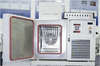
Linseis Inc. 8 Sample Dilatometer L75/120LT

Description
Features 8 measuring systems operate simultaneously temperature range -40°C up to +160°C sample dimensions 4 x 10 x 80mm measuring sensor LVDT 32 Bit Software running in Microsoft ® operating environment Description The Linseis dilatometer L75/120LT was developed to measure the expansion of polymer samples. Hereby up to 8 different samples can be measured simultaneously in a temperature range of –40°C up to +160°C. To cover the temperature range a commonly available climate chamber is used that incorporates a cooling generator and a heat source. The measuring sensors are mounted on top of the heat chamber and connect through a hole into the chamber. The complete arrangement is airtight, in order to avoid the intrusion of humidity into the measuring chamber. It is possible to insert inert gas into the measuring chamber. The temperature measurement is done by means of 4 type K thermocouples which are hanging always between 2 samples. This arrangement enables to get a good temperature profile over the measuring chamber. The change of the length of the samples over the temperature change is measured with a LVDT sensor (linear variable differential transformer). This sensor has a very high resolution of 14nm (Nanometer) 10E-9. All 8 LVDTs are connected to the data acquisition / controller parts into the connected computer. The normally used polymer samples can have a length of 80 up to 100mm. The cross-section of the samples can be 4 x 10mm up to 15 x 15mm. As the used measuring systems are made out of quartz with an expansion coefficient of approx. 5 x 10E-7/K and is thus very small compared to the normal expansion coefficient of the polymer samples, the expansion of the measuring system can be neglected. For very high accuracy measurements it is possible to use a calibration standard (none thermal expansion) to compensate the influence of quartz glass expansion. The maximum measuring range is +/- 1mm. To measure different sample length (80 up to 100mm) the piston of the measuring system can be adjusted by a motor. For the zero adjustment the piston will be adjusted by a threat made of invar (invar has a very low temperature expansion at RT) that independent from sample length the core of a transducer (LVDT) is always in the center (zero adjustment).
Description
Features 8 measuring systems operate simultaneously temperature range -40°C up to +160°C sample dimensions 4 x 10 x 80mm measuring sensor LVDT 32 Bit Software running in Microsoft ® operating environment Description The Linseis dilatometer L75/120LT was developed to measure the expansion of polymer samples. Hereby up to 8 different samples can be measured simultaneously in a temperature range of –40°C up to +160°C. To cover the temperature range a commonly available climate chamber is used that incorporates a cooling generator and a heat source. The measuring sensors are mounted on top of the heat chamber and connect through a hole into the chamber. The complete arrangement is airtight, in order to avoid the intrusion of humidity into the measuring chamber. It is possible to insert inert gas into the measuring chamber. The temperature measurement is done by means of 4 type K thermocouples which are hanging always between 2 samples. This arrangement enables to get a good temperature profile over the measuring chamber. The change of the length of the samples over the temperature change is measured with a LVDT sensor (linear variable differential transformer). This sensor has a very high resolution of 14nm (Nanometer) 10E-9. All 8 LVDTs are connected to the data acquisition / controller parts into the connected computer. The normally used polymer samples can have a length of 80 up to 100mm. The cross-section of the samples can be 4 x 10mm up to 15 x 15mm. As the used measuring systems are made out of quartz with an expansion coefficient of approx. 5 x 10E-7/K and is thus very small compared to the normal expansion coefficient of the polymer samples, the expansion of the measuring system can be neglected. For very high accuracy measurements it is possible to use a calibration standard (none thermal expansion) to compensate the influence of quartz glass expansion. The maximum measuring range is +/- 1mm. To measure different sample length (80 up to 100mm) the piston of the measuring system can be adjusted by a motor. For the zero adjustment the piston will be adjusted by a threat made of invar (invar has a very low temperature expansion at RT) that independent from sample length the core of a transducer (LVDT) is always in the center (zero adjustment).

Suppliers

Company
Product
Description
Supplier Links
8 Sample Dilatometer - L75/120LT - Linseis Inc.
Robbinsville, NJ, USA
8 Sample Dilatometer
L75/120LT
8 Sample Dilatometer L75/120LT
Features 8 measuring systems operate simultaneously temperature range -40°C up to +160°C sample dimensions 4 x 10 x 80mm measuring sensor LVDT 32 Bit Software running in Microsoft ® operating environment Description The Linseis dilatometer L75/120LT was developed to measure the expansion of polymer samples. Hereby up to 8 different samples can be measured simultaneously in a temperature range of –40°C up to +160°C. To cover the temperature range a commonly available climate chamber is used that incorporates a cooling generator and a heat source. The measuring sensors are mounted on top of the heat chamber and connect through a hole into the chamber. The complete arrangement is airtight, in order to avoid the intrusion of humidity into the measuring chamber. It is possible to insert inert gas into the measuring chamber. The temperature measurement is done by means of 4 type K thermocouples which are hanging always between 2 samples. This arrangement enables to get a good temperature profile over the measuring chamber. The change of the length of the samples over the temperature change is measured with a LVDT sensor (linear variable differential transformer). This sensor has a very high resolution of 14nm (Nanometer) 10E-9. All 8 LVDTs are connected to the data acquisition / controller parts into the connected computer. The normally used polymer samples can have a length of 80 up to 100mm. The cross-section of the samples can be 4 x 10mm up to 15 x 15mm. As the used measuring systems are made out of quartz with an expansion coefficient of approx. 5 x 10E-7/K and is thus very small compared to the normal expansion coefficient of the polymer samples, the expansion of the measuring system can be neglected. For very high accuracy measurements it is possible to use a calibration standard (none thermal expansion) to compensate the influence of quartz glass expansion. The maximum measuring range is +/- 1mm. To measure different sample length (80 up to 100mm) the piston of the measuring system can be adjusted by a motor. For the zero adjustment the piston will be adjusted by a threat made of invar (invar has a very low temperature expansion at RT) that independent from sample length the core of a transducer (LVDT) is always in the center (zero adjustment).

Features

  • 8 measuring systems operate simultaneously
  • temperature range -40°C up to +160°C
  • sample dimensions 4 x 10 x 80mm
  • measuring sensor LVDT
  • 32 Bit Software running in Microsoft ® operating environment

Description
The Linseis dilatometer L75/120LT was developed to measure the expansion of polymer samples. Hereby up to 8 different samples can be measured simultaneously in a temperature range of –40°C up to +160°C. To cover the temperature range a commonly available climate chamber is used that incorporates a cooling generator and a heat source. The measuring sensors are mounted on top of the heat chamber and connect through a hole into the chamber. The complete arrangement is airtight, in order to avoid the intrusion of humidity into the measuring chamber.
It is possible to insert inert gas into the measuring chamber. The temperature measurement is done by means of 4 type K thermocouples which are hanging always between 2 samples.
This arrangement enables to get a good temperature profile over the measuring chamber. The change of the length of the samples over the temperature change is measured with a LVDT sensor (linear variable differential transformer). This sensor has a very high resolution of 14nm (Nanometer) 10E-9. All 8 LVDTs are connected to the data acquisition / controller parts into the connected computer. The normally used polymer samples can have a length of 80 up to 100mm. The cross-section of the samples can be 4 x 10mm up to 15 x 15mm.
As the used measuring systems are made out of quartz with an expansion coefficient of approx. 5 x 10E-7/K and is thus very small compared to the normal expansion coefficient of the polymer samples, the expansion of the measuring system can be neglected.
For very high accuracy measurements it is possible to use a calibration standard (none thermal expansion) to compensate the influence of quartz glass expansion. The maximum measuring range is +/- 1mm. To measure different sample length (80 up to 100mm) the piston of the measuring system can be adjusted by a motor.
For the zero adjustment the piston will be adjusted by a threat made of invar (invar has a very low temperature expansion at RT) that independent from sample length the core of a transducer (LVDT) is always in the center (zero adjustment).

Technical Specifications

  Linseis Inc.
Product Category Calorimeters and Thermal Analyzers
Product Number L75/120LT
Product Name 8 Sample Dilatometer
Thermal Analyzer Type Dilatometer
Properties Measured Expansion Of Polymer Samples
Thermal Analyzer Performance Specs Samples Length: 80-100mm
Features Cooling; Programmable Heating; Atmosphere Control; Temperature Control
Display Analog; Video
Unlock Full Specs
to access all available technical data

Similar Products

Simultaneous Thermogravimetric Analyzer - STA300 - Hitachi High-Tech America
Specs
Thermal Analyzer Type Thermal Gravimetric Analyzer
Temperature Range 25 to 1500 C (77 to 2732 F)
Remote Interface Computer Interface; Application Software Included. (optional feature)
View Details
Fascinating Flexibility in Thermal Analysis - High-Temperature Differential Scanning Calorimeter: DSC 404 F1 Pegasus® -  - NETZSCH-Gerätebau GmbH
Specs
Calorimeter Type Differential Scanning Calorimeter
Properties Measured Thermodynamic Properties of Ceramics and Metallic High Performance Materials
Features Temperature Control
View Details
Thermomechanical Analyzer - TMA PT1000 - Linseis Inc.
Specs
Thermal Analyzer Type Thermal Mechanical Analyzer
Features Programmable Heating; Atmosphere Control; Temperature Control
Temperature Range -150 to 1500 C (-238 to 2732 F)
View Details
Thermogravimetry Differential Thermal Analyzer - TG-DTA/GC-MS - Rigaku Corporation
Specs
Thermal Analyzer Type Differential Thermal Analysis; Thermal Gravimetric Analyzer
Thermal Analyzer Performance Specs Thermal Stability
Features Coupled with a Mass Spectrometer; Coupled with a Gas Chromatograph
View Details
