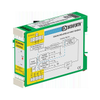
Campbell Scientific, Inc. Interface for Vibrating Wire Sensors AVW100

Description
The AVW100 is available as a replacement part or as needed for continuity or compatibility, but we recommend the AVW200-series interfaces for all new applications. The AVW200 interfaces are much more accurate and feature a high degree of noise immunity for your vibrating wire measurements. The AVW100 provides amplification and signal conditioning for the frequency signal of one vibrating wire or vibrating strip transducer. Compatible sensors include pressure, load, strain, or even vibrating wire temperature sensors. The recommended frequency range is 250 to 9900 Hz (up to 5000 Hz in the CR5000). It is similar in general design to our AVW1 and AVW4, but is designed for use with frequencies that those interfaces do not support (i.e., 250 to 1000 Hz).
Description
The AVW100 is available as a replacement part or as needed for continuity or compatibility, but we recommend the AVW200-series interfaces for all new applications. The AVW200 interfaces are much more accurate and feature a high degree of noise immunity for your vibrating wire measurements. The AVW100 provides amplification and signal conditioning for the frequency signal of one vibrating wire or vibrating strip transducer. Compatible sensors include pressure, load, strain, or even vibrating wire temperature sensors. The recommended frequency range is 250 to 9900 Hz (up to 5000 Hz in the CR5000). It is similar in general design to our AVW1 and AVW4, but is designed for use with frequencies that those interfaces do not support (i.e., 250 to 1000 Hz).

Suppliers

Company
Product
Description
Supplier Links
Interface for Vibrating Wire Sensors - AVW100 - Campbell Scientific, Inc.
Logan, UT, USA
Interface for Vibrating Wire Sensors
AVW100
Interface for Vibrating Wire Sensors AVW100
The AVW100 is available as a replacement part or as needed for continuity or compatibility, but we recommend the AVW200-series interfaces for all new applications. The AVW200 interfaces are much more accurate and feature a high degree of noise immunity for your vibrating wire measurements. The AVW100 provides amplification and signal conditioning for the frequency signal of one vibrating wire or vibrating strip transducer. Compatible sensors include pressure, load, strain, or even vibrating wire temperature sensors. The recommended frequency range is 250 to 9900 Hz (up to 5000 Hz in the CR5000). It is similar in general design to our AVW1 and AVW4, but is designed for use with frequencies that those interfaces do not support (i.e., 250 to 1000 Hz).

The AVW100 is available as a replacement part or as needed for continuity or compatibility, but we recommend the AVW200-series interfaces for all new applications. The AVW200 interfaces are much more accurate and feature a high degree of noise immunity for your vibrating wire measurements.

The AVW100 provides amplification and signal conditioning for the frequency signal of one vibrating wire or vibrating strip transducer. Compatible sensors include pressure, load, strain, or even vibrating wire temperature sensors. The recommended frequency range is 250 to 9900 Hz (up to 5000 Hz in the CR5000). It is similar in general design to our AVW1 and AVW4, but is designed for use with frequencies that those interfaces do not support (i.e., 250 to 1000 Hz).

Supplier's Site

Technical Specifications

  Campbell Scientific, Inc.
Product Category Signal Conditioners
Product Number AVW100
Product Name Interface for Vibrating Wire Sensors
Signal Conditioning Instrumentation Amplifier
Form Factor Panel / Chassis Mount
Outputs Frequency or Pulse Output
User Interface None
Unlock Full Specs
to access all available technical data

Similar Products

S7AC dc powered LVDT transducer amplifier. - S7AC - RDP Electrosense
Specs
Form Factor Modular Bay or Slot System
Outputs Frequency or Pulse Output; 500Hz
Operating Temperature 14 to 140 F (-10 to 60 C)
View Details
2 suppliers
Isolation - Digital Isolators - 4DIR1401HA -  - Infineon Technologies AG
Specs
Signal Conditioning SigIsol
View Details