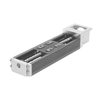
Yamaha Corporation Linear Motion Systems Multi robots

Description
Yamaha's multi-robot operation is an innovative solution that allows for the operation of multiple single-axis robots using a single controller. This operation provides several advantages over operating multiple single-axis controllers. Firstly, the sequence control is simple and easy to manage, as all the robots are controlled by a single controller. This helps reduce the complexity of the control system, making it easier to operate. Secondly, using a multi-axis controller reduces the overall cost of the system upgrade. Instead of replacing all the single-axis controllers, only the multi-axis controller needs to be upgraded, leading to cost savings. Furthermore, the compact design of the multi-axis controller helps save space compared to operating multiple single-axis controllers, which is especially useful in applications where space is limited. Another advantage of multi-axis controllers is that they allow for more sophisticated control. For instance, Yamaha's multi-axis controllers RCX221, RCX320, and RCX340 provide mixed control of the PHASER series and FLIP-X series. This means that users can operate different types of robots with different capabilities and functions, allowing for more advanced and versatile applications. Overall, Yamaha's multi-robot operation is an innovative solution that provides several advantages over operating multiple single-axis controllers. It simplifies sequence control, reduces costs, saves space, and allows for more sophisticated control.
Description
Yamaha's multi-robot operation is an innovative solution that allows for the operation of multiple single-axis robots using a single controller. This operation provides several advantages over operating multiple single-axis controllers. Firstly, the sequence control is simple and easy to manage, as all the robots are controlled by a single controller. This helps reduce the complexity of the control system, making it easier to operate. Secondly, using a multi-axis controller reduces the overall cost of the system upgrade. Instead of replacing all the single-axis controllers, only the multi-axis controller needs to be upgraded, leading to cost savings. Furthermore, the compact design of the multi-axis controller helps save space compared to operating multiple single-axis controllers, which is especially useful in applications where space is limited. Another advantage of multi-axis controllers is that they allow for more sophisticated control. For instance, Yamaha's multi-axis controllers RCX221, RCX320, and RCX340 provide mixed control of the PHASER series and FLIP-X series. This means that users can operate different types of robots with different capabilities and functions, allowing for more advanced and versatile applications. Overall, Yamaha's multi-robot operation is an innovative solution that provides several advantages over operating multiple single-axis controllers. It simplifies sequence control, reduces costs, saves space, and allows for more sophisticated control.

Suppliers

Company
Product
Description
Supplier Links
Hamamatsu, Shizuoka, Japan
Linear Motion Systems
Multi robots
Linear Motion Systems Multi robots
Yamaha's multi-robot operation is an innovative solution that allows for the operation of multiple single-axis robots using a single controller. This operation provides several advantages over operating multiple single-axis controllers. Firstly, the sequence control is simple and easy to manage, as all the robots are controlled by a single controller. This helps reduce the complexity of the control system, making it easier to operate. Secondly, using a multi-axis controller reduces the overall cost of the system upgrade. Instead of replacing all the single-axis controllers, only the multi-axis controller needs to be upgraded, leading to cost savings. Furthermore, the compact design of the multi-axis controller helps save space compared to operating multiple single-axis controllers, which is especially useful in applications where space is limited. Another advantage of multi-axis controllers is that they allow for more sophisticated control. For instance, Yamaha's multi-axis controllers RCX221, RCX320, and RCX340 provide mixed control of the PHASER series and FLIP-X series. This means that users can operate different types of robots with different capabilities and functions, allowing for more advanced and versatile applications. Overall, Yamaha's multi-robot operation is an innovative solution that provides several advantages over operating multiple single-axis controllers. It simplifies sequence control, reduces costs, saves space, and allows for more sophisticated control.

Yamaha's multi-robot operation is an innovative solution that allows for the operation of multiple single-axis robots using a single controller. This operation provides several advantages over operating multiple single-axis controllers. Firstly, the sequence control is simple and easy to manage, as all the robots are controlled by a single controller. This helps reduce the complexity of the control system, making it easier to operate.
Secondly, using a multi-axis controller reduces the overall cost of the system upgrade. Instead of replacing all the single-axis controllers, only the multi-axis controller needs to be upgraded, leading to cost savings. Furthermore, the compact design of the multi-axis controller helps save space compared to operating multiple single-axis controllers, which is especially useful in applications where space is limited.
Another advantage of multi-axis controllers is that they allow for more sophisticated control. For instance, Yamaha's multi-axis controllers RCX221, RCX320, and RCX340 provide mixed control of the PHASER series and FLIP-X series. This means that users can operate different types of robots with different capabilities and functions, allowing for more advanced and versatile applications.
Overall, Yamaha's multi-robot operation is an innovative solution that provides several advantages over operating multiple single-axis controllers. It simplifies sequence control, reduces costs, saves space, and allows for more sophisticated control.

Supplier's Site

Technical Specifications

  Yamaha Corporation
Product Category Linear Actuators
Product Number Multi robots
Product Name Linear Motion Systems
Unlock Full Specs
to access all available technical data

Similar Products

LA10 Series Linear Actuators - MMP LA10-12V-10-B-200-P - Midwest Motion Products, Inc.
Specs
Stroke or X-Axis Travel 6.81 inch (173 mm)
Rated Speed 1.05 in/sec (1.6 m/min)
Rated Force 787 lbs (357 kg)
View Details
P8-S Micro Linear Actuator - 75mm - 165:1 - 12 volts - P8-75-165-12-S - Actuonix Motion Devices
Specs
Device Type Rod Type
Actuation Type Electrical
Stroke or X-Axis Travel 2.95 inch (75 mm)
View Details
Linear Guide Actuator - ENDURO - Modern Linear Incorporated
Modern Linear Incorporated
Specs
Drive Type Belt Drive
Material Aluminum; Steel; Stainless Steel; Carbon Steel
View Details
STEPPER LINEAR ACTUATOR - 28 Series Size 11 (46mm)-BSA - 3X Motion Technologies Co., Ltd
Specs
Actuation Type Electrical
Drive Type Ball Screw
Motor Type DC
View Details