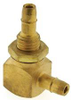
Xoxide PrimoChill UV Colored Barbed Y Fitting- 1/4 - UV Orange 70228

Description
Our Single Barb Fittings Features and Clamp Dynamics The threads are molded in precision-ground cavities resulting in perfectly matched threads at the parting line. This produces the cleanest, most accurate molded thread possible. Why our fittings are better. Our single-barbed fittings are designed so the mold parting line stops at the base of the barb. The ridge and the barb's conical surface are free of the molded-in leak path present in multiple barb fittings. The conical surface is glass-like and smooth allowing excellent sealing. The straight barb shaft provides space for the hose to relax behind the barb causing the clamp to work like a drawstring. This forces the hose diameter to become smaller than the flare of the fitting's barb. If the tubing swells from internal pressure (near burst), the clamp will be pulled up tight to the back of the barb and a tight seal will be maintained. Our Single Barb Fitting vs. Multiple Barb Fittings Clamp placement on a single barb fitting. Clamp positioning in the recess behind the barb allows for tubing compression anterior to the barb and results in a secure seal without excessive clamp pressure Clamp placement on a Multiple barb fitting. Clamp can only be placed over barb. In general, much more clamp pressure is required to secure a seal than that necessary with a single barb fitting Why multiple barb fittings fail Mismatches often occur with poor quality or worn tooling, causing misaligned threads and barbs that result in leakage. With multiple barb fitting designs, it is virtually impossible to avoid creating parting lines on the barb surface. These parting lines create leak paths which become more pronounced as the mold tooling wears. Mulitple Barb Fitting- Clamp Dynamics 1. Clamping on a barb's outer radius, in an attempt to force the tube down behind the barbs can cause damage. The sharp edges of the barbs become rounded resulting in less bite into the tubing. 2. Clamping pressure causes the tube to flare out behind the clamp and barbs located behind the clamp will have little or no effect. Multiple barbs are typically in close succession. This prevents the tubing from relaxing to its original size, which is essential to the barb's performance. If the tubing does not relax behind the barb, the barb is rendered useless, as shown above. (Note the bridging effect.)
Description
Our Single Barb Fittings Features and Clamp Dynamics The threads are molded in precision-ground cavities resulting in perfectly matched threads at the parting line. This produces the cleanest, most accurate molded thread possible. Why our fittings are better. Our single-barbed fittings are designed so the mold parting line stops at the base of the barb. The ridge and the barb's conical surface are free of the molded-in leak path present in multiple barb fittings. The conical surface is glass-like and smooth allowing excellent sealing. The straight barb shaft provides space for the hose to relax behind the barb causing the clamp to work like a drawstring. This forces the hose diameter to become smaller than the flare of the fitting's barb. If the tubing swells from internal pressure (near burst), the clamp will be pulled up tight to the back of the barb and a tight seal will be maintained. Our Single Barb Fitting vs. Multiple Barb Fittings Clamp placement on a single barb fitting. Clamp positioning in the recess behind the barb allows for tubing compression anterior to the barb and results in a secure seal without excessive clamp pressure Clamp placement on a Multiple barb fitting. Clamp can only be placed over barb. In general, much more clamp pressure is required to secure a seal than that necessary with a single barb fitting Why multiple barb fittings fail Mismatches often occur with poor quality or worn tooling, causing misaligned threads and barbs that result in leakage. With multiple barb fitting designs, it is virtually impossible to avoid creating parting lines on the barb surface. These parting lines create leak paths which become more pronounced as the mold tooling wears. Mulitple Barb Fitting- Clamp Dynamics 1. Clamping on a barb's outer radius, in an attempt to force the tube down behind the barbs can cause damage. The sharp edges of the barbs become rounded resulting in less bite into the tubing. 2. Clamping pressure causes the tube to flare out behind the clamp and barbs located behind the clamp will have little or no effect. Multiple barbs are typically in close succession. This prevents the tubing from relaxing to its original size, which is essential to the barb's performance. If the tubing does not relax behind the barb, the barb is rendered useless, as shown above. (Note the bridging effect.)

Suppliers

Company
Product
Description
Supplier Links
PrimoChill UV Colored Barbed Y Fitting- 1/4 - UV Orange - 70228 - Xoxide
Malvern, PA, USA
PrimoChill UV Colored Barbed Y Fitting- 1/4 - UV Orange
70228
PrimoChill UV Colored Barbed Y Fitting- 1/4 - UV Orange 70228
Our Single Barb Fittings Features and Clamp Dynamics The threads are molded in precision-ground cavities resulting in perfectly matched threads at the parting line. This produces the cleanest, most accurate molded thread possible. Why our fittings are better. Our single-barbed fittings are designed so the mold parting line stops at the base of the barb. The ridge and the barb's conical surface are free of the molded-in leak path present in multiple barb fittings. The conical surface is glass-like and smooth allowing excellent sealing. The straight barb shaft provides space for the hose to relax behind the barb causing the clamp to work like a drawstring. This forces the hose diameter to become smaller than the flare of the fitting's barb. If the tubing swells from internal pressure (near burst), the clamp will be pulled up tight to the back of the barb and a tight seal will be maintained. Our Single Barb Fitting vs. Multiple Barb Fittings Clamp placement on a single barb fitting. Clamp positioning in the recess behind the barb allows for tubing compression anterior to the barb and results in a secure seal without excessive clamp pressure Clamp placement on a Multiple barb fitting. Clamp can only be placed over barb. In general, much more clamp pressure is required to secure a seal than that necessary with a single barb fitting Why multiple barb fittings fail Mismatches often occur with poor quality or worn tooling, causing misaligned threads and barbs that result in leakage. With multiple barb fitting designs, it is virtually impossible to avoid creating parting lines on the barb surface. These parting lines create leak paths which become more pronounced as the mold tooling wears. Mulitple Barb Fitting- Clamp Dynamics 1. Clamping on a barb's outer radius, in an attempt to force the tube down behind the barbs can cause damage. The sharp edges of the barbs become rounded resulting in less bite into the tubing. 2. Clamping pressure causes the tube to flare out behind the clamp and barbs located behind the clamp will have little or no effect. Multiple barbs are typically in close succession. This prevents the tubing from relaxing to its original size, which is essential to the barb's performance. If the tubing does not relax behind the barb, the barb is rendered useless, as shown above. (Note the bridging effect.)

Our Single Barb Fittings Features and Clamp Dynamics The threads are molded in precision-ground cavities resulting in perfectly matched threads at the parting line. This produces the cleanest, most accurate molded thread possible.
Why our fittings are better. Our single-barbed fittings are designed so the mold parting line stops at the base of the barb. The ridge and the barb's conical surface are free of the molded-in leak path present in multiple barb fittings. The conical surface is glass-like and smooth allowing excellent sealing. The straight barb shaft provides space for the hose to relax behind the barb causing the clamp to work like a drawstring. This forces the hose diameter to become smaller than the flare of the fitting's barb. If the tubing swells from internal pressure (near burst), the clamp will be pulled up tight to the back of the barb and a tight seal will be maintained.
Our Single Barb Fitting vs. Multiple Barb Fittings
Clamp placement on a single barb fitting. Clamp positioning in the recess behind the barb allows for tubing compression anterior to the barb and results in a secure seal without excessive clamp pressure
Clamp placement on a Multiple barb fitting. Clamp can only be placed over barb. In general, much more clamp pressure is required to secure a seal than that necessary with a single barb fitting
Why multiple barb fittings fail Mismatches often occur with poor quality or worn tooling, causing misaligned threads and barbs that result in leakage. With multiple barb fitting designs, it is virtually impossible to avoid creating parting lines on the barb surface. These parting lines create leak paths which become more pronounced as the mold tooling wears.
Mulitple Barb Fitting- Clamp Dynamics
1. Clamping on a barb's outer radius, in an attempt to force the tube down behind the barbs can cause damage. The sharp edges of the barbs become rounded resulting in less bite into the tubing.
2. Clamping pressure causes the tube to flare out behind the clamp and barbs located behind the clamp will have little or no effect.
Multiple barbs are typically in close succession. This prevents the tubing from relaxing to its original size, which is essential to the barb's performance. If the tubing does not relax behind the barb, the barb is rendered useless, as shown above. (Note the bridging effect.)

Supplier's Site

Technical Specifications

  Xoxide
Product Category Tube Fittings
Product Number 70228
Product Name PrimoChill UV Colored Barbed Y Fitting- 1/4 - UV Orange
Unlock Full Specs
to access all available technical data

Similar Products

PD Series – Test Coupler - PD Series - HydraCheck Inc.
Specs
Fitting Type Quick Coupler; Coupling Fitting
Connection Type Tube - Male English Straight Thread; 1/4" NPT, 1/8" NPT, 7/16-20 ORB
Material Steel
View Details
Adapters - 61082 - Jergens, Inc.
Jergens, Inc.
Specs
Fitting Type Adapter Fitting
English Size 0.250 inch (6.35 mm)
View Details
ZoomLock MAX - MZK-T18-HNBR - Parker Sporlan Division
Parker Sporlan Division
Specs
Fitting Type Tee Fitting; HVAC / Refrigeration Fitting
English Size 1.125 inch (28.57 mm)
Temperature 250 F (121 C)
View Details
SAE Split Flanges - English & Metric - 62 Series - MAIN Manufacturing Products, Inc.
MAIN Manufacturing Products, Inc.
Specs
Connection Type Flange Connection; Split Flanges
English Size 0.500 to 2.000 inch (12.7 to 50.8 mm)
Metric Size 13.00 to 50.00 mm (0.5118 to 1.97 inch)
View Details