Wiesemann & Theis GmbH W&T 81500, Plastic fiber optic cable, spool of 500m 81500

Description
W&T 81500, Plastic fiber optic (POF) cable, spool of 500m Data transmission using light through a fiber optic cable offers two critical advantages over copper-based electrical transmission: 100% galvanic isolation: No conducting connection between the terminal devices. This virtually eliminates the problem of ground shift. No EMC problems: Since there is no direct electrical connection, and therefore no current flow, fiber optics transmission cannot be affected by radiated noise, nor can the system itself generate electromagnetic noise. The drawbacks of the traditional glass fiber optic cable include the complicated, time-consuming and therefore expensive assembly and handling of the transmission medium. The use of plastic fiber optics completely eliminates these problems. For shorter runs, assembly involves no more than using a sharp knife to cut the fiber optic cable and insert the end of the cable into the automatically locking fiber optic cable terminal on the terminal device: Cut fiber optic cable at as close to a right angle as possible Separate the two leads of the duplex cable to approx. 2 cm from each other Insert fiber optic cable into the patented receptacle of the W&T interface. Connect interface to serial terminal device. For frequent assembly tasks or with large transmission distances, it makes sense to use the special cutting tool, part number 81600, which provides good cutting quality with little effort. If you only need a small length, we can supply pre-cut by the meter, part number 81100.
Datasheet
Description
W&T 81500, Plastic fiber optic (POF) cable, spool of 500m Data transmission using light through a fiber optic cable offers two critical advantages over copper-based electrical transmission: 100% galvanic isolation: No conducting connection between the terminal devices. This virtually eliminates the problem of ground shift. No EMC problems: Since there is no direct electrical connection, and therefore no current flow, fiber optics transmission cannot be affected by radiated noise, nor can the system itself generate electromagnetic noise. The drawbacks of the traditional glass fiber optic cable include the complicated, time-consuming and therefore expensive assembly and handling of the transmission medium. The use of plastic fiber optics completely eliminates these problems. For shorter runs, assembly involves no more than using a sharp knife to cut the fiber optic cable and insert the end of the cable into the automatically locking fiber optic cable terminal on the terminal device: Cut fiber optic cable at as close to a right angle as possible Separate the two leads of the duplex cable to approx. 2 cm from each other Insert fiber optic cable into the patented receptacle of the W&T interface. Connect interface to serial terminal device. For frequent assembly tasks or with large transmission distances, it makes sense to use the special cutting tool, part number 81600, which provides good cutting quality with little effort. If you only need a small length, we can supply pre-cut by the meter, part number 81100.
Datasheet

Suppliers

Company
Product
Description
Supplier Links
W&T 81500, Plastic fiber optic cable, spool of 500m - 17854 - TOP-electronics USA
Tucson, AZ, United States
W&T 81500, Plastic fiber optic cable, spool of 500m
17854
W&T 81500, Plastic fiber optic cable, spool of 500m 17854
W&T 81500, Plastic fiber optic (POF) cable, spool of 500m Data transmission using light through a fiber optic cable offers two critical advantages over copper-based electrical transmission: 100% galvanic isolation: No conducting connection between the terminal devices. This virtually eliminates the problem of ground shift. No EMC problems: Since there is no direct electrical connection, and therefore no current flow, fiber optics transmission cannot be affected by radiated noise, nor can the system itself generate electromagnetic noise. The drawbacks of the traditional glass fiber optic cable include the complicated, time-consuming and therefore expensive assembly and handling of the transmission medium. The use of plastic fiber optics completely eliminates these problems. For shorter runs, assembly involves no more than using a sharp knife to cut the fiber optic cable and insert the end of the cable into the automatically locking fiber optic cable terminal on the terminal device: Cut fiber optic cable at as close to a right angle as possible Separate the two leads of the duplex cable to approx. 2 cm from each other Insert fiber optic cable into the patented receptacle of the W&T interface. Connect interface to serial terminal device. For frequent assembly tasks or with large transmission distances, it makes sense to use the special cutting tool, part number 81600, which provides good cutting quality with little effort. If you only need a small length, we can supply pre-cut by the meter, part number 81100.

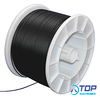
W&T 81500, Plastic fiber optic (POF) cable, spool of 500m

Data transmission using light through a fiber optic cable offers two critical advantages over copper-based electrical transmission: 100% galvanic isolation: No conducting connection between the terminal devices. This virtually eliminates the problem of ground shift.
No EMC problems: Since there is no direct electrical connection, and therefore no current flow, fiber optics transmission cannot be affected by radiated noise, nor can the system itself generate electromagnetic noise.
The drawbacks of the traditional glass fiber optic cable include the complicated, time-consuming and therefore expensive assembly and handling of the transmission medium. The use of plastic fiber optics completely eliminates these problems.
For shorter runs, assembly involves no more than using a sharp knife to cut the fiber optic cable and insert the end of the cable into the automatically locking fiber optic cable terminal on the terminal device:

  • Cut fiber optic cable at as close to a right angle as possible
  • Separate the two leads of the duplex cable to approx. 2 cm from each other
  • Insert fiber optic cable into the patented receptacle of the W&T interface.
  • Connect interface to serial terminal device.

For frequent assembly tasks or with large transmission distances, it makes sense to use the special cutting tool, part number 81600, which provides good cutting quality with little effort.
If you only need a small length, we can supply pre-cut by the meter, part number 81100.
Supplier's Site Datasheet

Technical Specifications

  TOP-electronics USA
Product Category Fiber Optic Cables
Product Number 17854
Product Name W&T 81500, Plastic fiber optic cable, spool of 500m
Unlock Full Specs
to access all available technical data

Similar Products

Fibre Optic Cable - 2846831 - RS Components, Ltd.
RS Components, Ltd.
Specs
Core Size 3000 µm (118 mils)
Features Other; OM1
View Details
Fiber Optic Retractile Cord - 116 - BRIM Electronics, Inc.
Specs
Cable Type Simplex; Duplex (optional feature)
Fiber Mode SingleMode
Core Size 900 µm (35.43 mils)
View Details
Fiber-optic cable - SOOC-DS-C-M4-2-R15 - Festo Corporation
Specs
Core Size 1250 µm (49.21 mils)
Bending Radius 15 mm (0.5906 inch)
Operating Temperature -55 to 70 C (-67 to 158 F)
View Details
2 suppliers