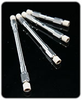
Western Analytical Products PolyCAT A Columns 102CT0315

Description
"For Cation-Exchange The PolyCAT A is made though a unique process for attaching Poly (aspartic acid) covalently to silica. Proteins elute from this polypeptide coating in sharp peaks with little tailing. Binding capacity and recovery are high as well. Operating conditions are similar to those used with other weak cation-exchange (WCX) materials (e.g. CM type). This cation exchange media can be used to separate by charge, or by polarity. Volatile mobile phases with high levels of organic solvents may be used. Cation-Exchange of Peptides with Volatile Solvents Ion-exchange is conveniently done with volatile solvents using PolyCAT A, our weak cation-exchange (WCX) material. A gradient of acetic acid (HOAc) uncharges its carboxyl- groups, and even highly basic peptides are readily eluted. as in the example below. Strong cation-exchange (SCX) materials, such as our PolySULFOETHYL Aspartamide, are generally too retentive to be used this way."
Description
"For Cation-Exchange The PolyCAT A is made though a unique process for attaching Poly (aspartic acid) covalently to silica. Proteins elute from this polypeptide coating in sharp peaks with little tailing. Binding capacity and recovery are high as well. Operating conditions are similar to those used with other weak cation-exchange (WCX) materials (e.g. CM type). This cation exchange media can be used to separate by charge, or by polarity. Volatile mobile phases with high levels of organic solvents may be used. Cation-Exchange of Peptides with Volatile Solvents Ion-exchange is conveniently done with volatile solvents using PolyCAT A, our weak cation-exchange (WCX) material. A gradient of acetic acid (HOAc) uncharges its carboxyl- groups, and even highly basic peptides are readily eluted. as in the example below. Strong cation-exchange (SCX) materials, such as our PolySULFOETHYL Aspartamide, are generally too retentive to be used this way."

Suppliers

Company
Product
Description
Supplier Links
Wildomar, CA, USA
PolyCAT A Columns
102CT0315
PolyCAT A Columns 102CT0315
"For Cation-Exchange The PolyCAT A is made though a unique process for attaching Poly (aspartic acid) covalently to silica. Proteins elute from this polypeptide coating in sharp peaks with little tailing. Binding capacity and recovery are high as well. Operating conditions are similar to those used with other weak cation-exchange (WCX) materials (e.g. CM type). This cation exchange media can be used to separate by charge, or by polarity. Volatile mobile phases with high levels of organic solvents may be used. Cation-Exchange of Peptides with Volatile Solvents Ion-exchange is conveniently done with volatile solvents using PolyCAT A, our weak cation-exchange (WCX) material. A gradient of acetic acid (HOAc) uncharges its carboxyl- groups, and even highly basic peptides are readily eluted. as in the example below. Strong cation-exchange (SCX) materials, such as our PolySULFOETHYL Aspartamide, are generally too retentive to be used this way."

"For Cation-Exchange
The PolyCAT A is made though a unique process for attaching Poly (aspartic acid) covalently to silica. Proteins elute from this polypeptide coating in sharp peaks with little tailing. Binding capacity and recovery are high as well. Operating conditions are similar to those used with other weak cation-exchange (WCX) materials (e.g. CM type). This cation exchange media can be used to separate by charge, or by polarity. Volatile mobile phases with high levels of organic solvents may be used.
Cation-Exchange of Peptides with Volatile Solvents
Ion-exchange is conveniently done with volatile solvents using PolyCAT A, our weak cation-exchange (WCX) material. A gradient of acetic acid (HOAc) uncharges its carboxyl- groups, and even highly basic peptides are readily eluted. as in the example below. Strong cation-exchange (SCX) materials, such as our PolySULFOETHYL Aspartamide, are generally too retentive to be used this way."

Supplier's Site

Technical Specifications

  Western Analytical Products
Product Category HPLC Columns
Product Number 102CT0315
Product Name PolyCAT A Columns
Pore Diameter 0.1500 µm (0.0059 mils)
Unlock Full Specs
to access all available technical data

Similar Products

PRP-C18,  5 µm, 100 Å, 4.6 x 50 mm - 79675 - Hamilton Company
Specs
Column Type Analytical
Stationary Phase/Separation Process Reversed Phase
Construction Material Stainless Steel
View Details
UPLC / UHPLC Columns -  - Waters Corporation
Waters Corporation
Specs
Column Type Analytical (optional feature); Guard (optional feature)
Stationary Phase/Separation Process Reversed Phase (optional feature)
Packing Diameter 1.6 µm (0.0630 mils)
View Details
Sodium Column - 1193020 - Pickering Laboratories, Inc.
Pickering Laboratories, Inc.
View Details
Pinnacle®DB PAH UHPLC Columns -  - Restek
Specs
Column Type Analytical
Stationary Phase/Separation Process Normally Bonded Phase
Construction Material Stainless Steel
View Details