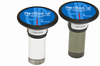
The ProCheck-S Solid Validation Standards are used as a quick and convenient “check” to determine if a Primary Calibration is needed prior to the next regularly scheduled primary calibration. Designed for use with HF scientific turbidimeters, they can be used as often as needed and will last for many years. Although actual values will be determined with testing, the typical value for the low range ProCheck-S will be less than 1 NTU for drinking water and other applications requiring a very low NTU range and the mid range ProCheck-S will typically be around 7 NTU for higher range applications.
How do they work?
Perform a full primary instrument turbidity calibration.
Insert the ProCheck-S standard with the red index mark facing forward.
Record the obtained value and log it.
Calculate the +/- 10% Min/Max Pass Range and log it.
Min range is the obtained value minus10%, the Max value is the obtained value plus 10%
To perform a validation check between scheduled primary instrument calibrations:
Insert the ProCheck-S standard with the red index mark facing forward.
Note the obtained value and compare it with the +/- 10% Min/Max Pass Range obtained earlier.
If the value falls within the Min/Max Pass Range the instrument has passed.
If the value falls outside the Min/Max Pass Range a full primary calibration of the instrument is needed.
The ProCheck-S Solid Validation Standards are used as a quick and convenient “check” to determine if a Primary Calibration is needed prior to the next regularly scheduled primary calibration. Designed for use with HF scientific turbidimeters, they can be used as often as needed and will last for many years. Although actual values will be determined with testing, the typical value for the low range ProCheck-S will be less than 1 NTU for drinking water and other applications requiring a very low NTU range and the mid range ProCheck-S will typically be around 7 NTU for higher range applications.
How do they work?
- Perform a full primary instrument turbidity calibration.
- Insert the ProCheck-S standard with the red index mark facing forward.
- Record the obtained value and log it.
- Calculate the +/- 10% Min/Max Pass Range and log it.
- Min range is the obtained value minus10%, the Max value is the obtained value plus 10%
To perform a validation check between scheduled primary instrument calibrations:
- Insert the ProCheck-S standard with the red index mark facing forward.
- Note the obtained value and compare it with the +/- 10% Min/Max Pass Range obtained earlier.
- If the value falls within the Min/Max Pass Range the instrument has passed.
- If the value falls outside the Min/Max Pass Range a full primary calibration of the instrument is needed.