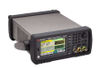
The N5183A is a 40 GHz RF Generator from Agilent. An RF generator is a tool engineers use to generate sinusoidal outputs while testing electronic equipment. The output will automatically have its frequency varied or swept between frequencies. A “sweep” is one complete cycle of a frequency variation. Engineers use RF signal generators as test equipment, mostly to measure responses of filters, amplifiers, and electrical components.
Additional Features:
Address parametric testing of microwave components & receivers
Perform local oscillator (LO) upconversion for microwave backhaul links or CW blocking for receiver testing
Maximize test throughput with 600-µs frequency switching
Characterize microwave filters & amplifiers with good output power and level accuracy
Signal Characteristics
100 kHz to 20, 31.8 or 40 GHz
+18 dBm at 20 GHz output power
≤ 900 µs frequency switching speeds
≤ -98 dBc/Hz typical phase noise at 20 kHz offset
Modulation and Sweep
AM, FM, φM, and pulse modulation
< 10 ns pulse rise/fall time and 20 ns pulse widths
Digital and step sweep
Automation and Communcation Interface
100BaseT LAN, USB 2.0 and GPIB
LXI class-B compliant
SCPI and IVI-COM drivers
Backward compatible with PSG, 8340, 8360 and 8370 Series signal generators
The Agilent N5183A MXG microwave analog signal generators deliver the performance needed for broadband component manufacturing up to 40 GHz. This instrument provides ≤ 900 µs frequency switching (≤600 µs typically) to improve test times for applications like antenna test and manufacturing, with a small size (2RU) to better utilize rack space. Excellent power and level accuracy make the MXG microwave a reliable stimulus for driving high power devices. The MXG microwave can be configured to meet your test needs today, from LO substitution and CW interferer to analog modulation for device characterization, and is easily upgraded to meet your needs in the future.
The N5183A is a 40 GHz RF Generator from Agilent. An RF generator is a tool engineers use to generate sinusoidal outputs while testing electronic equipment. The output will automatically have its frequency varied or swept between frequencies. A “sweep” is one complete cycle of a frequency variation. Engineers use RF signal generators as test equipment, mostly to measure responses of filters, amplifiers, and electrical components.
Additional Features:
- Address parametric testing of microwave components & receivers
- Perform local oscillator (LO) upconversion for microwave backhaul links or CW blocking for receiver testing
- Maximize test throughput with 600-µs frequency switching
- Characterize microwave filters & amplifiers with good output power and level accuracy
Signal Characteristics
- 100 kHz to 20, 31.8 or 40 GHz
- +18 dBm at 20 GHz output power
- ≤ 900 µs frequency switching speeds
- ≤ -98 dBc/Hz typical phase noise at 20 kHz offset
Modulation and Sweep
- AM, FM, ΦM, and pulse modulation
- < 10 ns pulse rise/fall time and 20 ns pulse widths
- Digital and step sweep
Automation and Communcation Interface
- 100BaseT LAN, USB 2.0 and GPIB
- LXI class-B compliant
- SCPI and IVI-COM drivers
- Backward compatible with PSG, 8340, 8360 and 8370 Series signal generators
The Agilent N5183A MXG microwave analog signal generators deliver the performance needed for broadband component manufacturing up to 40 GHz. This instrument provides ≤ 900 µs frequency switching (≤600 µs typically) to improve test times for applications like antenna test and manufacturing, with a small size (2RU) to better utilize rack space. Excellent power and level accuracy make the MXG microwave a reliable stimulus for driving high power devices. The MXG microwave can be configured to meet your test needs today, from LO substitution and CW interferer to analog modulation for device characterization, and is easily upgraded to meet your needs in the future.