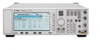
The E4425B is a 3 GHz RF Generator from Agilent. An RF generator is a tool engineers use to generate sinusoidal outputs while testing electronic equipment. The output will automatically have its frequency varied or swept between frequencies. A “sweep” is one complete cycle of a frequency variation. Engineers use RF signal generators as test equipment, mostly to measure responses of filters, amplifiers, and electrical components.
Additional Features:
Frequency range: 250 kHz-3 GHz
Underrange: 100 kHz
Resolution: 0.01 Hz
Power requirements: 90 to 254 V; 50, 60, or 400 Hz; 200 W maximum
High spectral purity
Flexible architecture, upgrade paths for options
Choice of electronic or mechanical attenuator
Superior level accuracy
Wideband FM and Phase Modulation, AM and Pulse Modulation
Step sweep (frequency, power and list)
Built-in function generator
Lightweight, rack-mountable
The Agilent E4425B ESG-AP RF Signal Generator provides outstanding phase-noise performance and analog modulation features for all general-purpose test needs. The Agilent E4425B offers excellent performance with superior quality, reliability and worldwide support. The Agilent E4425B provides comprehensive analog modulation capabilities, including AM, FM, phase modulation and pulse modulation. It is ideally suited to meet the demanding requirements of today's receiver test, component test and local oscillator application.
Standard Agilent Technologies ESG family RF signal generators incorporate a broad array of capabilities for testing both analog and digital communications systems. Adding flexible options provides a test solution that will evaluate the performance of a communication system to the requirements of nearly all current and proposed air interface standards. Many test functions can be customized to meet the needs of proprietary and other nonstandard wireless protocols as well. You can configure your instrument to address a wide variety of tests—from altering nearly every aspect of a digital signal or signal operating environment, to creating experimental signals. This flexibility, along with an architecture that accepts future enhancements makes the ESG family an excellent choice for wireless communications system testing now and in the future.
The E4425B is a 3 GHz RF Generator from Agilent. An RF generator is a tool engineers use to generate sinusoidal outputs while testing electronic equipment. The output will automatically have its frequency varied or swept between frequencies. A “sweep” is one complete cycle of a frequency variation. Engineers use RF signal generators as test equipment, mostly to measure responses of filters, amplifiers, and electrical components.
Additional Features:
- Frequency range: 250 kHz-3 GHz
- Underrange: 100 kHz
- Resolution: 0.01 Hz
- Power requirements: 90 to 254 V; 50, 60, or 400 Hz; 200 W maximum
- High spectral purity
- Flexible architecture, upgrade paths for options
- Choice of electronic or mechanical attenuator
- Superior level accuracy
- Wideband FM and Phase Modulation, AM and Pulse Modulation
- Step sweep (frequency, power and list)
- Built-in function generator
- Lightweight, rack-mountable
The Agilent E4425B ESG-AP RF Signal Generator provides outstanding phase-noise performance and analog modulation features for all general-purpose test needs. The Agilent E4425B offers excellent performance with superior quality, reliability and worldwide support. The Agilent E4425B provides comprehensive analog modulation capabilities, including AM, FM, phase modulation and pulse modulation. It is ideally suited to meet the demanding requirements of today's receiver test, component test and local oscillator application.
Standard Agilent Technologies ESG family RF signal generators incorporate a broad array of capabilities for testing both analog and digital communications systems. Adding flexible options provides a test solution that will evaluate the performance of a communication system to the requirements of nearly all current and proposed air interface standards. Many test functions can be customized to meet the needs of proprietary and other nonstandard wireless protocols as well. You can configure your instrument to address a wide variety of tests—from altering nearly every aspect of a digital signal or signal operating environment, to creating experimental signals. This flexibility, along with an architecture that accepts future enhancements makes the ESG family an excellent choice for wireless communications system testing now and in the future.