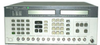
The 8782B is a 250 MHz RF Generator from Agilent. An RF generator is a tool engineers use to generate sinusoidal outputs while testing electronic equipment. The output will automatically have its frequency varied or swept between frequencies. A “sweep” is one complete cycle of a frequency variation. Engineers use RF signal generators as test equipment, mostly to measure responses of filters, amplifiers, and electrical components.
Additional Features:
1 to 250 MHz IF testing
Calibrated 100 MHz BW I/Q vector modulation inputs
BPSK, QPSK, 8PSK, 16QAM, 64QAM, 256QAM, 9PRS, 25PRS, 49PRS and 81PRS digital modulation, pulse, vector and scalar
Arbitrary vector modulation with bandwidths up to 100 MHz (200 MHz typical)
Simulates impairments such as quadrature error and phase lock error
Unmodulated coherent carrier for demodulating IF signals
Built-in pseudo random bit sequence (PRBS) generator
Optional 1 GHz LO output for up-conversion to the 750 to 1250 MHz RF bands
The Agilent 8782B vector signal generator is designed to test digital microwave and RF receivers. It is a 1 MHz to 250 MHz synthesized signal generator with a wide range of digital modulations, as well as vector (analog I and Q), pulse and scalar (AM) modulation. A vector (I/Q) modulator is built-in. The analog I (In-phase) and Q (Quadrature-phase) inputs allow for arbitrary phase and magnitude modulation while digitally-coded information can be applied to the digital inputs either in parallel or serial. The Agilent 8782B has a built-in pseudo random bit sequence (PRBS) generator making digital modulation from BPSK to 256QAM possible without using external digital data sources.
The 8782B is a 250 MHz RF Generator from Agilent. An RF generator is a tool engineers use to generate sinusoidal outputs while testing electronic equipment. The output will automatically have its frequency varied or swept between frequencies. A “sweep” is one complete cycle of a frequency variation. Engineers use RF signal generators as test equipment, mostly to measure responses of filters, amplifiers, and electrical components.
Additional Features:
- 1 to 250 MHz IF testing
- Calibrated 100 MHz BW I/Q vector modulation inputs
- BPSK, QPSK, 8PSK, 16QAM, 64QAM, 256QAM, 9PRS, 25PRS, 49PRS and 81PRS digital modulation, pulse, vector and scalar
- Arbitrary vector modulation with bandwidths up to 100 MHz (200 MHz typical)
- Simulates impairments such as quadrature error and phase lock error
- Unmodulated coherent carrier for demodulating IF signals
- Built-in pseudo random bit sequence (PRBS) generator
- Optional 1 GHz LO output for up-conversion to the 750 to 1250 MHz RF bands
The Agilent 8782B vector signal generator is designed to test digital microwave and RF receivers. It is a 1 MHz to 250 MHz synthesized signal generator with a wide range of digital modulations, as well as vector (analog I and Q), pulse and scalar (AM) modulation. A vector (I/Q) modulator is built-in. The analog I (In-phase) and Q (Quadrature-phase) inputs allow for arbitrary phase and magnitude modulation while digitally-coded information can be applied to the digital inputs either in parallel or serial. The Agilent 8782B has a built-in pseudo random bit sequence (PRBS) generator making digital modulation from BPSK to 256QAM possible without using external digital data sources.