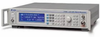
The 2025 is a 2.51 GHz RF Generator from IFR. An RF generator is a tool engineers use to generate sinusoidal outputs while testing electronic equipment. The output will automatically have its frequency varied or swept between frequencies. A “sweep” is one complete cycle of a frequency variation. Engineers use RF signal generators as test equipment, mostly to measure responses of filters, amplifiers, and electrical components.
Additional Features:
Frequency range: 9 kHz to 2.51 GHz
Excellent spectral purity
Linear and logarithmic sweep mode RPP to 50 W
Sine, triangular and square wave two tone modulation source
GPIB and RS-232 remote control
Comprehensive modulation: AM, FM, ∅M, Pulse & FSK
3.9 kHz Bessel filtered FSK
The IFR 2025 Signal Generator is portable and lightweight, offering carrier frequencies from 9 kHz to 2.51 GHz with a wide choice of modulation modes. The instrument is suitable for a wide range of applications in laboratory, production, and maintenance environments.
The GPIB facility allows the unit to be included in ATE systems for faster manufacturing throughput. An RS-232 interface is provided with a command set in common with the GPIB to simplify remote control of the signal generator in basic test systems or via a modem.
The 2025 is a 2.51 GHz RF Generator from IFR. An RF generator is a tool engineers use to generate sinusoidal outputs while testing electronic equipment. The output will automatically have its frequency varied or swept between frequencies. A “sweep” is one complete cycle of a frequency variation. Engineers use RF signal generators as test equipment, mostly to measure responses of filters, amplifiers, and electrical components.
Additional Features:
- Frequency range: 9 kHz to 2.51 GHz
- Excellent spectral purity
- Linear and logarithmic sweep mode RPP to 50 W
- Sine, triangular and square wave two tone modulation source
- GPIB and RS-232 remote control
- Comprehensive modulation: AM, FM, ∅M, Pulse & FSK
- 3.9 kHz Bessel filtered FSK
The IFR 2025 Signal Generator is portable and lightweight, offering carrier frequencies from 9 kHz to 2.51 GHz with a wide choice of modulation modes. The instrument is suitable for a wide range of applications in laboratory, production, and maintenance environments.
The GPIB facility allows the unit to be included in ATE systems for faster manufacturing throughput. An RS-232 interface is provided with a command set in common with the GPIB to simplify remote control of the signal generator in basic test systems or via a modem.